Und dann auf "Zum Home-Bildschirm [+]".

Stöbern
genialokal zum Startbildschirm hinzufügen
Installieren Sie die genialokal App auf Ihrem Startbildschirm für einen schnellen Zugriff und eine komfortable Nutzung.
Installieren Sie die genialokal App auf Ihrem Startbildschirm für einen schnellen Zugriff und eine komfortable Nutzung.
Ihr gewünschter Artikel ist in 0 Buchhandlungen vorrätig - wählen Sie hier eine Buchhandlung in Ihrer Nähe aus:

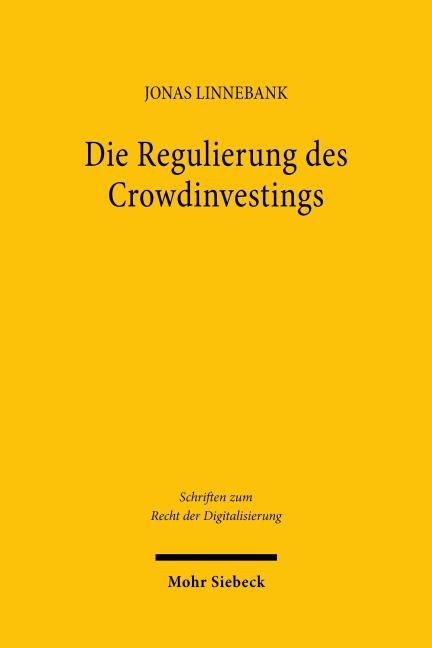
Jonas Linnebank examines the regulation of equity-based crowdfunding in Germany, the European Union, the United States, and the United Kingdom through a comparative legal analysis. The central question is whether Regulation (EU) 2020/1503 on European Crowdfunding Service Providers (ECSPR) establishes a harmonized, competitive, and at the same time effective investor-protection framework across the European Union. Methodologically, the author employs a functional comparative law approach, systematically contrasting national and supranational regulatory regimes and analyzing their doctrinal foundations. In addition, insights from capital market theory and behavioral economics are incorporated in order to assess their effects on market structure, information asymmetries, and investor behavior.
The ECSPR represents an important step toward harmonization of European equity-based crowdfunding, particularly through a uniform authorization regime and standardized information and investor protection requirements for platforms. Nevertheless, national differences persist, for example with regard to prospectus liability, permissible corporate forms, and certain financial instruments. The comparative analysis conducted reveals various regulatory regimes along with their commonalities and differences. Against this background, Jonas Linnebank sets out policy recommendations for the further development of the European regulatory framework. These include the establishment of a coherent EU-wide liability regime, a review of the issuance thresholds, risk-appropriate due diligence obligations, and adjustments concerning financial instruments, special purpose vehicle structures, and marketing rules.
Born 1996; studied law at the University of Mannheim; Bachelor of Laws in 2019; First State Examination in Law in 2022; PhD in 2026 (Hannover); legal clerkship at the Hanseatic Higher Regional Court since 2024.
Einführung
§ 1 Einleitung
§ 2 Grundlagen des Crowdinvestings
§ 3 Zielsetzung und Gang der Arbeit
Kapitel 1: Crowdinvesting in Deutschland unter nationalem Recht
§ 1 Einleitung
§ 2 Erlaubnispflichten
§ 3 Aufsichtsbehörde
§ 4 Angebotsmöglichkeiten
§ 5 Anlegerschutz
§ 6 Prospektpflicht
§ 7 Prospekthaftung
§ 8 Zusammenfassung
Kapitel 2: Crowdinvesting in der Europäischen Union unter der ECSP-VO
§ 1 Einleitung
§ 2 Erlaubnispflichten
§ 3 Aufsichtsbehörde
§ 4 Angebotsmöglichkeiten
§ 5 Anlegerschutz
§ 6 Prospektpflicht mittels eines Anlagebasisinformationsblattes
§ 7 Prospekthaftung
§ 8 Zusammenfassung
Kapitel 3: Crowdinvesting in den Vereinigten Staaten
§ 1 Einleitung
§ 2 Erlaubnispflichten
§ 3 Aufsichtsbehörde
§ 4 Angebotsmöglichkeiten
§ 5 Anlegerschutz
§ 6 Prospektpflicht
§ 7 Prospekthaftung
§ 8 Zusammenfassung
Kapitel 4: Crowdinvesting in dem Vereinigten Königreich
§ 1 Einleitung
§ 2 Erlaubnispflichten
§ 3 Aufsichtsbehörde
§ 4 Angebotsmöglichkeiten
§ 5 Anlegerschutz
§ 6 Prospektpflicht
§ 7 Prospekthaftung
§ 8 Regulatory Sandbox
§ 9 Zusammenfassung
Kapitel 5: Rechtsvergleichende Analyse
§ 1 Einleitung
§ 2 Erlaubnispflichten
§ 3 Aufsichtsbehörde
§ 4 Angebotsmöglichkeiten
§ 5 Anlegerschutz
§ 6 Prospektpflicht
§ 7 Prospekthaftung
Schlussbetrachtung
§ 1 Zusammenfassende Handlungsempfehlungen
§ 2 Gesetzesvorschläge