Und dann auf "Zum Home-Bildschirm [+]".

Stöbern
genialokal zum Startbildschirm hinzufügen
Installieren Sie die genialokal App auf Ihrem Startbildschirm für einen schnellen Zugriff und eine komfortable Nutzung.
Installieren Sie die genialokal App auf Ihrem Startbildschirm für einen schnellen Zugriff und eine komfortable Nutzung.
Ihr gewünschter Artikel ist in 0 Buchhandlungen vorrätig - wählen Sie hier eine Buchhandlung in Ihrer Nähe aus:

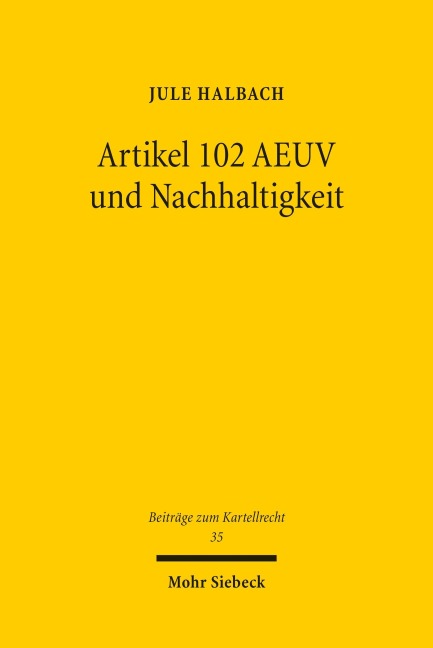
Jule Halbach examines whether and how sustainability considerations can be taken into account in the enforcement of the control of abuse practices under Article 102 of the Treaty on the Functioning of the European Union. She adopts a broad understanding of sustainability that encompasses environmental, social, and economic concerns alike and is based on a holistic contextualization of the United Nations' seventeen Sustainable Development Goals. While schools of economic thought ranging from Ordoliberalism and the Chicago School to the New Brandeis School are likely to reject an unlimited consideration of such concerns, European primary law points in a different direction through the principle of consistency, the Union' s objectives, and its horizontal clauses. At the same time, competition on the merits can only be understood as sustainable competition where actual market structures support such an orientation.
The author proposes a Sustainability Inclusion Model that distinguishes between competition-inherent and non-competition sustainability considerations and incorporates them into every stage of abuse control, from market definition and the assessment of dominance to specific forms of abuse such as predatory pricing, margin squeezes, rebate schemes, and self-preferencing, as well as objective justification, antitrust procedure, and private enforcement. Sustainability operates as a "sword" where conduct harmful to sustainability by dominant undertakings itself constitutes an abuse, and as a "shield" where positive sustainability effects justify certain conduct. This may occur, for example, through an extension of the Wouters doctrine, an intergenerational and intragenerationally expanded concept of the consumer, or through efficiencies beyond competition, provided that mere greenwashing is excluded.
From an economic perspective, Jule Halbach analyzes how sustainability values can be quantified through stated and revealed preferences as well as True Cost Accounting, and how these values can be integrated into tools such as a sustainability-sensitive As-Efficient-Competitor (AEC) test. She concludes that European primary law permits the consideration of sustainability concerns and that, depending on the circumstances of the individual case, this permissive approach may evolve into a legal obligation to take such concerns into account.
Born 1998; studied law at EBS University, Wiesbaden; First State Examination in Law and Master of Arts in Business (2023); 2024 Master of Laws (Brussels School of Competition); PhD in 2026 (University of Jena); legal clerkship (Rechtsreferendariat).
Einführung
I. Forschungsfrage
II. Inhaltliche Eingrenzung
III. Gang der Darstellung
A. Nachhaltigkeit als rechtlicher Begriff
I. Konzeptionelle Grundlagen der Nachhaltigkeit
II. Nachhaltigkeit im rechtlichen Mehrebenensystem
III. Zwischenergebnis
B. Einbeziehung von Nachhaltigkeit in die Anwendung von Art. 102 AEUV
I. Spannungsverhältnis zwischen Nachhaltigkeit und Kartellrecht
II. Systematisierung kartellrechtlicher Fälle mit Nachhaltigkeitsbezug
III. Nachhaltigkeitsaspekte auf den Prüfungsebenen des Art. 102 AEUV: Möglichkeiten der Integration
C. Quantifizierung von Nachhaltigkeitsaspekten
I. Ökonomischer Gesamtwert
II. Methoden zur Erfassung von Nachhaltigkeitswerten
Fazit