Stöbern
genialokal zum Startbildschirm hinzufügen
Installieren Sie die genialokal App auf Ihrem Startbildschirm für einen schnellen Zugriff und eine komfortable Nutzung.
Installieren Sie die genialokal App auf Ihrem Startbildschirm für einen schnellen Zugriff und eine komfortable Nutzung.
Tippen Sie einfach auf Teilen:
 Und dann auf "Zum Home-Bildschirm [+]".
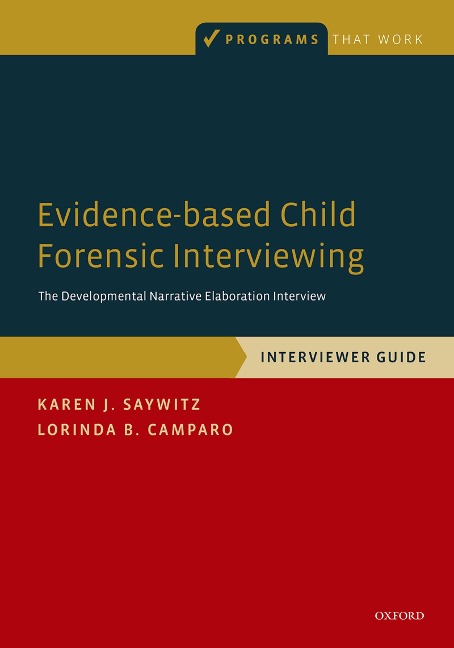
Interviewers face a dilemma when questioning children in a forensic context--an inherent mismatch between the needs of the legal system and the capabilities of young children. This is especially problematic when legal decisions with potentially serious consequences depend on the results of the interview, such as in cases involving eyewitness memory, divorce, and allegations of abuse and neglect. Without accommodations to a child's developmental level, interviews can result in false reports, miscommunication, and misinterpretation, despite an interviewer's best intentions. Evidence-based Child Forensic Interviewing addresses this discrepancy and presents an innovative approach to close the gap by providing the scaffolding, structure, and guidance children need to perform optimally. Created by Drs. Karen J. Saywitz and Lorinda B. Camparo and outlined in this guide, the Developmental Narrative Elaboration (DNE) Interview is an evidence-based step-by-step process and set of techniques for forensic contexts designed to help children ages 3-12 accurately tell as much as they can about their experiences and perceptions. The DNE is comprised of a developmentally sensitive core template and optional techniques that can be embedded at the interviewer's discretion as cases unfold. This book reviews the relevant research and then, with sample language, transcripts, and suggested activities, details a three-phased interview with examples. This empirically supported guide is designed to meet the needs of both novice and seasoned professionals in mental health, social service, law enforcement, and the legal system when children's input is needed for legal and social-service decision making.
Karen J. Saywitz, PhD, is a Professor in the Department of Psychiatry and Biobehavioral Sciences at the UCLA School of Medicine. For 20 years she has trained students in medicine, psychology, social work, nursing, and law on the development of children and adolescents and directed programs providing mental health services to children and families in the public sector. Dr. Saywitz is past-president of the American Psychological Association's Division of Child, Youth and Family Services. Lorinda B. Camparo, PhD, is a Professor of Psychology at Whittier College, where she has taught and conducted research on child forensic interviewing with undergraduate students since 1997. She has been an active member of the Executive Committee for The Society for Child and Family Policy and Practice (APA Division 37) for the past 15 years, serving as Program Chair for the millennium convention, Editor of The Advocate, and Member-at-Large for Communication & Technology.
Chapter 1: Introductory Information for Interviewers Chapter 2: Evidence Base for the Developmental Narrative Elaboration Interview Phase I: Preliminary Phase Chapter 3: Before the Interview: Setting up the Interview Context Chapter 4: Beginning the Interview: Introductions, Creating a Template, and Developing Rapport Chapter 5: Demystifying Legal Process and the Interview Chapter 6: Before the Core Interview: Teaching the Narrative Elaboration Strategy Chapter 7: Before the Core Interview: Optional Methods for Improving Communication Chapter 8: The Core DNE Interview Chapter 9: Exploring the Details in Allegations of Abuse and Neglect Phase III: Closure Chapter 10: Closing the Interview Appendix A: Reminder Cards for Elementary School-Aged Children Appendix B: Reminder Cards for Preschoolers Appendix C: Sample Transcript of Child Learning to Use the Reminder Cards Appendix D: Sample Transcript of Additional Practice Task Appendix E: Thinking Cards for Resisting Suggestive Questions References About the Authors
Dieses eBook wird im PDF-Format geliefert und ist mit einem Adobe Kopierschutz (DRM) versehen. Sie können dieses eBook mit allen Geräten lesen, die das PDF-Format und den Adobe Kopierschutz (DRM) unterstützen.
Zum Beispiel mit den folgenden Geräten:
• tolino Reader
Laden Sie das eBook direkt über den Reader-Shop auf dem tolino herunter oder übertragen Sie das eBook auf Ihren tolino mit einer kostenlosen Software wie beispielsweise Adobe Digital Editions.
• Sony Reader & andere eBook Reader
Laden Sie das eBook direkt über den Reader-Shop herunter oder übertragen Sie das eBook mit der kostenlosen Software Sony READER FOR PC/Mac oder Adobe Digital Editions auf ein Standard-Lesegeräte mit epub- und Adobe DRM-Unterstützung.
• Tablets & Smartphones
Möchten Sie dieses eBook auf Ihrem Smartphone oder Tablet lesen, finden Sie hier unsere kostenlose Lese-App für iPhone/iPad und Android Smartphone/Tablets.
• PC & Mac
Lesen Sie das eBook direkt nach dem Herunterladen mit einer kostenlosen Lesesoftware, beispielsweise Adobe Digital Editions, Sony READER FOR PC/Mac oder direkt über Ihre eBook-Bibliothek in Ihrem Konto unter „Meine eBooks“ - „online lesen“.
Schalten Sie das eBook mit Ihrer persönlichen Adobe ID auf bis zu sechs Geräten gleichzeitig frei.
Bitte beachten Sie, dass die Kindle-Geräte das Format nicht unterstützen und dieses eBook somit nicht auf Kindle-Geräten lesbar ist.