Und dann auf "Zum Home-Bildschirm [+]".

Stöbern
genialokal zum Startbildschirm hinzufügen
Installieren Sie die genialokal App auf Ihrem Startbildschirm für einen schnellen Zugriff und eine komfortable Nutzung.
Installieren Sie die genialokal App auf Ihrem Startbildschirm für einen schnellen Zugriff und eine komfortable Nutzung.
Ihr gewünschter Artikel ist in 0 Buchhandlungen vorrätig - wählen Sie hier eine Buchhandlung in Ihrer Nähe aus:

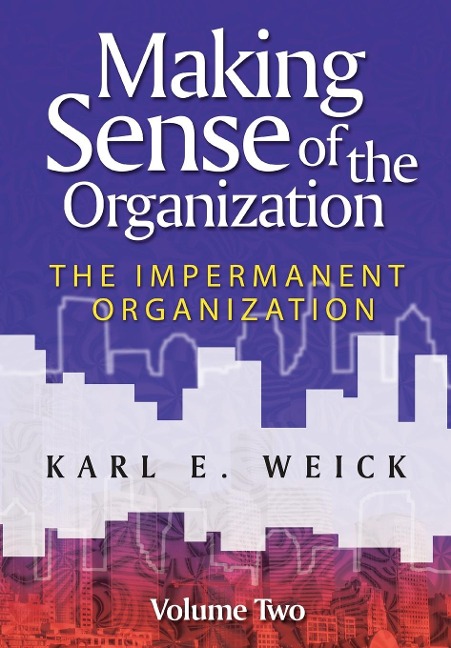
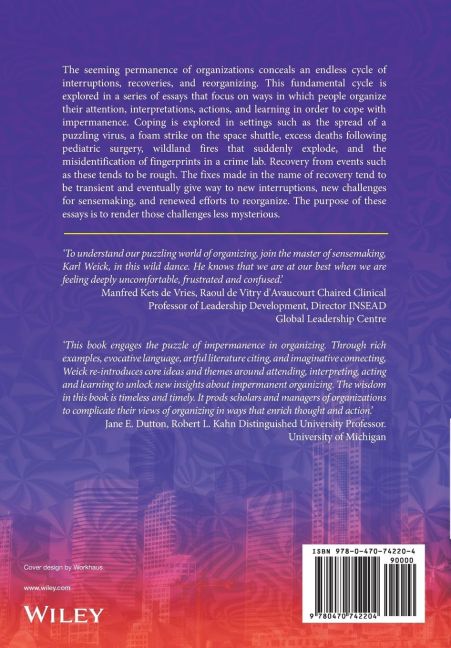
The seeming permanence of organizations conceals an endless cycle of interruptions, recoveries, and re-organizing. This fundamental cycle is explored in a series of essays that focus on ways in which people organize their attention, interpretations, actions, and learning in order to cope with impermanence. Coping is explored in settings such as the spread of a puzzling virus, a foam strike on the space shuttle, excess deaths following pediatric surgery, wildland fires that suddenly explode, and the misidentification of fingerprints in a crime lab. Recovery from events such as these tends to be rough. The fixes made in the name of recovery tend to be transient and eventually give way to new interruptions, new challenges for sensemaking, and renewed efforts to reorganize. The purpose of these essays is to render the challenges less mysterious.
Karl Weick is the Rensis Likert College Professor of Organizational Behavior and Psychology, and Professor of Psychology at the University of Michigan. He is one of the leading figures in the American Academy of Management and he is seen by many as one of the most influential thinkers and writers in the field.
Preface vii Acknowledgments ix Part I Introduction 1 1. Organized Impermanence: An Overview 3 2. Mundane Poetics: Searching for Wisdom in Organizational Theory 9 3. Faith, Evidence, and Action: Better Guesses in an Unknowable World 27 Part II Attending 45 4. Managing the Unexpected: Complexity as Distributed Sensemaking 47 5. Information Overload Revisited 65
Kathleen M. Sutcliffe and Karl. E Weick 6. Organizing for Mindfulness: Eastern Wisdom and Western Knowledge 85
Karl E. Weick and Ted Putnam Part III Interpretation 107 7. Making Sense of Blurred Images: Mindful Organizing in Mission STS-107 109 8. Organizing and the Process of Sensemaking 129
Karl E. Weick, Kathleen M. Sutcliffe, and David Obstfeld 9. Impermanent Systems and Medical Errors: Variety Mitigates Adversity 153 Part IV Action 173 10. Hospitals as Cultures of Entrapment: A Re-analysis of the Bristol Royal Infirmary 175
Karl E. Weick and Kathleen M. Sutcliffe 11. Enacting an Environment: The Infrastructure of Organizing 189 12. Positive Organizing and Organizational Tragedy 207 Part V Learning and Change 223 13. Emergent Change as a Universal in Organizations 225 14. Drop Your Tools: An Allegory for Organizational Studies 243 15. Leadership as the Legitimation of Doubt 261 Epilogue 273 References 275 Index 281