Und dann auf "Zum Home-Bildschirm [+]".

Stöbern
genialokal zum Startbildschirm hinzufügen
Installieren Sie die genialokal App auf Ihrem Startbildschirm für einen schnellen Zugriff und eine komfortable Nutzung.
Installieren Sie die genialokal App auf Ihrem Startbildschirm für einen schnellen Zugriff und eine komfortable Nutzung.
Ihr gewünschter Artikel ist in 0 Buchhandlungen vorrätig - wählen Sie hier eine Buchhandlung in Ihrer Nähe aus:

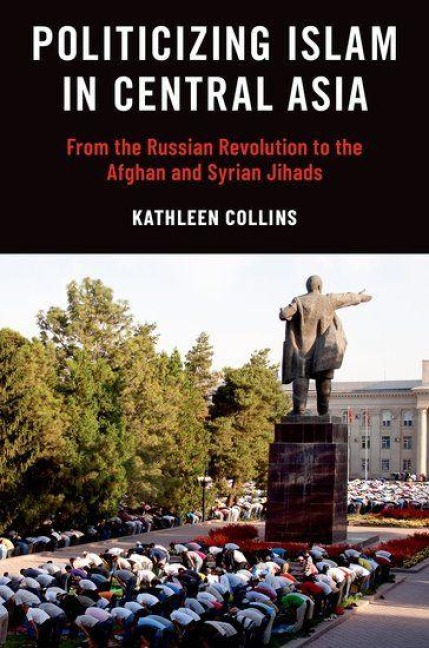
A sweeping history of Islamism in Central Asia from the Russian Revolution to the present through Soviet-era archival documents, oral histories, and a trove of interviews and focus groups. Few observers anticipated a surge of Islamism in Central Asia, after seventy years of forced communist atheism. Muslims do not inevitably support Islamism, a modern political ideology of Islam. Yet, Islamism became the dominant form of political opposition in post-Soviet Uzbekistan and Tajikistan. In Politicizing Islam in Central Asia, Kathleen Collins explores the causes, dynamics, and variation in Islamist movements-first within the USSR, and then in the post-Soviet states of Tajikistan, Uzbekistan, and Kyrgyzstan. Drawing upon extensive ethnographic and historical research on Islamist mobilization, she explains the strategies and relative success of each Central Asian Islamist movement. Collins argues that in each case, state repression of Islam, by Soviet and post-Soviet regimes, together with the diffusion of religious ideologies, motivated Islamist mobilization. Sweeping in scope, this book traces the dynamics of Central Asian Islamist movements from the Soviet era through the Tajik civil war, the Afghan jihad against the US, and the foreign fighter movement joining the Syrian jihad.
Kathleen Collins is Associate Professor of Political Science and an Affiliate Faculty of Islamic Studies at the University of Minnesota, Twin Cities. Collins is recipient of the national Carnegie Scholar Award and the McKnight Land-Grant Professorship Award. Collins is also author of Clan Politics and Regime Transition in Central Asia (2006), which won the award for the best book in the social science fields from the international Central Eurasian Studies Society. She won the S. M. Lipset Award in a national competition for the best dissertation in Comparative Politics or Sociology. She has published two dozen academic articles in edited books and journals. Collins teaches doctoral and undergraduate courses on Central Asian politics, Russian/Soviet history and politics, Afghanistan's wars, political Islam, Islam and democracy, and religion and politics. Additionally, she has worked on projects with or consulted for the United States Agency for International Development, the United Nations Development Program, the International Crisis Group, the National Bureau of Asian Research, and Freedom House. She has presented her work to multiple US government agencies, including the Helsinki Commission, the Department of State, and the Department of Defense.
- List of Figures - List of Images - List of Tables - List of Maps - Acknowledgements - Technical Note - List of Acronyms - PART I - Introduction - 1: Secular Authoritarianism, Ideology, and Islamist Mobilization - PART II: The USSR Politicizes Islam - 2: The Russian Revolution and Muslim Mobilization - 3: The Atheist State: Repressing and Politicizing Islam - 4: Muslim Belief and Everyday Resistance - PART III: Tajikistan: From Moderate Islamists to Muslim Democrats - 5: The Islamic Revival Party Challenges Communism - 6: A Democratic Islamic Party Confronts An Extremist Secular State - 7: The Attraction and Limits of Islamist Ideas in Tajikistan - PART IV: Uzbekistan: From Salafists to Salafi-Jihadists - 8: Seeking Justice and Purity: Islamists against Communism and Karimov - 9: Making Extremists: The Uzbek Jihad Moves to Afghanistan - 10: The Attraction and Limits of Islamist Ideas in Uzbekistan - PART V: Kyrgyzstan: Civil Islam and Emergent Islamists - 11: Religious Liberalization and Civil Islam in Kyrgyzstan - 12: Emergent Islamism in Kyrgyzstan - 13: The Attraction and Limits of Islamist Ideas in Kyrgyzstan - PART VI: From Central Asia to Syria: Transnational Salafi-Jihadists - 14: Central Asians Join the Syrian Jihad - 15: From Central Asia to Afghanistan, Syria, and Beyond - Appendix - Glossary - Index