Und dann auf "Zum Home-Bildschirm [+]".

Stöbern
genialokal zum Startbildschirm hinzufügen
Installieren Sie die genialokal App auf Ihrem Startbildschirm für einen schnellen Zugriff und eine komfortable Nutzung.
Installieren Sie die genialokal App auf Ihrem Startbildschirm für einen schnellen Zugriff und eine komfortable Nutzung.

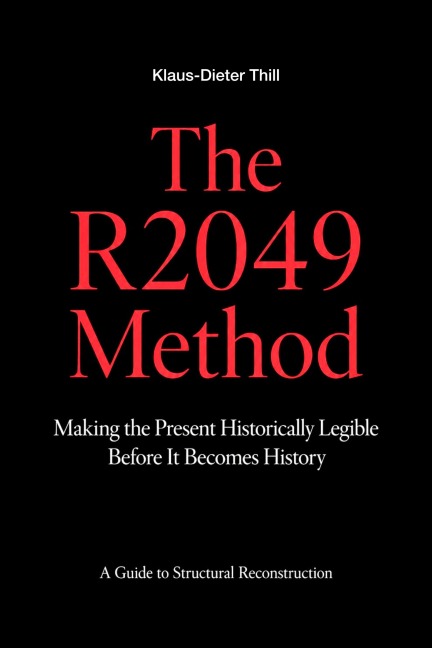

"Why do the most consequential structures of the present often become obvious only after their effects can no longer be ignored?"
The R2049 Method offers a systematic way to examine present-day human systems from an anticipated historical distance. It does not attempt to predict the future. Instead, it asks which structural conditions are already shaping events, behaviour, dependencies, decisions, and emerging developments while their significance remains hidden behind familiar explanations.
At the centre of the book are three concepts: "Struction", the effective ordering architecture through which human systems function; "Structagnosia", the difficulty of recognising that architecture while experiencing its effects; and the "R2049 Method", a disciplined procedure for reconstructing structural relationships from present evidence.
Using the five structural functions of "Orientation, Sequence, Handover, Decision, and Closure", the method helps distinguish visible events from the conditions that repeatedly produce them. It makes compensations, hidden dependencies, informal workarounds, and discrepancies between formal and effective order analytically visible.
The approach can be applied to individuals, organisations, institutions, technologies, and broader social developments. Its purpose is not to provide universal solutions, but to improve the question that comes before every meaningful intervention: "Have we correctly understood the structure of the problem, or of the development, we are trying to change?"
The R2049 Method is ultimately a guide to reading the present differently: not by claiming knowledge of what will happen, but by making visible what may already be becoming structurally true.
The author develops analytical frameworks for understanding the structures that shape human systems. His work focuses on structural perception, organisational dynamics, emerging dependencies, and the question of how the present can be read before its consequences become historically obvious. The R2049 Method brings these strands together in a practical approach to structural reconstruction.