
Stöbern
genialokal zum Startbildschirm hinzufügen
Installieren Sie die genialokal App auf Ihrem Startbildschirm für einen schnellen Zugriff und eine komfortable Nutzung.
Installieren Sie die genialokal App auf Ihrem Startbildschirm für einen schnellen Zugriff und eine komfortable Nutzung.
Tippen Sie einfach auf Teilen:
 Und dann auf "Zum Home-Bildschirm [+]".
Bei genialokal.de kaufen Sie online bei Ihrer lokalen, inhabergeführten Buchhandlung!
Ihr gewünschter Artikel ist in 0 Buchhandlungen vorrätig - wählen Sie hier eine Buchhandlung in Ihrer Nähe aus:

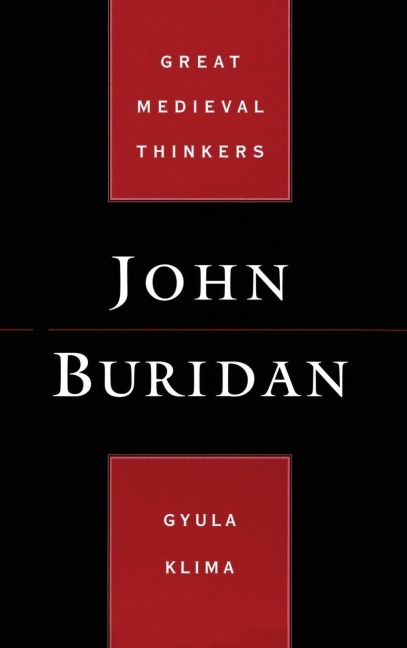
This is a brief, accessible introduction to the thought of the philosopher John Buridan (ca. 1295-1361). Little is known about Buridan's life, most of which was spent studying and then teaching at the University of Paris. Buridan's works are mostly by-products of his teaching. They consist mainly of commentaries on Aristotle, covering the whole extent of Aristotelian philosophy, ranging from logic to metaphysics, to natural science, to ethics and politics. Aside from these running commentaries on Aristotle's texts, Buridan wrote influential question-commentaries. These were a typical genre of the medieval scholastic output, in which the authors systematically and thoroughly discussed the most problematic issues raised by the text they were lecturing on. The question-format allowed Buridan to work out in detail his characteristically nominalist take on practically all aspects of Aristotelian philosophy, using the conceptual tools he developed in his works on logic. Buridan's influence in the late Middle Ages can hardly be overestimated. His ideas quickly spread not only through his own works, but to an even larger extent through the work of his students and younger colleagues, such as Nicholas Oresme, Marisilius of Inghen, and Albert of Saxony, who in turn became very influential themselves, and turned Buridan's ideas into standard textbook material in the curricula of many late medieval European universities. With the waning of scholasticism Buridan's fame quickly faded. Gyula Klima argues, however, that many of Buridan's academic concerns are strikingly similar to those of modern philosophy and his work sometimes quite directly addresses modern philosophical questions.
Gyula Klima is a Professor of Philosophy at Fordham University.
- Preface
- 1: Buridans Life, Works, and Influence
- 2: Buridans logic and the medieval logical tradition
- 3: The Primacy of Mental Language
- 4: The various kinds of concepts and the idea of a mental language
- 5: Natural language and the idea of a formal syntax in Buridan
- 6: Existential import and the Square of Opposition
- 7: Ontological commitment
- 8: The properties of terms (proprietates terminorum)
- 9: The semantics of propositions
- 10: Logical validity in a token-based, semantically closed logic
- 11: The possibility of scientific knowledge
- 12: Buridans anti-skepticism
- 13: Buridans essentialist nominalism
- Bibliography