Und dann auf "Zum Home-Bildschirm [+]".

Stöbern
genialokal zum Startbildschirm hinzufügen
Installieren Sie die genialokal App auf Ihrem Startbildschirm für einen schnellen Zugriff und eine komfortable Nutzung.
Installieren Sie die genialokal App auf Ihrem Startbildschirm für einen schnellen Zugriff und eine komfortable Nutzung.
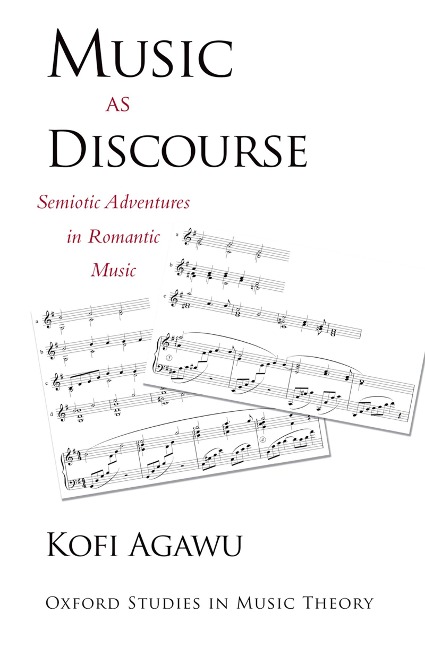
The question of whether music has meaning has been the subject of sustained debate ever since music became a subject of academic inquiry. Is music a language? Does it communicate specific ideas and emotions? What does music mean, and how does this meaning occur? Kofi Agawu's Music as Discourse has become a standard and definitive work in musical semiotics. Working at the nexus of musicology, ethnomusicology, and music philosophy and aesthetics, Agawu presents a synthetic and innovative approach to musical meaning which argues deftly for the thinking of music as a discourse in itself--composed not only of sequences of gestures, phrases, or progressions, but rather also of the very philosophical and linguistic props that enable the analytical formulations made about music as an object of study. The book provides extensive demonstration of the pertinence of a semiological approach to understanding the fully-freighted language of romantic music, stresses the importance of a generative approach to tonal understanding, and provides further insight into the analogy between music and language. Music as Discourse is an essential read for all who are interested in the theory, analysis and semiotics of music of the romantic period.
Kofi Agawu is Professor of Music at Princeton University and an adjunct professor at the University of Ghana, Legon. He is also author of Representing African Music: Postcolonial Notes, Queries, Positions.
Introduction PART I Theory 1. Music as Language 2. Criteria for Analysis I 3. Criteria for Analysis II 4. Bridges to Free Composition 5. Paradigmatic Analysis PART II Analyses 6. Liszt, Orpheus (1853-1854) 7. Brahms, Intermezzo in E Minor, op. 119, no. 2 (1893), and Symphony no. 1/ii (1872-1879) 8. Mahler, Symphony no. 9/i (1908-1909) 9. Beethoven, String Quartet, op. 130/i (1825-1826), and Stravinsky, Symphonies of Wind Instruments (1920) Epilogue Bibliography Index
Dieses eBook wird im PDF-Format geliefert und ist mit einem Adobe Kopierschutz (DRM) versehen. Sie können dieses eBook mit allen Geräten lesen, die das PDF-Format und den Adobe Kopierschutz (DRM) unterstützen.
Zum Beispiel mit den folgenden Geräten:
• tolino Reader
Laden Sie das eBook direkt über den Reader-Shop auf dem tolino herunter oder übertragen Sie das eBook auf Ihren tolino mit einer kostenlosen Software wie beispielsweise Adobe Digital Editions.
• Sony Reader & andere eBook Reader
Laden Sie das eBook direkt über den Reader-Shop herunter oder übertragen Sie das eBook mit der kostenlosen Software Sony READER FOR PC/Mac oder Adobe Digital Editions auf ein Standard-Lesegeräte mit epub- und Adobe DRM-Unterstützung.
• Tablets & Smartphones
Möchten Sie dieses eBook auf Ihrem Smartphone oder Tablet lesen, finden Sie hier unsere kostenlose Lese-App für iPhone/iPad und Android Smartphone/Tablets.
• PC & Mac
Lesen Sie das eBook direkt nach dem Herunterladen mit einer kostenlosen Lesesoftware, beispielsweise Adobe Digital Editions, Sony READER FOR PC/Mac oder direkt über Ihre eBook-Bibliothek in Ihrem Konto unter „Meine eBooks“ - „online lesen“.
Schalten Sie das eBook mit Ihrer persönlichen Adobe ID auf bis zu sechs Geräten gleichzeitig frei.
Bitte beachten Sie, dass die Kindle-Geräte das Format nicht unterstützen und dieses eBook somit nicht auf Kindle-Geräten lesbar ist.