Und dann auf "Zum Home-Bildschirm [+]".

Stöbern
genialokal zum Startbildschirm hinzufügen
Installieren Sie die genialokal App auf Ihrem Startbildschirm für einen schnellen Zugriff und eine komfortable Nutzung.
Installieren Sie die genialokal App auf Ihrem Startbildschirm für einen schnellen Zugriff und eine komfortable Nutzung.
Ihr gewünschter Artikel ist in 0 Buchhandlungen vorrätig - wählen Sie hier eine Buchhandlung in Ihrer Nähe aus:

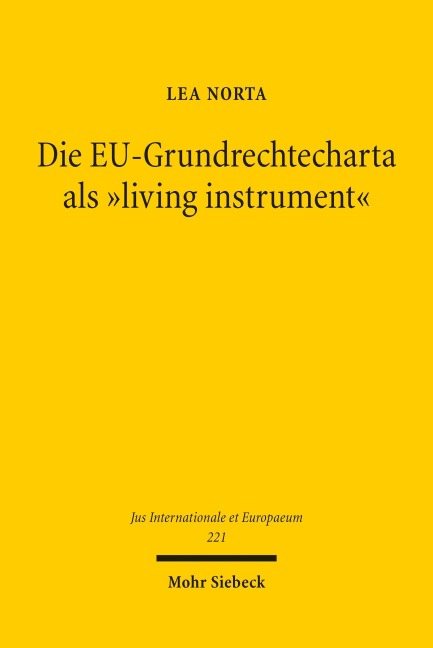
Lea Norta analyses the Charter of Fundamental Rights of the European Union as a living instrument and advances the thesis that its substantive guarantees are open to an intertemporal interpretation, the scope of which nevertheless remains constrained by methodological, institutional, and competence-based limits. At the centre of the study lies the question of the extent to which the Charter, since acquiring binding force as primary EU law in 2009, is capable of responding to social, technological, environmental, and legal developments within the European multilevel system.
The theoretical framework draws on the European Court of Human Rights' living-instrument doctrine, the concept of constitutional evolution, the distinction between static and dynamic interpretation, and the relationship between normativity and social reality. The author demonstrates that static and dynamic interpretation do not constitute autonomous methods of interpretation but rather normative meta-principles that determine the temporal point of reference for interpretation. On this basis, she develops the concept of intertemporal openness as a graduated model of fundamental-rights interpretation.
The study concludes that the Charter of Fundamental Rights is, in principle, capable of further development. Such development, however, depends largely on the degree of integration achieved in the relevant field. The more extensively a field is shaped by EU law, and the more the effective enforcement of fundamental guarantees enshrined in primary law requires further development, the more readily the Court of Justice of the European Union may dynamically specify fundamental-rights standards. By contrast, where primary law provides only limited competences, leaves political discretion to the Member States, or where no sufficiently consolidated European consensus exists, the constitutional allocation of powers calls for judicial restraint. Dynamic interpretation of fundamental rights must therefore not serve to anticipate political integration or to effect a conceale
Born 1996; legal clerkship (Rechtsreferendariat) at the Regional Court of Cologne; 2026 PhD (University of Cologne).
Einleitung
§ 1 Einführung in die Problematik - § 2 Eingrenzung des Untersuchungsgegenstandes - § 3 Gang der Untersuchung - § 4 Kontextualisierung des Untersuchungsgegenstandes
Erstes Kapitel: Dogmatische und methodologische Grundlegung
§ 1 Intertemporale Offenheit und (grund-)rechtliche Dogmatik - § 2 Das Zusammenspiel von Normativität (Sollen) und Faktizität (Sein) - § 3 Normative Verortung: Berücksichtigung nachträglicher außerrechtlicher Entwicklungen im Prozess der Normkonkretisierung
Zweites Kapitel: Untersuchung der intertemporalen Offenheit der Grundrechtecharta aus methodologischer Perspektive
§ 1 Grundlegende methodologische Überlegungen zur Zulässigkeit der dynamischen Auslegung - § 2 Intertemporale Offenheit der Grundrechtecharta - § 3 Zulässigkeit der dynamischen Auslegung der Grundrechtecharta durch nationale Verfassungs- und Fachgerichte?
Drittes Kapitel: Untersuchung der intertemporalen Offenheit der Grundrechtecharta aus kompetenziell-institutioneller und funktionell-rechtlicher Perspektive
§ 1 Kompetenziell-institutioneller Ansatz: "Gewaltenteilung" im Mehrebenensystem der Europäischen Union - § 2 Funktionell-rechtlicher Ansatz
Viertes Kapitel: Die Auslegung als "living instrument" im völkerrechtlichen und verfassungsrechtlichen Kontext
§ 1 Berücksichtigung außerrechtlicher Entwicklungen in der Interpretation internationaler Menschenrechtsabkommen - § 2 Die Auslegung der Grundrechtecharta als "living instrument" - Übertragbarkeit der völkerrechtlichen Grundsätze? - § 3 Berücksichtigung außerrechtlicher Entwicklungen in der Interpretation von Verfassungsdokumenten - § 4 "Verfassungswandel" der Grundrechtecharta - Übertragbarkeit der verfassungsrechtlichen Grundsätze?
Schlussbetrachtung
Zusammenfassende Thesen