Und dann auf "Zum Home-Bildschirm [+]".

Stöbern
genialokal zum Startbildschirm hinzufügen
Installieren Sie die genialokal App auf Ihrem Startbildschirm für einen schnellen Zugriff und eine komfortable Nutzung.
Installieren Sie die genialokal App auf Ihrem Startbildschirm für einen schnellen Zugriff und eine komfortable Nutzung.
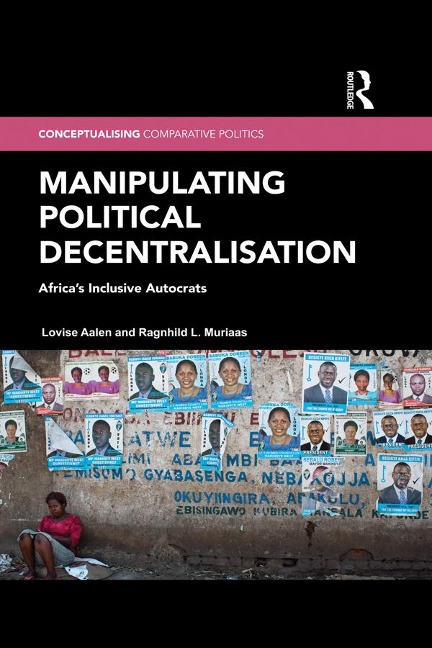
Can autocrats establish representative subnational governments? And which strategies of manipulation are available if they would like to reduce the uncertainty caused by introducing political decentralisation? In the wake of local government reforms, several states across the world have introduced legislation that provides for subnational elections. This does not mean that representative subnational governments in these countries are all of a certain standard. Political decentralisation should not be confused with democratisation, as the process is likely to be manipulated in ways that do not produce meaningful avenues for political participation and contestation locally. Using examples from Africa, Lovise Aalen and Ragnhild L. Muriaas propose five requirements for representative subnational governments and four strategies that national governments might use to manipulate the outcome of political decentralisation. The case studies of Ethiopia, Malawi, South Africa, and Uganda illustrate why autocrats sometimes are more open to competition at the subnational level than democrats. Manipulating Political Decentralisation provides a new conceptual tool to assess representative subnational governments' quality, aiding us in building theories on the consequences of political decentralisation on democratisation.
Lovise Aalen is a Political Scientist and Research Director at Chr. Michelsen Institute. Her research interests include institutional solutions in divided societies, including power sharing, federalism, and decentralisation. She has explored the impact of introducing ethnic federalism in Ethiopia, and has demonstrated how ethnic-based federalism was an important tool for the ruling party to gain legitimacy, control, and support across ethnic groups, thereby sustaining the national government rather than deepening democracy. Ragnhild L. Muriaas is Professor in Political Science at the University of Bergen and an Associated Senior Researcher at Chr. Michelsen Institute. Her key research interest is explaining variation in the inclusionary aspects of African regimes. She has led international research projects and published extensively on topics related to political decentralisation, traditional authorities, and women's representation in Malawi, Uganda, South Africa, and Zambia.
Series Editors' Foreword 1. Introduction 1.1 Elections in authoritarian regimes 1.2 Extending elections to the subnational level 1.3 The argument of the book 1.4 Conceptualisation and methods 1.5 Outline of the book 2. Four Strategies of Manipulation 2.1 Advocating for decentralisation after the Cold War 2.2 How decentralisation failed to deliver 2.3 Why some governments decentralise 2.4 Strategies for Manipulating Political Decentralisation 2.5 Possibilities for contestation and participation 2.6 Conclusions 3. The Requirements of Political Decentralisation 3.1 Unpacking the relationship between regime type and decentralisation 3.2 Elections as hallmarks of political decentralisation 3.3 Requirements for representative subnational governments 3.4 The Four Ways of Manipulating Political Decentralisation 3.5 Case selection 3.6 Conclusions 4. Decentralisation through dominance in Ethiopia 4.1 Ethiopia under EPRDF: Decentralisation and autocratisation side by side 4.2 The requirements of representative subnational governments and their challenges 4.3 Manipulating political decentralisation through dominance 4.4 No contestation but mass-participation 4.5 Conclusions 5. Institutional interruption in Malawi 5.1 Regime and stalled political decentralisation 5.2 The requirements of representative subnational governments 5.3 Identifying Manipulation Strategies 5.4 Opportunities for Contestation and Participation 5.5 Conclusion 6. Overwhelming the opposition in Uganda 6.1 The decentralising autocrat 6.2 The requirements of representative subnational governments 6.3 Identifying Manipulation Strategies 6.4 Opportunities for Contestation and Participation 6.5 Conclusion 7. Regionalised opposition in South Africa 7.1 Democracy and the dominant position of ANC 7.2 The requirements for representative subnational governments 7.3 Manipulating Political Decentralisation 7.4 Consequences for contestation and participation 7.5 Conclusion 8. Conclusions 8.1 The five requirements of representative SNGs 8.2 Manipulation strategies and the space for contestation and participation 8.3 Extension to other cases 8.4 The challenges of measuring and comparing local government 8.5 Inclusive autocrats 8.6 The way forward
Dieses eBook wird im PDF-Format geliefert und ist mit einem Adobe Kopierschutz (DRM) versehen. Sie können dieses eBook mit allen Geräten lesen, die das PDF-Format und den Adobe Kopierschutz (DRM) unterstützen.
Zum Beispiel mit den folgenden Geräten:
• tolino Reader
Laden Sie das eBook direkt über den Reader-Shop auf dem tolino herunter oder übertragen Sie das eBook auf Ihren tolino mit einer kostenlosen Software wie beispielsweise Adobe Digital Editions.
• Sony Reader & andere eBook Reader
Laden Sie das eBook direkt über den Reader-Shop herunter oder übertragen Sie das eBook mit der kostenlosen Software Sony READER FOR PC/Mac oder Adobe Digital Editions auf ein Standard-Lesegeräte mit epub- und Adobe DRM-Unterstützung.
• Tablets & Smartphones
Möchten Sie dieses eBook auf Ihrem Smartphone oder Tablet lesen, finden Sie hier unsere kostenlose Lese-App für iPhone/iPad und Android Smartphone/Tablets.
• PC & Mac
Lesen Sie das eBook direkt nach dem Herunterladen mit einer kostenlosen Lesesoftware, beispielsweise Adobe Digital Editions, Sony READER FOR PC/Mac oder direkt über Ihre eBook-Bibliothek in Ihrem Konto unter „Meine eBooks“ - „online lesen“.
Schalten Sie das eBook mit Ihrer persönlichen Adobe ID auf bis zu sechs Geräten gleichzeitig frei.
Bitte beachten Sie, dass die Kindle-Geräte das Format nicht unterstützen und dieses eBook somit nicht auf Kindle-Geräten lesbar ist.