
Stöbern
genialokal zum Startbildschirm hinzufügen
Installieren Sie die genialokal App auf Ihrem Startbildschirm für einen schnellen Zugriff und eine komfortable Nutzung.
Installieren Sie die genialokal App auf Ihrem Startbildschirm für einen schnellen Zugriff und eine komfortable Nutzung.
Tippen Sie einfach auf Teilen:
 Und dann auf "Zum Home-Bildschirm [+]".
Bei genialokal.de kaufen Sie online bei Ihrer lokalen, inhabergeführten Buchhandlung!
Ihr gewünschter Artikel ist in 0 Buchhandlungen vorrätig - wählen Sie hier eine Buchhandlung in Ihrer Nähe aus:

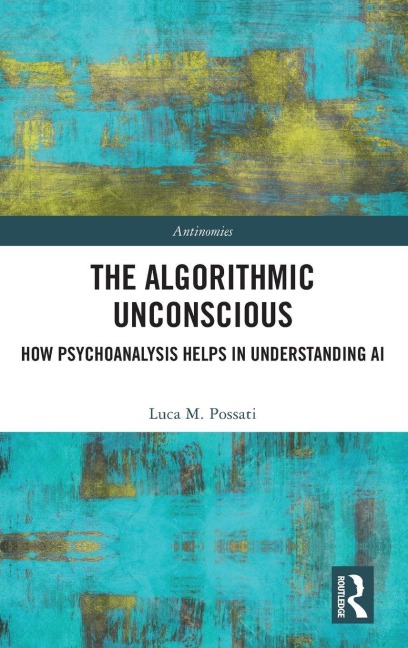
This book applies the concepts and methods of psychoanalysis to the study of artificial intelligence (AI) and human-AI interaction. It develops a new, more fruitful approach for applying psychoanalysis to AI and machine behavior. It appeals to a broad range of scholars: philosophers working on psychoanalysis, technology, AI ethics, and cognitive sciences, psychoanalysts, psychologists, and computer scientists.
The book is divided into four parts. The first part (Chapter 1) analyzes the concept of "machine behavior." The second part (Chapter 2) develops a reinterpretation of some fundamental Freudian and Lacanian concepts through Bruno Latour's actor-network theory. The third part (Chapters 3 and 4) focuses on the nature and structure of the algorithmic unconscious. The author claims that the unconscious roots of AI lie in a form of projective identification, i.e., an emotional and imaginative exchange between humans and machines. In the fourth part of the book (Chapter 5), the author advances the thesis that neuropsychoanalysis and the affective neurosciences can provide a new paradigm for research on artificial general intelligence.
The Algorithmic Unconscious explores a completely new approach to AI, which can also be defined as a form of "therapy." Analyzing the projective identification processes that take place in groups of professional programmers and designers, as well as the "hidden" features of AI (errors, noise information, biases, etc.), represents an important tool to enable a healthy and positive relationship between humans and AI. Psychoanalysis is used as a critical space for reflection, innovation, and progress.
Luca M. Possati is a researcher in philosophy at the University of Porto, Portugal. His fields of investigation are philosophy of technology and artificial intelligence. He is the author of many studies in phenomenology and the history of philosophy.
Introduction 1. Why an Algorithmic Unconscious for AI? 2. The Unconscious and Technology 3. The Difficulty of Being AI 4. Errors, Noise, Bias, and Sleeping 5. A Freudian Computer: Neuropsychoanalysis and Affective Neuroscience as a Framework to Understand Artificial General Intelligence 6. Conclusions: Toward an Ethnographic and Psychoanalytic Study of AI