Und dann auf "Zum Home-Bildschirm [+]".

Stöbern
genialokal zum Startbildschirm hinzufügen
Installieren Sie die genialokal App auf Ihrem Startbildschirm für einen schnellen Zugriff und eine komfortable Nutzung.
Installieren Sie die genialokal App auf Ihrem Startbildschirm für einen schnellen Zugriff und eine komfortable Nutzung.
Ihr gewünschter Artikel ist in 0 Buchhandlungen vorrätig - wählen Sie hier eine Buchhandlung in Ihrer Nähe aus:

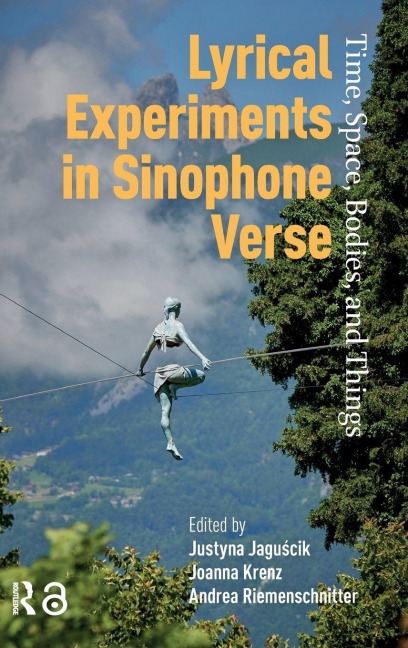
The 1919 May Fourth movement was the breeding ground for experiments by authors inspired by new world literary trends. This volume identifies three foci in contemporary poetry discourses: formal crossovers, multiple realities, and liquid boundaries. These three themes often intersect within texts from mainland China, Hong Kong and Taiwan.
Justyna Jaguscik is a senior lecturer in Chinese language, culture and history at the University of Bern. She is the co-editor of Sinophone Utopias: Explorations of Chinese Future Beyond the China Dream (2023) and the author of book chapters and essays on contemporary female-authored Chinese-language poetry, and independent trans-Asian theater and cultural activism. Joanna Krenz is an assistant professor at Adam Mickiewicz University in Pozna.. Her research interests revolve around contemporary literature, with particular focus on Chinese poetry, in intercultural and interdisciplinary contexts, including its interactions with natural sciences and technology. She is the author of In Search of Singularity: Poetry in Poland and China Since 1989 (2022) and an active translator of Chinese modern poetry and fiction into Polish. Andrea Riemenschnitter is professor em. of Modern Chinese Language and Literature, University of Zurich. Her most recent book is Sinophone Utopias. Exploring Futures Beyond the China Dream (2023, co-ed.). She has published in Archiv Orientalni, AS, ICCC, Interventions, JMLC, MCLC, Monumenta Serica, etc.
Introduction - Justyna Jaguscik, Joanna Krenz, and Andrea Riemenschnitter - Treading a Tightrope: Chinese Poetry in the Modern World, I Multiple Realities, Chapter 1. Nick Admussen - The Death of Transnational Time: Locality, Reader Response, and the Strange Loop, Chapter 2. Liansu Meng - Redefining Family Women: The Ecofeminist Poetics of Shu Ting and Wang Xiaoni, Chapter 3. Andrea Lingenfelter - Green mountains, green history, who will bear witness? A Woman's Montage: Zhai Yongming's Following Huang Gongwang through the Fuchun Mountains, Chapter 4. Andrea Riemenschnitter - Deep Lyricism: Yu Jian's On the Ancient Road of Hubei's Xishui County: A Detour, Chapter 5. Joanna Krenz - From a Poetry Popsicle to a Polymathic Herstorian: Xiao Bing's Possible Worlds Through the Lens of Critical Code Studies, II Formal Crossovers, Chapter 6. Susanne Weigelin-Schwiedrzik - Lu Xun and Kuriyagawa Hakuson: Reading Dead Fire and After Death, Chapter 7. Victor Vuilleumier - Ma Junwu's Reinvented Lyricism: Revolutionary Landscape, Romanticism, Science Fiction, and Darwinian Geology, Chapter 8. Zhiyi Yang - To World Poetry and Back: Xutang's Classicist Lyricism and the Ethnic Digital Bookshelf, Chapter 9. Michelle Yeh - Nativism Revisited: Paradoxes in Modern Poetry in Taiwan, Chapter 10. Dean Anthony Brink - Processing Strangers as Vital Jouissance in Hsia Yü's First Person, III Liquid Boundaries, Chapter 11. Simona Gallo - I Sing of Flesh: The Rhythm of Mu Dan's Self-translation, Chapter 12. Mary Shuk Han Wong - Dark Tourism: Leung Ping-kwan's Eastern European Journeys in 1990 and 1991, Chapter 13. Chris Song - Hong Kong's Leftist Poetry: Sinophone and/or Huawen?, Chapter 14. Maghiel van Crevel - Poetry and Subalternity: What Are We Looking for?, Chapter 15. Justyna Jaguscik - Wu Xia's Poetics of Affect, Bibliography, Index