Und dann auf "Zum Home-Bildschirm [+]".

Stöbern
genialokal zum Startbildschirm hinzufügen
Installieren Sie die genialokal App auf Ihrem Startbildschirm für einen schnellen Zugriff und eine komfortable Nutzung.
Installieren Sie die genialokal App auf Ihrem Startbildschirm für einen schnellen Zugriff und eine komfortable Nutzung.
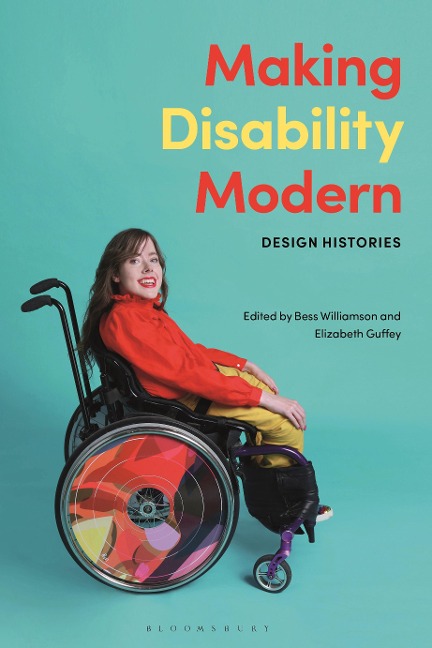
Making Disability Modern: Design Histories brings together leading scholars from a range of disciplinary and national perspectives to examine how designed objects and spaces contributes to the meanings of ability and disability from the late 18th century to the present day, and in homes, offices, and schools to realms of national and international politics. The contributors reveal the social role of objects - particularly those designed for use by people with disabilities, such as walking sticks, wheelchairs, and prosthetic limbs - and consider the active role that makers, users and designers take to reshape the material environment into a usable world. But it also aims to make clear that definitions of disability-and ability-are often shaped by design.
Elizabeth Guffey is Professor of Art and Design History at Purchase College, State University of New York, USA, where she also heads the MA in Modern and Contemporary Art. She is the author of Designing Disability: Symbols, Space, and Society (Bloomsbury, 2017), Posters: A Global History (2014), and Retro: The Culture of Revival (2002).
Bess Williamson is Associate Professor of Design History at the School of the Art Institute of Chicago, where she teaches courses on modern and contemporary design in relation to politics and social change. Her book, Accessible America: A History of Disability and Design (2019), describes the role of design in the US Disability Rights cause of the last half of the 20th century.
Acknowledgments
Introduction: Rethinking Design History through Disability, Rethinking Disability through Design
Elizabeth Guffey and Bess Williamson, School of the Art Institute of Chicago, USA
Section I: Designers and Users From Craft to Industry
Introduction
1. The Material Culture of Gout in Early America, Nicole Belolan (Rutgers University, USA)
2. Walking Cane Style and Medicalized Mobility, Cara Kiernan Fallon (University of Pennsylvania, USA)
3. Artificial Limbs on the Panama Canal, Caroline Lieffers (Yale University, USA)
4. Technologies for the Deaf in British India, 1850-1950, Aparna Nair (University of Oklahoma, USA)
Section II: Disability and World-Making in the Twentieth Century
Introduction
5. The Ideologies of Designing for Disability, Elizabeth Guffey (Purdue University, USA)
6. Architecture, Science, and Disabled Citizenship, Wanda Katja Liebermann (Florida Atlantic University, USA)
7. Disability and Modern Chemical Sensitivities, Debra Riley Parr (Columbia College Chicago, USA)
8. Design for Deaf Education: An Early History of the National Technical Institute for the Deaf, Kristoffer Whitney (Rochester Institute of Technology, USA)
9. Designing the Japanese Walking Bag, Elizabeth Guffey (Purdue University, USA)
Section III: Making Disability Digital
Introduction
10. The Politics and Logistics of Ergonomic Design, Jennifer Kaufmann-Buhler (Purdue University, USA)
11. Designing Emergency Access: Lifeline & LifeCall, Elizabeth Ellcessor (University of Virginia, USA)
12. 3D Printed Prosthetics and the Uses of Design, Bess Williamson (School of the Art Institute of Chicago, USA)
13. Materializing User Identities and Digital Humanities, Jaipreet Virdi (University of Delaware, USA)
Dieses eBook wird im PDF-Format geliefert und ist mit einem Adobe Kopierschutz (DRM) versehen. Sie können dieses eBook mit allen Geräten lesen, die das PDF-Format und den Adobe Kopierschutz (DRM) unterstützen.
Zum Beispiel mit den folgenden Geräten:
• tolino Reader
Laden Sie das eBook direkt über den Reader-Shop auf dem tolino herunter oder übertragen Sie das eBook auf Ihren tolino mit einer kostenlosen Software wie beispielsweise Adobe Digital Editions.
• Sony Reader & andere eBook Reader
Laden Sie das eBook direkt über den Reader-Shop herunter oder übertragen Sie das eBook mit der kostenlosen Software Sony READER FOR PC/Mac oder Adobe Digital Editions auf ein Standard-Lesegeräte mit epub- und Adobe DRM-Unterstützung.
• Tablets & Smartphones
Möchten Sie dieses eBook auf Ihrem Smartphone oder Tablet lesen, finden Sie hier unsere kostenlose Lese-App für iPhone/iPad und Android Smartphone/Tablets.
• PC & Mac
Lesen Sie das eBook direkt nach dem Herunterladen mit einer kostenlosen Lesesoftware, beispielsweise Adobe Digital Editions, Sony READER FOR PC/Mac oder direkt über Ihre eBook-Bibliothek in Ihrem Konto unter „Meine eBooks“ - „online lesen“.
Schalten Sie das eBook mit Ihrer persönlichen Adobe ID auf bis zu sechs Geräten gleichzeitig frei.
Bitte beachten Sie, dass die Kindle-Geräte das Format nicht unterstützen und dieses eBook somit nicht auf Kindle-Geräten lesbar ist.