
Stöbern
genialokal zum Startbildschirm hinzufügen
Installieren Sie die genialokal App auf Ihrem Startbildschirm für einen schnellen Zugriff und eine komfortable Nutzung.
Installieren Sie die genialokal App auf Ihrem Startbildschirm für einen schnellen Zugriff und eine komfortable Nutzung.
Tippen Sie einfach auf Teilen:
 Und dann auf "Zum Home-Bildschirm [+]".
Bei genialokal.de kaufen Sie online bei Ihrer lokalen, inhabergeführten Buchhandlung!
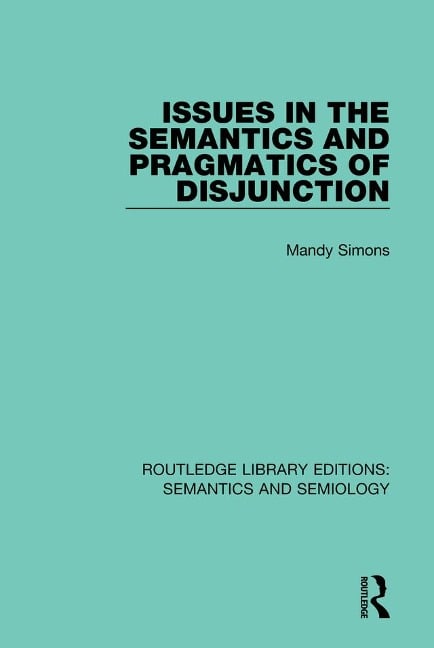
First published in 2000, this book is about sentences containing the word or, dealing primarily with sentences in which or conjoins clauses, but also some cases in which it conjoins expressions of other categories. The author aims to give an account of the discourse properties and felicity conditions of disjunction, and to use this account in explaining the behaviour of presupposition projection and of anaphora in disjunctive sentences. The author begins by giving an account of the discourse properties and felicity conditions of disjunction before turning to the presupposition projection problem. The final two chapters discuss anaphora and its interactions with disjunction.
Simons, Mandy
1. Introduction; 1.1. Overview 1.1.1. What this dissertation is about 1.1.2. Context change: Pragmatic vs. semantic approaches 1.2. The Stalnakerian Model of Presupposition and Assertion 1.3. Dynamic Semantics 1.3.1. The Fundamentals 1.3.2. File Change Semantics (FCS) and the CCP proposal 1.3.3. Discourse Representation Theory (DRT) 1.3.4. Dynamic Montague Grammar (DMG) Notes to Chapter One; 2. Disjunctive Sentences In Discourse; 2.1. Introduction 2.2. The Discourse Function and Felicity Conditions of Disjunction 2.2.1. The Basic Observations 2.2.2. Relation and Manner in the Stalnakerian Model 2.3. The Enriched Context Change Framework 2.3.1. Presentation 2.3.2. Disjunction and the Relevant Informativity Condition 2.3.3. Disjunction and Simplicity 2.3.4. Disjunction and Rooth's Alternative Semantics 2.3.5. Summary 2.4. Some Exceptions 2.4.1. Floutings 2.4.2. Reasoning contexts 2.4.3. Metalinguistic or 2.5. The Exclusive Interpretation of or 2.5.1. Critique of the ambiguity account 2.5.2. Gazdar's (1979) account 2.5.3. Exclusivity from exhaustiveness 2.5.4. Exclusivity from alternativeness 2.5.5. Summary 2.6. Conclusion Notes to Chapter Two; 3. Presupposition Projection; 3.1. Introduction 3.1.1. The Basic Question 3.1.2. The Theoretical Issues 3.2. The Data 3.3. The Satisfaction Account of Presupposition Projection 3.3.1. Basics of the Satisfaction Account 3.3.2. CCPs for disjunction 3.3.3. Critique 3.4. Towards a New Account 3.4.1. Gazdar's cancellation theory 3.4.2. The accommodation view: Van der Sandt (1992) 3.4.3. Translating DRSs into Stalnakerian contexts 3.5. The Account in Action 3.5.1. Basic cases 3.5.2. Entailing disjunctions again 3.5.3. Beaver's counterexample 3.6. Conclusion Notes to Chapter Three; 4. Internal Anaphora; 4.1. Introduction 4.2. Anaphora-based Accounts in Dynamic Semantic Theories 4.2.1. DMG: Groenendijk and Stokhof (1990) 4.2.2. DRT: Kamp and Reyle (1993) 4.2.3. A second DRT proposal: Krahmer and Muskens (1994) 4.2.4. Van der Sandt (1992) revisited 4.3. A Felicity-based Approach 4.3.1. Introduction to the account 4.3.2. The E-type account of anaphora 4.3.3. A felicity-based solution to the internal anaphora puzzle 4.3.4. Summary 4.4. Further Data 4.4.1. Narrow scope antecedents 4.4.2. Non-E-type unbound anaphora 4.4.3. Pleonastic pronouns 4.5. Conclusion Notes to Chapter Four; 5. External Anaphora; 5.1. Introduction 5.2. The Basic Data 5.2.1. Anaphora to a disjunction of NPs 5.2.2. Clausal disjunction 5.3. A First Reformulation of the E-type Account 5.4. A Compositional Structural E-type Account 5.4.1. Presentation 5.4.2. Comparison with Chapter Four account 5.4.3. Narrow scope antecedents 5.5. Application to the External Anaphora Data 5.5.1. Anaphora to a disjunction of NPs 5.5.2. Anaphora to clausal disjunctions 5.5.3. Summary 5.6. The Single-antecedent Reading 5.6.1. Derivation of single-antecedent readings 5.6.2. Maximal quantifier antecedents 5.6.3. Summary 5.7. Other Approaches to External Anaphora 5.8. Further Issues for the E-type Account 5.8.1. Inference-based anaphora 5.8.2. Interpretation of plural pronouns 5.8.3. Anaphora to NP disjuncts and conjuncts 5.9. Conclusion Notes to Chapter Five; Concluding Remarks; Grice, Stalnaker and Dynamic Semantics; Appendix; Bibliography; Index
Dieses eBook wird im PDF-Format geliefert und ist mit einem Adobe Kopierschutz (DRM) versehen. Sie können dieses eBook mit allen Geräten lesen, die das PDF-Format und den Adobe Kopierschutz (DRM) unterstützen.
Zum Beispiel mit den folgenden Geräten:
• tolino Reader
Laden Sie das eBook direkt über den Reader-Shop auf dem tolino herunter oder übertragen Sie das eBook auf Ihren tolino mit einer kostenlosen Software wie beispielsweise Adobe Digital Editions.
• Sony Reader & andere eBook Reader
Laden Sie das eBook direkt über den Reader-Shop herunter oder übertragen Sie das eBook mit der kostenlosen Software Sony READER FOR PC/Mac oder Adobe Digital Editions auf ein Standard-Lesegeräte mit epub- und Adobe DRM-Unterstützung.
• Tablets & Smartphones
Möchten Sie dieses eBook auf Ihrem Smartphone oder Tablet lesen, finden Sie hier unsere kostenlose Lese-App für iPhone/iPad und Android Smartphone/Tablets.
• PC & Mac
Lesen Sie das eBook direkt nach dem Herunterladen mit einer kostenlosen Lesesoftware, beispielsweise Adobe Digital Editions, Sony READER FOR PC/Mac oder direkt über Ihre eBook-Bibliothek in Ihrem Konto unter „Meine eBooks“ - „online lesen“.
Schalten Sie das eBook mit Ihrer persönlichen Adobe ID auf bis zu sechs Geräten gleichzeitig frei.
Bitte beachten Sie, dass die Kindle-Geräte das Format nicht unterstützen und dieses eBook somit nicht auf Kindle-Geräten lesbar ist.