Und dann auf "Zum Home-Bildschirm [+]".

Stöbern
genialokal zum Startbildschirm hinzufügen
Installieren Sie die genialokal App auf Ihrem Startbildschirm für einen schnellen Zugriff und eine komfortable Nutzung.
Installieren Sie die genialokal App auf Ihrem Startbildschirm für einen schnellen Zugriff und eine komfortable Nutzung.
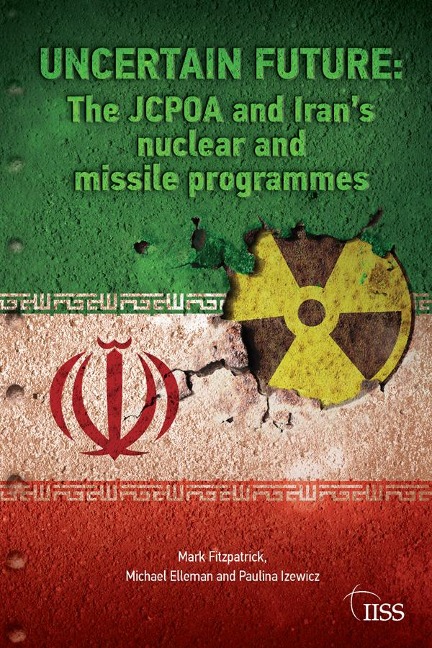
In July 2015, eight parties - France, Germany and the United Kingdom, together with the European Union and China, Russia and the United States on the one side, and Iran on the other - adopted the Joint Comprehensive Plan of Action (JCPOA), better known as the Iran nuclear deal. Under the agreement, Iran accepted limits to its nuclear programme in return for sanctions relief. Hailed by some as a diplomatic achievement, detractors - both in the US and the Middle East - saw the deal as overly lenient. In May 2018, US President Donald Trump announced that the US would cease waiving sanctions and withdraw from the agreement. This Adelphi book assesses that Trump's decision was a grave error. Like any multilateral agreement, the deal was not perfect, but Iran had been honouring its commitments. Drawing on a deep understanding of the non-proliferation regime and technical expertise, the authors trace the emergence of antipathy to the JCPOA and set out how many of the politicised criticisms of the accord are demonstrably incorrect. They argue that the little-known Procurement Channel - established by the JCPOA to give Iran a legitimate route to procure goods and services for its now-limited nuclear programme - has been an effective check on Iran's illicit procurement of nuclear-related goods. Moreover, this book demonstrates that Iran's nuclear and ballistic-missile programmes are not intrinsically linked, as not all Iranian missiles are designed to be nuclear-capable. While the deal endures for now, its survival will ultimately depend on Iran.
Mark Fitzpatrick is an associate fellow at the IISS. Until the end of 2018, he was Executive Director of IISS-Americas and director of the Institute's Non-proliferation and Nuclear Policy Programme. Prior to joining IISS in 2005, he was a career US Foreign Service Officer. Michael Elleman is Senior Fellow for Missile Defence at the IISS and the principal author of the IISS Strategic Dossier Iran's Ballistic Missile Capabilities: A net assessment. He previously worked as a missile expert for weapons inspection missions in Iraq and spent two decades as a scientist at Lockheed Martin. Paulina Izewicz is a Senior Research Associate with the James Martin Center for Nonproliferation Studies at the Middlebury Institute of International Studies at Monterey. Until spring 2018, she managed programmatic work on sanctions and led a Track 1.5 dialogue with Iran for the IISS.
Introduction Mark Fitzpatrick 1. Assessing the JCPOA Mark Fitzpatrick 2.The Procurement Channel Paulina Izewicz 3.Evaluating Design Intent in Iran's Ballistic-missile Programme Mark Fitzpatrick and Michael Elleman Conclusions
Dieses eBook wird im PDF-Format geliefert und ist mit einem Adobe Kopierschutz (DRM) versehen. Sie können dieses eBook mit allen Geräten lesen, die das PDF-Format und den Adobe Kopierschutz (DRM) unterstützen.
Zum Beispiel mit den folgenden Geräten:
• tolino Reader
Laden Sie das eBook direkt über den Reader-Shop auf dem tolino herunter oder übertragen Sie das eBook auf Ihren tolino mit einer kostenlosen Software wie beispielsweise Adobe Digital Editions.
• Sony Reader & andere eBook Reader
Laden Sie das eBook direkt über den Reader-Shop herunter oder übertragen Sie das eBook mit der kostenlosen Software Sony READER FOR PC/Mac oder Adobe Digital Editions auf ein Standard-Lesegeräte mit epub- und Adobe DRM-Unterstützung.
• Tablets & Smartphones
Möchten Sie dieses eBook auf Ihrem Smartphone oder Tablet lesen, finden Sie hier unsere kostenlose Lese-App für iPhone/iPad und Android Smartphone/Tablets.
• PC & Mac
Lesen Sie das eBook direkt nach dem Herunterladen mit einer kostenlosen Lesesoftware, beispielsweise Adobe Digital Editions, Sony READER FOR PC/Mac oder direkt über Ihre eBook-Bibliothek in Ihrem Konto unter „Meine eBooks“ - „online lesen“.
Schalten Sie das eBook mit Ihrer persönlichen Adobe ID auf bis zu sechs Geräten gleichzeitig frei.
Bitte beachten Sie, dass die Kindle-Geräte das Format nicht unterstützen und dieses eBook somit nicht auf Kindle-Geräten lesbar ist.