Und dann auf "Zum Home-Bildschirm [+]".

Stöbern
genialokal zum Startbildschirm hinzufügen
Installieren Sie die genialokal App auf Ihrem Startbildschirm für einen schnellen Zugriff und eine komfortable Nutzung.
Installieren Sie die genialokal App auf Ihrem Startbildschirm für einen schnellen Zugriff und eine komfortable Nutzung.

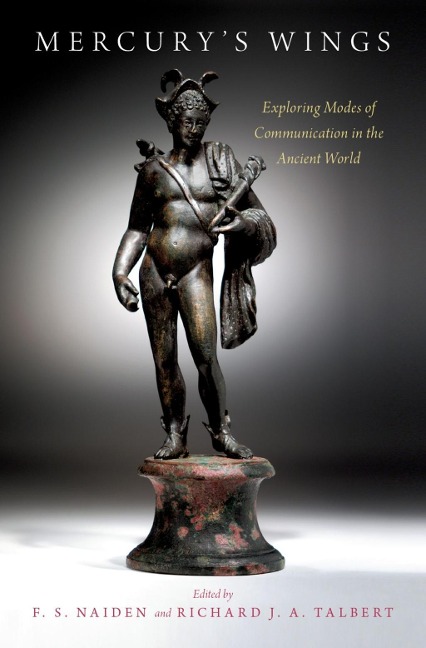
Mercury's Wings: Exploring Modes of Communication in the Ancient World is the first-ever volume of essays devoted to ancient communications. Comparable previous work has been mainly confined to articles on aspects of communication in the Roman empire. This set of 18 essays with an introduction by the co-editors marks a milestone, therefore, that demonstrates the importance and rich further potential of the topic. The authors, who include art historians, Assyriologists, Classicists and Egyptologists, take the broad view of communications as a vehicle not just for the transmission of information, but also for the conduct of religion, commerce, and culture. Encompassed within this scope are varied purposes of communication such as propaganda and celebration, as well as profit and administration. Each essay deals with a communications network, or with a means or type of communication, or with the special features of religious communication or communication in and among large empires. The spatial, temporal, and cultural boundaries of the volume take in the Near East as well as Greece and Rome, and cover a period of some 2,000 years beginning in the second millennium BCE and ending with the spread of Christianity during the last centuries of the Roman Empire in the West. In all, about one quarter of the essays deal with the Near East, one quarter with Greece, one quarter with Greece and Rome together, and one quarter with the Roman empire and its Persian and Indian rivals. Some essays concern topics in cultural history, such as Greek music and Roman art; some concern economic history in both Mesopotamia and Rome; and some concern traditional historical topics such as diplomacy and war in the Mediterranean world. Each essay draws on recent work in the theory of communications.
F. S. Naiden is Professor of History at the University of North Carolina, Chapel Hill. Richard J. A. Talbert is William Rand Kenan, Jr. Professor of History at the University of North Carolina, Chapel Hill.
Contents Figures, Maps, and Tables Abbreviations Contributors Introduction, by F. S. Naiden and Richard Talbert
Part I Networks 1 Environmental Perspectives on Ancient Communication, by Grant Parker 2 Libraries and Communication in the Ancient World, by Matthew Nicholls 3 Communication and Roman Long-distance Trade, by Taco Terpstra 4 Military Communication: The Example of the Classical Battlefield, by F. S. Naiden
Part II Modes 5 Monuments of the Hittite and Neo-Assyrian Empires during the Late Bronze and Iron Ages, by James F. Osborne 6 Communicating with Images in the Roman Empire, by Jennifer Trimble 7 Musical Persuasion in Early Greece, by Timothy Power 8 Gesture in the Ancient Mediterranean World, by Gregory S. Aldrete 9 Exercising Sympathy in Mesopotamian Letters, by Seth Richardson
Part III Divinities 10 Messages and the Mesopotamian Gods: Signals and Systematics, by Seth Richardson 11 Pilgrimage and Communication, by Ian Rutherford 12 The Inspired Voice: Enigmatic Oracular Communication, by Julia Kindt 13 Christianity, by Michael Kulikowski
Part IV Engagements 14 Cross-cultural Communication in the Hellenistic Mediterranean and Western and South Asia, by Matthew Canepa 15 Cross-cultural Communication in Egypt, by J. G. Manning 16 Diplomatic Communication in the Ancient Mediterranean, by Sheila L. Ager 17 Coinage and the Roman Economy, by Kenneth W. Harl 18 Communicating through Maps: The Roman Case, by Richard Talbert
Gazetteer Index