Und dann auf "Zum Home-Bildschirm [+]".

Stöbern
genialokal zum Startbildschirm hinzufügen
Installieren Sie die genialokal App auf Ihrem Startbildschirm für einen schnellen Zugriff und eine komfortable Nutzung.
Installieren Sie die genialokal App auf Ihrem Startbildschirm für einen schnellen Zugriff und eine komfortable Nutzung.
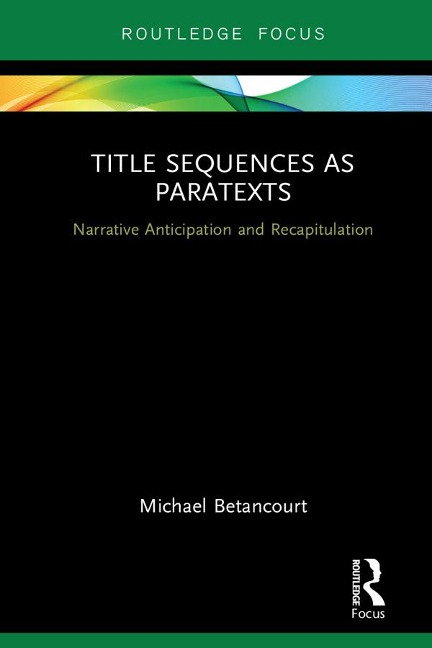
In his third book on the semiotics of title sequences, Title Sequences as Paratexts, theorist Michael Betancourt offers an analysis of the relationship between the title sequence and its primary text-the narrative whose production the titles credit. Using a wealth of examples drawn from across film history-ranging from White Zombie (1931), Citizen Kane (1940) and Bullitt (1968) to Prince of Darkness (1987), Mission: Impossible (1996), Sucker Punch (2011) and Guardians of the Galaxy, Vol. 2 (2017)-Betancourt develops an understanding of how the audience interprets title sequences as instances of paranarrative, simultaneously engaging them as both narrative exposition and as credits for the production. This theory of cinematic paratexts, while focused on the title sequence, has application to trailers, commercials, and other media as well.
Michael Betancourt is an artist/theorist concerned with digital technology and capitalist ideology. His writing has been translated into Chinese, French, Greek, Italian, Japanese, Persian, Portuguese, and Spanish, and been published in magazines such as The Atlantic, Make Magazine, Millennium Film Journal, Leonardo, Semiotica, and CTheory. He wrote The ____________ Manifesto, and other books such as The Critique of Digital Capitalism, The History of Motion Graphics, Semiotics and Title Sequences, Synchronization and Title Sequences, Glitch Art in Theory and Practice, and Beyond Spatial Montage: Windowing. These publications complement his movies, which have screened internationally at the Black Maria Film Festival, Art Basel Miami Beach, Contemporary Art Ruhr, Athens Video Art Festival, Festival des Cinemas Differents de Paris, Anthology Film Archives, Millennium Film Workshop, the San Francisco Cinematheque's Crossroads, and Experiments in Cinema, among many others.
List of Figures Acknowledgements 1 INTRODUCTION Limina Anticipation and Recapitulation Problems of Cinematic Paratext 2 Narrative Exposition Pseudo-Independence Intratextuality 3 Expositional Modes The Allegory mode Lexical Expertise 4 The Comment mode Narrative Futurity Intertextuality and Quotation 5 The Summary mode Complex Summary Narrative Restatement 6 The Prologue mode Realist Integration Expository Texts 7 CONCLUSIONS The Paradoxes of Cinematic Paratext Typography and Pseudo-Independence The Ideology of Naturalism::Stylization Index
Dieses eBook wird im PDF-Format geliefert und ist mit einem Adobe Kopierschutz (DRM) versehen. Sie können dieses eBook mit allen Geräten lesen, die das PDF-Format und den Adobe Kopierschutz (DRM) unterstützen.
Zum Beispiel mit den folgenden Geräten:
• tolino Reader
Laden Sie das eBook direkt über den Reader-Shop auf dem tolino herunter oder übertragen Sie das eBook auf Ihren tolino mit einer kostenlosen Software wie beispielsweise Adobe Digital Editions.
• Sony Reader & andere eBook Reader
Laden Sie das eBook direkt über den Reader-Shop herunter oder übertragen Sie das eBook mit der kostenlosen Software Sony READER FOR PC/Mac oder Adobe Digital Editions auf ein Standard-Lesegeräte mit epub- und Adobe DRM-Unterstützung.
• Tablets & Smartphones
Möchten Sie dieses eBook auf Ihrem Smartphone oder Tablet lesen, finden Sie hier unsere kostenlose Lese-App für iPhone/iPad und Android Smartphone/Tablets.
• PC & Mac
Lesen Sie das eBook direkt nach dem Herunterladen mit einer kostenlosen Lesesoftware, beispielsweise Adobe Digital Editions, Sony READER FOR PC/Mac oder direkt über Ihre eBook-Bibliothek in Ihrem Konto unter „Meine eBooks“ - „online lesen“.
Schalten Sie das eBook mit Ihrer persönlichen Adobe ID auf bis zu sechs Geräten gleichzeitig frei.
Bitte beachten Sie, dass die Kindle-Geräte das Format nicht unterstützen und dieses eBook somit nicht auf Kindle-Geräten lesbar ist.