
Stöbern
genialokal zum Startbildschirm hinzufügen
Installieren Sie die genialokal App auf Ihrem Startbildschirm für einen schnellen Zugriff und eine komfortable Nutzung.
Installieren Sie die genialokal App auf Ihrem Startbildschirm für einen schnellen Zugriff und eine komfortable Nutzung.
Tippen Sie einfach auf Teilen:
 Und dann auf "Zum Home-Bildschirm [+]".
Bei genialokal.de kaufen Sie online bei Ihrer lokalen, inhabergeführten Buchhandlung!
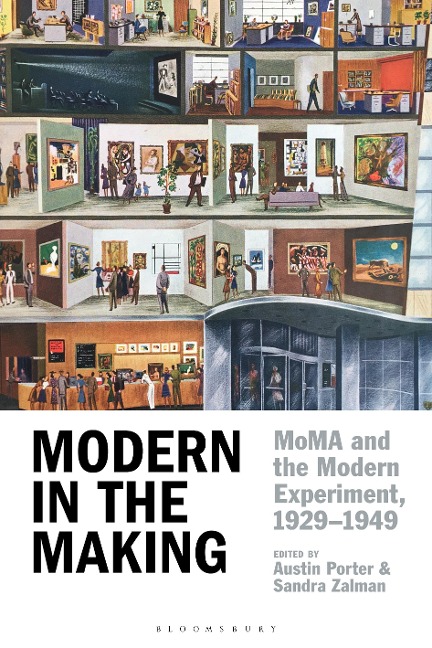
Today the Museum of Modern Art is widely recognized for establishing the canon of modern art; yet in its early years, the museum considered modern art part of a still unfolding experiment in contemporary visual production. By bracketing MoMA's early history from its later reputation, this book explores the ways the Museum acted as a laboratory to set an ambitious agenda for the exhibition of a multidisciplinary idea of modern art.
Between its founding in 1929 and its 20th anniversary in 1949, MoMA created the first museum departments of architecture and design, film, and photography in the country, marshaled modern art as a political tool, and brought consumer culture into a versatile yet institutional context. Encompassing 14 essays that investigate the diversity of modern art, this volume demonstrates how MoMA's programming shaped a version of modern art that was not elitist but fundamentally intertwined with all levels of cultural production.
Austin Porter is Assistant Professor of Art History and American Studies at Kenyon College, USA.
Sandra Zalman is Associate Professor and Program Director of Art History at the University of Houston, USA.
Introduction
Establishing the Modern: MoMA and the Modern Experiment, Austin Porter (Kenyon College, USA) and Sandra Zalman (University of Houston, USA)
Part I: Vernacular Influences
Chapter 1: Folk Surrealism, Marci Kwon (Stanford University, USA)
Chapter 2: New Rugs by American Artists: Modernism, Abstraction, and Rug Design at MoMA, Jennifer Padgett (Crystal Bridges Museum of American Art, USA)
Chapter 3: MoMA's Child Artists, John Blakinger (University of Southern California, USA)
Chapter 4: "Floor, Ceiling, Wall, Garden Market: The Curatorial Scene of Twenty Centuries of Mexican Art, Andy Campbell (University of Southern California, USA)
Part II: New Mediums for a New Museum: Photography, Dance, Architecture and Design
Chapter 5: Aesthetic versus the "Mere Historic": Civil War and Frontier Photography at MoMA, Sarah Kate Gillespie (Gettysburg College, USA)
Chapter 6: An Exact Instant in the History of the Modern, Jason Hill (University of Delaware, USA)
Chapter 7: Performance and the Dance Archives at the Museum of Modern Art, Swagato Chakravorty (Yale University, USA)
Chapter 8: Architecture on Display: Breuer's House in the Museum Garden, Catarina Schlee Flaksman (Independent Scholar)
Part III: Mobilizing Modernism
Chapter 9: Reproducing Art and the Museum: Ancestral Sources in and beyond the Museum of Modern Art, Rachel Kaplan (Los Angeles County Museum of Art, USA)
Chapter 10: The 'Great Gallery' Goes to New York: Ancient American Rock Art, MOMA, and the New York Avant-Garde, James Farmer (Virginia Commonwealth University, USA)
Chapter 11: "Toward a Happier and More Successful Life," or When Veterans Made, Art in the Modern Museum, Suzanne Hudson (University of Southern California, USA)
Part IV: MoMA's Global Vision
Chapter 12: Occidental Arrangements: MoMA's Emerging Global History of Art at Midcentury, John Ott (James Madison University, USA)
Chapter 13: Exhibiting Italian Democracy in Twentieth Century Italian Art at the Museum of Modern Art, Antje Gamble (Murray State University, USA)
Chapter 14: American Exceptionalism at the Modern, 1942-1959: Dorothy Miller's Americans, Angela Miller (Washington University, USA)
Index
Dieses eBook wird im PDF-Format geliefert und ist mit einem Adobe Kopierschutz (DRM) versehen. Sie können dieses eBook mit allen Geräten lesen, die das PDF-Format und den Adobe Kopierschutz (DRM) unterstützen.
Zum Beispiel mit den folgenden Geräten:
• tolino Reader
Laden Sie das eBook direkt über den Reader-Shop auf dem tolino herunter oder übertragen Sie das eBook auf Ihren tolino mit einer kostenlosen Software wie beispielsweise Adobe Digital Editions.
• Sony Reader & andere eBook Reader
Laden Sie das eBook direkt über den Reader-Shop herunter oder übertragen Sie das eBook mit der kostenlosen Software Sony READER FOR PC/Mac oder Adobe Digital Editions auf ein Standard-Lesegeräte mit epub- und Adobe DRM-Unterstützung.
• Tablets & Smartphones
Möchten Sie dieses eBook auf Ihrem Smartphone oder Tablet lesen, finden Sie hier unsere kostenlose Lese-App für iPhone/iPad und Android Smartphone/Tablets.
• PC & Mac
Lesen Sie das eBook direkt nach dem Herunterladen mit einer kostenlosen Lesesoftware, beispielsweise Adobe Digital Editions, Sony READER FOR PC/Mac oder direkt über Ihre eBook-Bibliothek in Ihrem Konto unter „Meine eBooks“ - „online lesen“.
Schalten Sie das eBook mit Ihrer persönlichen Adobe ID auf bis zu sechs Geräten gleichzeitig frei.
Bitte beachten Sie, dass die Kindle-Geräte das Format nicht unterstützen und dieses eBook somit nicht auf Kindle-Geräten lesbar ist.