Und dann auf "Zum Home-Bildschirm [+]".

Stöbern
genialokal zum Startbildschirm hinzufügen
Installieren Sie die genialokal App auf Ihrem Startbildschirm für einen schnellen Zugriff und eine komfortable Nutzung.
Installieren Sie die genialokal App auf Ihrem Startbildschirm für einen schnellen Zugriff und eine komfortable Nutzung.
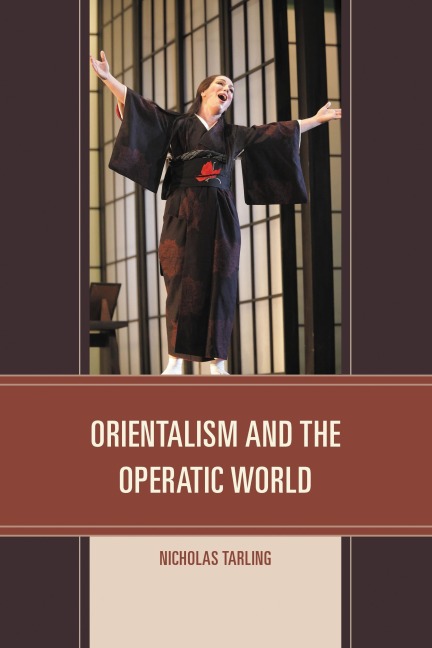
Western opera is a globalized and globalizing phenomenon and affords us a unique opportunity for exploring the concept of "orientalism," the subject of literary scholar Edward Said's modern classic on the topic. Nicholas Tarling's Orientalism and the Operatic World places opera in the context of its steady globalization over the past two centuries. In this important survey, Tarling first considers how the Orient appears on the operatic stage in Britain, France, Germany, Russia, and the United States before exploring individual operas according to the region of the "Orient" in which the work is set.
Throughout, Tarling offers key insights into such notable operas as George Frideric Handel's Berenice, Giuseppe Verdi's Aida, Giacomo Puccini's MadamaButterfly, Pietro Mascagni's Iris, and others. Orientalism and the Operatic World argues that any close study of the history of Western opera, in the end, fails to support the notion propounded by Said that Westerners inevitably stereotyped, dehumanized, and ultimately sought only to dominate the East through art. Instead, Tarling argues that opera is a humanizing art, one that emphasizes what humanity has in common by epic depictions of passion through the vehicle of song.
Orientalism and the Operatic World is not merely for opera buffs or even first-time listeners. It should also interest historians of both the East and West, scholars of international relations, and cultural theorists.
Nicholas Tarling is an octogenarian. A graduate of Cambridge University, he is an Emeritus Professor of History at the University of Auckland, and still attached to its New Zealand Asia Institute, his main field being the history of Southeast Asia. He is grateful to
Overture
Part One: Recitatives
Chapter 1: Globalising and Glocalising Opera
Chapter 2: The Genre
Chapter 3: Orientalisms
Part Two: Arias
Chapter 4: Bible-based operas
Chapter 5: Crusaders, Arabs and Turks
Chapter 6: Egypt
Chapter 7: India and Ceylon
Chapter 8: China.
Chapter 9: Japan
Chapter 10: Russia
Finale
About the Author
Dieses eBook wird im PDF-Format geliefert und ist mit einem Adobe Kopierschutz (DRM) versehen. Sie können dieses eBook mit allen Geräten lesen, die das PDF-Format und den Adobe Kopierschutz (DRM) unterstützen.
Zum Beispiel mit den folgenden Geräten:
• tolino Reader
Laden Sie das eBook direkt über den Reader-Shop auf dem tolino herunter oder übertragen Sie das eBook auf Ihren tolino mit einer kostenlosen Software wie beispielsweise Adobe Digital Editions.
• Sony Reader & andere eBook Reader
Laden Sie das eBook direkt über den Reader-Shop herunter oder übertragen Sie das eBook mit der kostenlosen Software Sony READER FOR PC/Mac oder Adobe Digital Editions auf ein Standard-Lesegeräte mit epub- und Adobe DRM-Unterstützung.
• Tablets & Smartphones
Möchten Sie dieses eBook auf Ihrem Smartphone oder Tablet lesen, finden Sie hier unsere kostenlose Lese-App für iPhone/iPad und Android Smartphone/Tablets.
• PC & Mac
Lesen Sie das eBook direkt nach dem Herunterladen mit einer kostenlosen Lesesoftware, beispielsweise Adobe Digital Editions, Sony READER FOR PC/Mac oder direkt über Ihre eBook-Bibliothek in Ihrem Konto unter „Meine eBooks“ - „online lesen“.
Schalten Sie das eBook mit Ihrer persönlichen Adobe ID auf bis zu sechs Geräten gleichzeitig frei.
Bitte beachten Sie, dass die Kindle-Geräte das Format nicht unterstützen und dieses eBook somit nicht auf Kindle-Geräten lesbar ist.