Und dann auf "Zum Home-Bildschirm [+]".

Stöbern
genialokal zum Startbildschirm hinzufügen
Installieren Sie die genialokal App auf Ihrem Startbildschirm für einen schnellen Zugriff und eine komfortable Nutzung.
Installieren Sie die genialokal App auf Ihrem Startbildschirm für einen schnellen Zugriff und eine komfortable Nutzung.
Ihr gewünschter Artikel ist in 0 Buchhandlungen vorrätig - wählen Sie hier eine Buchhandlung in Ihrer Nähe aus:

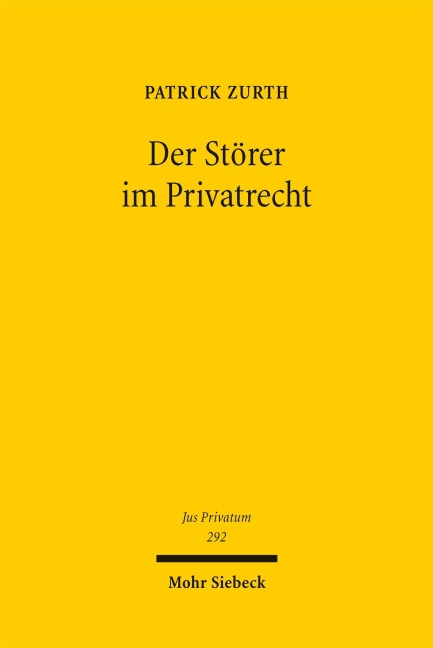
Although the German Civil Code (BGB) has contained injunctive relief for the protection of property rights in § 1004 since its inception, numerous dogmatic problems still surround this provision. Patrick Zurth examines injunctive relief from a legal-historical, legal-economic, and legal-dogmatic perspective, developing a new understanding of the "disturber." This characteristic forms the central element of § 1004 German Civil Code and also appears outside this norm in civil law, particularly in the case of so-called disturber liability in intellectual property and personality rights. The aim of this work is to deduce a uniform concept of disturbance across various sub-areas of private law. In particular, the proximity of injunctive relief to tort law is highlighted and the concept of disturbance in private law is further developed by including duties of conduct.
Born 1987; studied law at Humboldt-Universität zu Berlin (First Law Examination, 2012) and at Stanford (LL.M., 2020); 2016 doctorate (HU Berlin); 2017 Second Law Examination (Berlin); Academic Councilor at Ludwig-Maximilians-Universität München; 2025 habilitation at the same university; HWS 2025 deputy chair at the University of Mannheim.