Und dann auf "Zum Home-Bildschirm [+]".

Stöbern
genialokal zum Startbildschirm hinzufügen
Installieren Sie die genialokal App auf Ihrem Startbildschirm für einen schnellen Zugriff und eine komfortable Nutzung.
Installieren Sie die genialokal App auf Ihrem Startbildschirm für einen schnellen Zugriff und eine komfortable Nutzung.
Ihr gewünschter Artikel ist in 0 Buchhandlungen vorrätig - wählen Sie hier eine Buchhandlung in Ihrer Nähe aus:

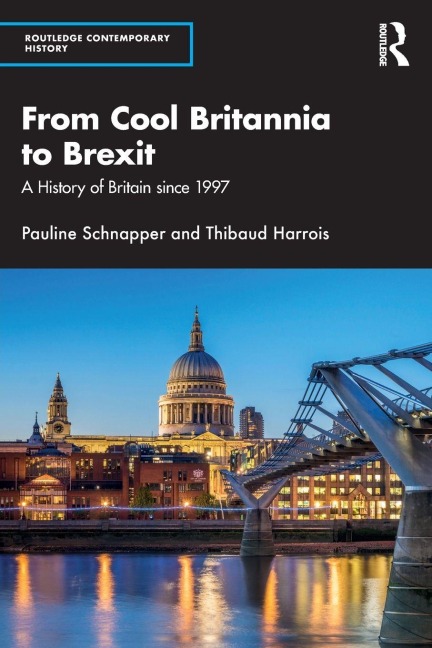
This book discusses and analyses the last three decades of British political history, looking at why Britain found itself shut out from its immediate neighbours on the continent in 2016, twenty years after the country was celebrated as a prosperous, optimistic and culturally influential "Cool Britannia".
Pauline Schnapper is Professor of British Politics at Université Sorbonne Nouvelle, Paris. Her research covers in particular British European policy and post-Brexit politics. Her most recent publications include La Politique au Royaume-Uni (La Découverte, 2022) and, with Helen Drake, '"We thought we were friends!": Franco-British bilateral diplomacy and the shock of Brexit' (Journal of Contemporary European Research, 2021). Thibaud Harrois is Senior Lecturer in British Politics at Université Sorbonne Nouvelle, Paris. His research focuses on British foreign and security policy. His latest publications include 'The politicisation of the Common Foreign and Security Policy in the British domestic debate on Brexit: A challenge to EU-UK foreign and security cooperation' (Contemporary British History, 2023).
Introduction Chapter 1: The constitution Introduction Political parties and constitutional reforms Reforming Britain's constitution The Brexit referendum: a challenge to parliamentary democracy The Covid-19 crisis and the constitution Constitutional Monarchy at the end of the second Elizabethan era Conclusion Chapter 2: Parties, elections and voters Introduction The new party system(s) The crisis of representation - how voting changed Changes in parties - policies and organisation New forms of participation Conclusion Chapter 3: The state of the union Introduction Devolution to Scotland and Wales Northern Ireland The 2014 Scottish independence referendum The Brexit effect Consequences of the Covid pandemic The state of England Conclusion Chapter 4: Britain and Europe: the road to Brexit Introduction The ambiguities of New Labour The rise of Euroscepticism The Brexit referendum UK-EU relations after Brexit Conclusion Chapter 5: Britain in the world Introduction New Labour, old values ? The UK, NATO and the defence of Europe in the post-Cold War context The Franco-British Saint-Malo Declaration: introducing new concepts in European defence Liberal interventionism and the 'special relationship' with the USA The legacy of 'Blair's wars' and 'liberal conservatism' The 'Arab Spring' and its aftermath No 'strategic shrinkage': reviewing the UK's defence and security priorities The United Kingdom and the EU's foreign and security policy 'Global Britain': a redefinition of Britain's role in the world? Conclusion Chapter 6: The economy Introduction The New Labour era (1997-2010) Gordon Brown's premiership and the aftermath of the 2008 global financial crisis (2007-2010) The Conservative-led coalition government (2010-2015) and the Conservative government before the 2016 referendum What political response to economic challenges after 2016? Conclusion Chapter 7: A more diverse and unequal society Introduction Demographic trends Immigration and multiculturalism Class and social inequalities Inequalities, poverty and unemployment The housing crisis Conclusion Chapter 8: Education Introduction New Labour's education agenda (1997-2010) Education policy and reforms under the Coalition Government (2010-2015) New challenges: education policy in the aftermath of Brexit and Covid-19 Conclusion Chapter 9: Old and new media Introduction The evolution of traditional media: the press, television and the radio Scandals and ethics Conclusion Chapter 10: Cultural policy Introduction The New Labour vision - Cool Britannia? The impact of austerity on the cultural sector Two shocks: Brexit and Covid The legacy of empire and culture wars Conclusion