Und dann auf "Zum Home-Bildschirm [+]".

Stöbern
genialokal zum Startbildschirm hinzufügen
Installieren Sie die genialokal App auf Ihrem Startbildschirm für einen schnellen Zugriff und eine komfortable Nutzung.
Installieren Sie die genialokal App auf Ihrem Startbildschirm für einen schnellen Zugriff und eine komfortable Nutzung.
Ihr gewünschter Artikel ist in 0 Buchhandlungen vorrätig - wählen Sie hier eine Buchhandlung in Ihrer Nähe aus:

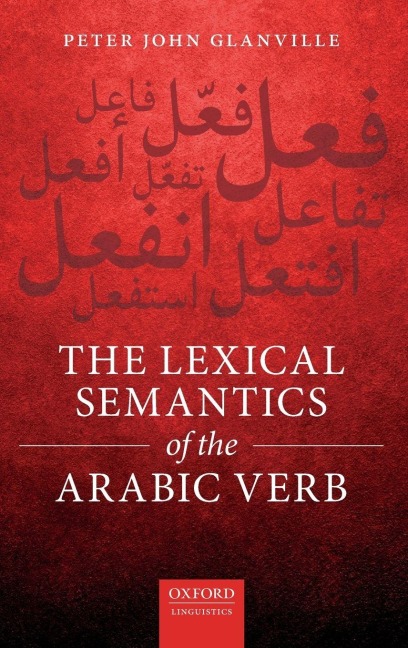
This book is an investigation of Arabic derivational morphology that focuses on the relationship between verb meaning and linguistic form. Beginning with the ground form, the book offers a comprehensive analysis of the most common verb patterns of Arabic from a lexical semantic perspective. Peter Glanville explains why verbs with seemingly unrelated meanings share the same phonological shape, and analyses sets of words that contain the same consonantal root to arrive at a common abstraction. He uses both contemporary and historical data to explore the semantics of reflexivity, symmetry, causation, and repetition, and argues that the verb patterns of Arabic that express these phenomena have come about as the result of grammaticalization and analogical processes that are common cross-linguistically. The book adopts an approach to morphology in which rule-based derivation has created word patterns and consonantal roots, with the result that in some derivations roots may be extractedfrom a source word and plugged in to a pattern. It illustrates the semantic relationship between a source word and its derivative, while also offering evidence to support the view of the consonantal root as a morphological object. The volume will be a valuable resource for advanced undergraduate and graduate students of Arabic language and linguistics who are interested in understanding the verb patterns of Arabic, the derivational relationships between words, and the construction of meaning in the mind. It will also appeal to researchers and students in morphology, semantics, historical linguistics, and cognitive linguistics.
Peter John Glanville teaches Arabic and Arabic linguistics at the University of Maryland, where he is Director of the Arabic program. He holds a Ph.D. in Arabic Studies from the University of Texas at Austin, and an M.Sc. in Applied Linguistics from the University of Edinburgh. His research focuses on Arabic morphology and syntax, in addition to Arabic language pedagogy.
Acknowledgments
List of figures
List of abbreviations
A note on primary references
1: Introduction and overview
2: Words, roots, and patterns
3: Ground form verb patterns
4: Reflexive marking
5: Symmetry
6: Causation and actionalization
7: Repetition
8: The beginnings of a system
Primary references
Bibliography
Index