Und dann auf "Zum Home-Bildschirm [+]".

Stöbern
genialokal zum Startbildschirm hinzufügen
Installieren Sie die genialokal App auf Ihrem Startbildschirm für einen schnellen Zugriff und eine komfortable Nutzung.
Installieren Sie die genialokal App auf Ihrem Startbildschirm für einen schnellen Zugriff und eine komfortable Nutzung.
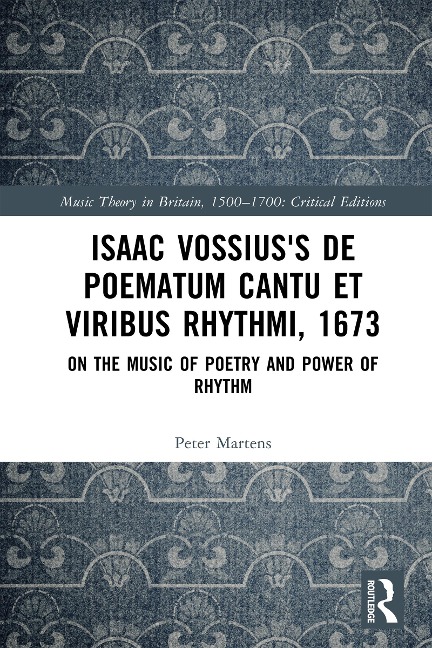
Dr Peter Martens provides the first complete edited English translation of, and commentary on, Issac Vossius's De poematum cantu et viribus rythmi, a late seventeenth-century work of Continental musical humanism, all the more interesting for being published in England and dedicated to royalist Henry Bennett, Duke of Arlington. This treatise plays an important but poorly understood role in the continued development of rhythmopoeia; Vossius continues the arguments of figures such as Vincenzo Galilei and Marin Mersenne - desiring to link linguistic rhythm, music, and the passions - by proposing a practical, if undemonstrated, method for doing so based on ancient poetic feet. This resuscitation of poetic feet in the service of affect is made explicit by Vossius, but is undoubtedly more familiar to musicologists from Wolfgang Caspar Printz's 1696 Phrynis Mitilenaeus or Johann Mattheson's 1739 Der vollkommene Capellmeister. Vossius, or more correctly, De poematum cantu, was often cited during the century after its publication, and no modern treatment of rhythmopoeia seems complete without a citation or short excerpt from this work. There is little secondary literature that focuses on this treatise, but what does exist links this work directly to John Dryden's composition of his 1687 and 1697 St. Cecilia odes, and their musical settings by Giovanni Battista Draghi and Jeremiah Clarke, respectively. In Dean Mace and H. Neville Davies' debate over the extent of Vossius's influence on these works can be found a rich picture of the contentious issues surrounding text-setting and musical affect that so occupied a great many writers in late-seventeenth-century England. A full translation and accompanying discussion of Vossius's own sources and musical influences allows English-language students and scholars to access and study this work in the depth and to the degree it deserves.
Peter Martens is Professor of Music Theory at Texas Tech University and serves as Associate Dean for Faculty, Research and Creative Activity in the Talkington College of Visual & Performing Arts. Dr. Martens holds bachelor's degrees in music and classics from Lawrence University, and M.A. and Ph.D. degrees in the History and Theory of Music from the University of Chicago.
1. Introductory essay 2. English translation 3. Original Latin text 4. Index
Dieses eBook wird im PDF-Format geliefert und ist mit einem Adobe Kopierschutz (DRM) versehen. Sie können dieses eBook mit allen Geräten lesen, die das PDF-Format und den Adobe Kopierschutz (DRM) unterstützen.
Zum Beispiel mit den folgenden Geräten:
• tolino Reader
Laden Sie das eBook direkt über den Reader-Shop auf dem tolino herunter oder übertragen Sie das eBook auf Ihren tolino mit einer kostenlosen Software wie beispielsweise Adobe Digital Editions.
• Sony Reader & andere eBook Reader
Laden Sie das eBook direkt über den Reader-Shop herunter oder übertragen Sie das eBook mit der kostenlosen Software Sony READER FOR PC/Mac oder Adobe Digital Editions auf ein Standard-Lesegeräte mit epub- und Adobe DRM-Unterstützung.
• Tablets & Smartphones
Möchten Sie dieses eBook auf Ihrem Smartphone oder Tablet lesen, finden Sie hier unsere kostenlose Lese-App für iPhone/iPad und Android Smartphone/Tablets.
• PC & Mac
Lesen Sie das eBook direkt nach dem Herunterladen mit einer kostenlosen Lesesoftware, beispielsweise Adobe Digital Editions, Sony READER FOR PC/Mac oder direkt über Ihre eBook-Bibliothek in Ihrem Konto unter „Meine eBooks“ - „online lesen“.
Schalten Sie das eBook mit Ihrer persönlichen Adobe ID auf bis zu sechs Geräten gleichzeitig frei.
Bitte beachten Sie, dass die Kindle-Geräte das Format nicht unterstützen und dieses eBook somit nicht auf Kindle-Geräten lesbar ist.