Und dann auf "Zum Home-Bildschirm [+]".

Stöbern
genialokal zum Startbildschirm hinzufügen
Installieren Sie die genialokal App auf Ihrem Startbildschirm für einen schnellen Zugriff und eine komfortable Nutzung.
Installieren Sie die genialokal App auf Ihrem Startbildschirm für einen schnellen Zugriff und eine komfortable Nutzung.
Ihr gewünschter Artikel ist in 0 Buchhandlungen vorrätig - wählen Sie hier eine Buchhandlung in Ihrer Nähe aus:

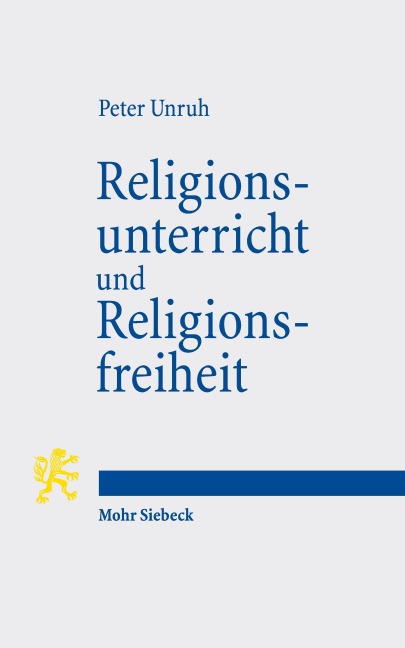
Far-reaching changes in the sociology of religion have consequences and, in particular, challenges for religious education within the meaning of Article 7 (2) and (3) of the Basic Law. While new interdenominational and interreligious models have long since established themselves in school practice, their recognition under constitutional law is (still) being called into question by the currently prevailing dogmatism. It is largely based on a leading decision of the Federal Constitutional Court from 1987, the sustainability of which must be questioned for the present and the future. Peter Unruh therefore suggests a dogmatic opening: By systematically drawing on Article 4 of the Basic Law as the central norm of constitutional law on religion, new perspectives for interpreting Article 7(2) and (3) of the Basic Law can be developed. Elements of the dogmatics of Art. 4 GG are made beneficial for the (extended) interpretation of Art. 7 para. 2 and 3 GG. The interdenominational and interreligious models of religious education encountered in practice can thus be fundamentally exonerated from the verdict of unconstitutionality. Overall, the work shows a constitutionally sound way in which the dogmatics of Article 7 (2) and (3) of the Basic Law can be adapted to social realities and the future of religious education can be secured under religious constitutional law.
Born 1965; doctorate in 1993; habilitation in 2001; President of the Regional Church Office of the Evangelical Lutheran Church in Northern Germany and Associate Professor of Public Law, European Law and Philosophy of Law at the Georg August University of Göttingen.
A. Einleitung
B. Ausgangs- und Rahmenbedingungen
I. Die normative Regelung des Religionsunterrichts
1. Kirche, Schule und Religionsunterricht vor 1919
2. Die Weimarer Reichsverfassung von 1919
3. Das Grundgesetz von 1949
II. Abriss der Dogmatik zu Art. 7 Abs. 2 und 3 GG
1. Dogmatischer Status
2. Öffentliche Schulen
3. Ordentliches Lehrfach
4. Die Übereinstimmungsklausel
5. Abmelderecht
III. Insbesondere: Die Rechtsprechung des Bundesverfassungs-gerichts
IV. Der Religionsunterricht in der Praxis
1. Das Separatmodell
2. Das interkonfessionelle Modell
3. Das interreligiöse Modell
4. Das Abstinenzmodell
V. Zwischenfazi
C. Der Religionsunterricht im religionsverfassungsrechtlichen System des Grundgesetzes
I. Die Religionsfreiheit als Fundament des Religionsverfassungs-rechts
II. Die Struktur des Religionsverfassungsrechts
1. Das Fundament: Das Grundrecht auf Religionsfreiheit aus Art. 4 Abs. 1 und 2 GG
2. Das Verbot der Staatskirche
3. Das Selbstbestimmungsrecht der Religionsgemeinschaften
4. Der Status der Säulen und Verstrebungen
III. Exkurs: Art. 7 Abs.2 und 3 GG als "verfassungswidriges
Verfassungsrecht"?
IV. Zwischenfazit zum Systemgedanken
V. Dogmatische Verbindungslinien
1. Der Begriff der Religion
2. Die religiös-weltanschauliche Neutralität des Staates
D. Auswirkungen auf die Dogmatik zu Art. 7 Abs. 2 und 3 GG
I. Die Übereinstimmungsklausel im Fokus
II. Die Dogmatik zum Religionsunterricht im Lichte der Religi-onsfreiheit
1. Authentische Religion in der öffentlichen Schule
2. Die inhaltliche Verantwortung der Religionsgemeinschaften
3. Authentizität und Selbstverständnis
4. Das Korrektiv der Plausibilität
III. Folgerungen
1. Das Erfordernis theologischer Plausibilisierung
2. Regionale Diversität
3. Quis iudicabit?
4. Organisatorische Anforderungen
E. Zusammenfassung und Ausblick