Und dann auf "Zum Home-Bildschirm [+]".

Stöbern
genialokal zum Startbildschirm hinzufügen
Installieren Sie die genialokal App auf Ihrem Startbildschirm für einen schnellen Zugriff und eine komfortable Nutzung.
Installieren Sie die genialokal App auf Ihrem Startbildschirm für einen schnellen Zugriff und eine komfortable Nutzung.
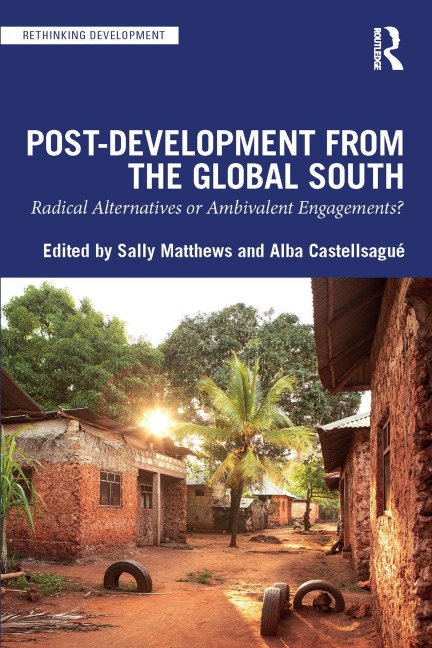
Post-development advocates and decolonial thinkers are calling for radical alternatives to development, but how do these ideals sit with the day-to-day reality of marginalised communities struggling with poverty, precarity, and the deprivation of human rights? This book investigates how post-development alternatives are being understood and negotiated on the ground in the Global South. Indigenous concepts and practices attributed to people in the Global South are seen by post-development thinkers as offering transformative alternatives to dominant development models of progress and economic growth. For example, buen vivir from particular regions of South America points to a 'culture of life' and ubuntu in Southern Africa emphasises human connectedness and mutuality. Such terms are associated with social and environmental sustainability, and a greater connection to Southern epistemologies. Drawing on extensive fieldwork, this book takes us directly to Global South communities from around the world, to consider the complex ways in which they negotiate the ideas and practices associated with (post)development, and their views on the supposed indigenous alternatives. The book encourages a contextual approach that embraces the tensions and contradictions that exist within different communities. Taking the reader from abstract post-development theory right into the heart of communities directly impacted by development, this book will be an important guide for students, researchers and practitioners looking for better ways to address the desires and aspirations of marginalised communities in the Global South.
Sally Matthews is an Associate Professor in the Department of Political and International Studies at Rhodes University, South Africa. She is interested in a rather eclectic range of topics - post-development theory, the politics of knowledge production on Africa, the role of NGOs in Africa, higher education transformation and decolonisation - which are all loosely related to the question of whether and how those who occupy positions of privilege can act in the interests of the marginalised and oppressed. Alba Castellsagué is an Assistant Professor (Lecturer) in the Pedagogy Department at the University of Girona (UdG). She has teaching and research experience in the fields of education and international development, gender equality and migration studies.
1. Introduction PART I: AMBIVALENCE, NOSTALGIA, COMPLEXITY 2. In search of post-development alternatives: ubuntu and development in South Africa 3. 'Hardware' and 'software' bikas: Nepali notions on development and its alternatives 4. Development as nostalgia and reverie in Eastern Rwanda 5. CAMPFIRE and the politics of ambivalence: attitudes towards development in Kanyemba, Zimbabwe PART II: BUEN VIVIR, LIVING WELL AND WELLBEING 6. The vivir bien rhetoric and Afro-Bolivian women's struggles for recognition and inclusive citizenship 7. Revisiting the indigeneity-modernity relationship: vivir bien in the Bolivian Highlands 8. 'Money is a universal need': exploring Indigenous peoples' engagement with externally-led development in the Peruvian Amazon PART III: ALTERNATIVES? 9. Economies of solidarity in Tehran: new commons and diverse economies on the margins? 10. Ontology in action: ecocentrism as defence of place in Indigenous social movement practices, South Africa 11. Ambivalent perspectives on degrowth and alternatives to development: exploring notions of kalamboan and ginhawa in Siquijor province, Philippines 12. Conclusion
Dieses eBook wird im PDF-Format geliefert und ist mit einem Adobe Kopierschutz (DRM) versehen. Sie können dieses eBook mit allen Geräten lesen, die das PDF-Format und den Adobe Kopierschutz (DRM) unterstützen.
Zum Beispiel mit den folgenden Geräten:
• tolino Reader
Laden Sie das eBook direkt über den Reader-Shop auf dem tolino herunter oder übertragen Sie das eBook auf Ihren tolino mit einer kostenlosen Software wie beispielsweise Adobe Digital Editions.
• Sony Reader & andere eBook Reader
Laden Sie das eBook direkt über den Reader-Shop herunter oder übertragen Sie das eBook mit der kostenlosen Software Sony READER FOR PC/Mac oder Adobe Digital Editions auf ein Standard-Lesegeräte mit epub- und Adobe DRM-Unterstützung.
• Tablets & Smartphones
Möchten Sie dieses eBook auf Ihrem Smartphone oder Tablet lesen, finden Sie hier unsere kostenlose Lese-App für iPhone/iPad und Android Smartphone/Tablets.
• PC & Mac
Lesen Sie das eBook direkt nach dem Herunterladen mit einer kostenlosen Lesesoftware, beispielsweise Adobe Digital Editions, Sony READER FOR PC/Mac oder direkt über Ihre eBook-Bibliothek in Ihrem Konto unter „Meine eBooks“ - „online lesen“.
Schalten Sie das eBook mit Ihrer persönlichen Adobe ID auf bis zu sechs Geräten gleichzeitig frei.
Bitte beachten Sie, dass die Kindle-Geräte das Format nicht unterstützen und dieses eBook somit nicht auf Kindle-Geräten lesbar ist.