Und dann auf "Zum Home-Bildschirm [+]".

Stöbern
genialokal zum Startbildschirm hinzufügen
Installieren Sie die genialokal App auf Ihrem Startbildschirm für einen schnellen Zugriff und eine komfortable Nutzung.
Installieren Sie die genialokal App auf Ihrem Startbildschirm für einen schnellen Zugriff und eine komfortable Nutzung.

Ihr gewünschter Artikel ist in 0 Buchhandlungen vorrätig - wählen Sie hier eine Buchhandlung in Ihrer Nähe aus:

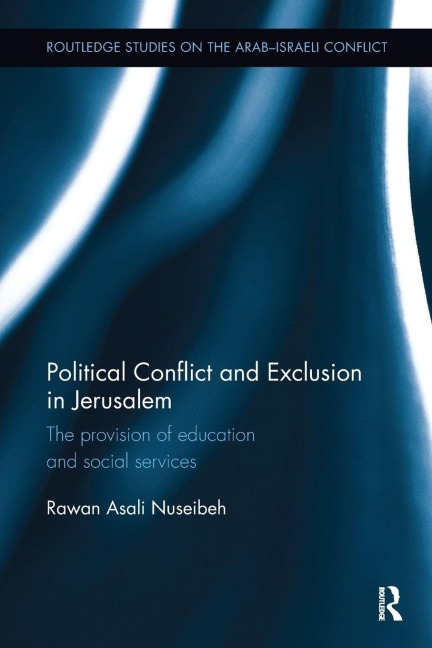

Political Conflict and Exclusion in Jerusalem offers a detailed description of the structure of the education sector in East Jerusalem with its four main providers; the Palestinian Authority through Awqaf schools, the Israeli Authority through municipal schools, the United Nations Relief and Works Agency and private schools. Its study reveals that there is no single body that oversees the provision of educational services in the city to ensure that the services provided are sufficient and of quality. Employing a qualitative research strategy with semi-structured interviews and focus groups in Palestinian and Israeli schools, this book offers a comprehensive and revealing comparison of the educational services provided to both their students. It explores how Palestinian and Israeli students routinely receive vastly different learning opportunities, in terms of school funding, qualified staff, school facilities and school programmes, which as a result disempowers Palestinians and ensures an Israeli Jewish hegemony over the city.
Rawan Asali Nuseibeh completed her PhD fellowship at Durham University in 2013 at the Schools of Applied Social Sciences and of Government and International Affairs. Her field of research has included educational and social exclusion in areas of conflict and fragility, with a focus on Jerusalem.
Introduction 1 Education, Society and the State 2 The Case of Israel 3 Educational Policies in the State of Israel 4 The Structure of Educational Provisions in East Jerusalem 5 The Infrastructure of the Education Sector in East Jerusalem 6 Human Resources in the Education Sector 7 Educational Programs and Parental Support 8 The Taught Curriculums 9 The Consequences of Educational Inequality Conclusion