Und dann auf "Zum Home-Bildschirm [+]".

Stöbern
genialokal zum Startbildschirm hinzufügen
Installieren Sie die genialokal App auf Ihrem Startbildschirm für einen schnellen Zugriff und eine komfortable Nutzung.
Installieren Sie die genialokal App auf Ihrem Startbildschirm für einen schnellen Zugriff und eine komfortable Nutzung.

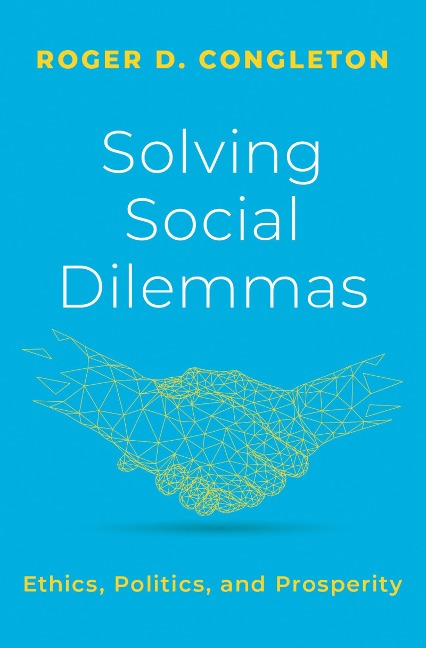
An original account of the role of ethical dispositions in the development of prosperous commercial societies In Solving Social Dilemmas, Roger Congleton provides an explanation for the rise of prosperous commercial societies. Congleton argues that an endless series of social, economic, and political dilemmas have to be solved or ameliorated to sustain social and economic progress and suggests that the most plausible solutions involve internalized rules of conduct. Previous foundational texts suggest that institutions often emerge to address social dilemmas, but Congleton focuses on a solution that is arguably prior to formal institutions: the internalization of principles and rules of conduct that directly affect individual behavior and thereby group outcomes. Supported by an intellectual and analytical history of the emergence of commercial societies in the West, the book uses elementary game theory to review a few dozen social, economic, and political dilemmas that need to be solved if prosperous societies are to emerge. It shows that ethical dispositions are likely to play important roles in solutions to all the problems examined-and arguably many more. Congleton does not claim that commercial networks result from ethical as opposed to unethical behavior, but that some ethical systems include rules that support the development of extended market networks, specialization, and innovation. As evidence the book traces how the increasing support of commerce in ethical theories in the seventeenth, eighteenth, and nineteenth centuries helped launch "the great acceleration" and the emergence of the first truly commercial societies. By combining substantive theoretical work with analysis of centuries of ethical writings, Solving Social Dilemmas reveals that commercial societies have moral foundations.
Roger D. Congleton is the BB&T Professor of Economics at West Virginia University. He joined the Department of Economics at West Virginia University in 2011, after a long association with the Department of Economics and Center for Study of Public Choice at George Mason University. He is currently co-editor of Constitutional Political Economy, a past president of the Public Choice Society, and a past director of the Center for Study of Public Choice. He has published and lectured widely on the political economy of public policy, constitutional history, and constitutional theory.
Chapter 1: Grounding Ideas and a Short Overview PART I: Social Dilemmas, Ethics, and the Origins of Communities and Commerce Chapter 2: Ethics and the Quality of Life in Communities Chapter 3: Ethics, Exchange, and Production Chapter 4: Ethics and Neoclassical Price Theory Chapter 5: Ethics and Economic Progress PART II: Ethics and the Political Economy of Prosperity Chapter 6: Ethics, Customary Law, and Law Enforcement Chapter 7: Ethics and Democratic Governance Chapter 8: Choosing a Good Society PART III: Ethical Theories and Commerce Chapter 9: A Beginning: Aristotle on Ethics, Markets, and Politics Chapter 10: From Renaissance to Early Enlightenment Chapter 11: Classical Liberalism, Ethics, and Commerce Chapter 12: Utilitarianism: Commerce and the Good Society Chapter 13: The Arguments Revisited and Summarized References