Und dann auf "Zum Home-Bildschirm [+]".

Stöbern
genialokal zum Startbildschirm hinzufügen
Installieren Sie die genialokal App auf Ihrem Startbildschirm für einen schnellen Zugriff und eine komfortable Nutzung.
Installieren Sie die genialokal App auf Ihrem Startbildschirm für einen schnellen Zugriff und eine komfortable Nutzung.
Ihr gewünschter Artikel ist in 0 Buchhandlungen vorrätig - wählen Sie hier eine Buchhandlung in Ihrer Nähe aus:

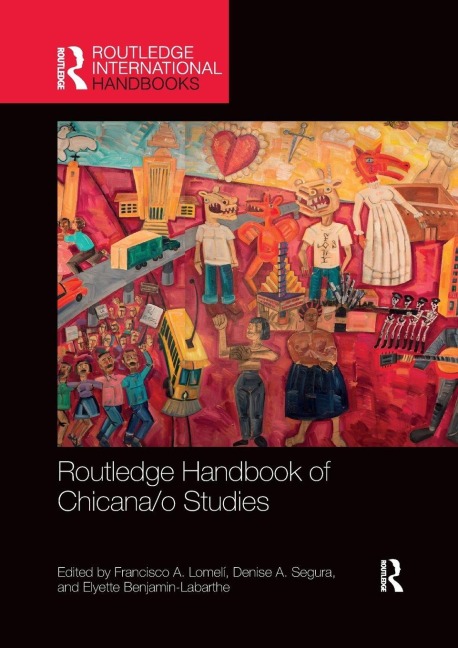
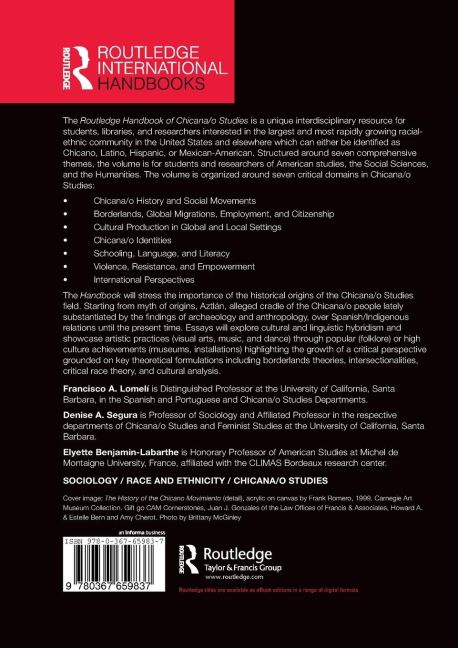
The Routledge Handbook of Chicana/o Studies is a unique interdisciplinary resource for students, libraries, and researchers interested in the largest and most rapidly growing racial-ethnic community in the United States and elsewhere which can either be identified as Chicano, Latino, Hispanic, or Mexican-American.
Francisco A. Lomelí is Distinguished Professor at the University of California, Santa Barbara, in the Spanish and Portuguese and Chicana/o Studies Departments. His areas of interest and expertise include Chicana/o literature and culture, Southwest literary history, Latin American literature (the novels and certain regions like Central America, Mexico, parts of South America), Spanglish, and literary theory pertaining to Chicana/o Studies. Denise A. Segura is Professor of Sociology and Affiliated Professor in the respective departments of Chicana/o Studies and Feminist Studies at the University of California, Santa Barbara. Recipient of the Lifetime Distinguished Contributions to Research, Teaching and Service from the Latina/o Sociology Section of the American Sociological Association, she publishes widely in Chicana feminist studies borderlands studies, and Chicana/Mexicana employment. She co-edited with Patricia Zavella, Women and Migration in the U.S.-Mexico Borderlands, Duke University Press, 2007. Elyette Benjamin-Labarthe is Honorary Professor of American Studies at Michel de Montaigne University, France, affiliated with the CLIMAS Bordeaux research center, and has published extensively on Chicano poetry, literature, culture, arts, drama, cinema, on the literature of immigration, and transcultural phenomena. Her main contributions to the field, as author, co-author, editor, or co-editor are Vous Avez Dit Chicano, Ecritures Hispaniques aux Etats-Unis: Mémoire et Mutations, Cinéma américain: aux marches du Paradis, Cinéma métis: le cinéma de la frontière Mexique/Etats-Unis, Confrontations et Métissages. She has been conferred the distinction of Knight of the Legion of Honor for services rendered to French research and that of Commander of Academic Palms for her educational activities.
Introduction: Handbook of Chicana/o Studies, Francisco A. Lomelí, Denise A. Segura and Elyette Benjamin-Labarthe Part I. Chicana/o History and Social Movements Introduction to Chicana/o History and Social Movements 1. What is Aztlán?: Homeland, Quest, Female Place, David Carrasco 2. Chicano History- A General Approach, Mario T. García 3. Recent Chicana/o Historiography: Advances, Shortcoming, and Challenges, Alex M. Saragoza 4. The Chicano Movement, Ramón A. Gutiérrez 5. A Genealogy of Chicana History, the Chicana Movement, and Chicana Studies, Miroslava Chávez-García 6. Bilingual Education: History, Policy, and Insights from Critical Race Theory, Grace P. McField Part II. Borderlands: Contested (Im)migrations, Culture and Citizenship Introduction to Borderlands: Contested (Im)migrations, Culture and Citizenship 7. México y lo Mexicano in Aztlán: Transborder Economic, Cultural and Political Links, David R. Maciel and María Rosa García-Acevedo 8. Immigration, Latinos, and the Media, Leo R. Chávez 9. Mobilizing for Life: Illegality, Organ Transplants, and Migrant Biosociality, Jonathan Xavier Inda 10. Discourses of Violence and Peace: About and On the U.S.-Mexico Border, María-Socorro Tabuenca 11. Reconstructing Home in the Borderlands, Patricia Zavella Part III.Cultural Production in Local and Global Settings Introduction to Cultural Production in Local and Global Settings 12. Colonial, De-colonial, and Transnational Choreographies in Ritual Danzas and Popular Bailes of Greater Mexico, Enrique R. Lamadrid 13