Stöbern
genialokal zum Startbildschirm hinzufügen
Installieren Sie die genialokal App auf Ihrem Startbildschirm für einen schnellen Zugriff und eine komfortable Nutzung.
Installieren Sie die genialokal App auf Ihrem Startbildschirm für einen schnellen Zugriff und eine komfortable Nutzung.
Tippen Sie einfach auf Teilen:
 Und dann auf "Zum Home-Bildschirm [+]".
Ihr gewünschter Artikel ist in 0 Buchhandlungen vorrätig - wählen Sie hier eine Buchhandlung in Ihrer Nähe aus:

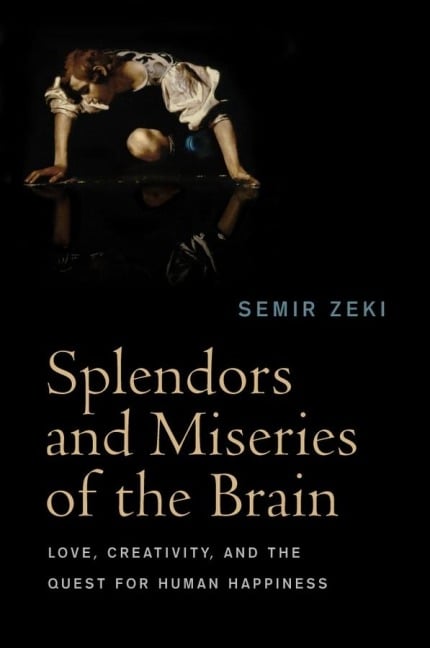
Splendors and Miseries of the Brain examines the elegant and efficient machinery of the brain, showing that by studying music, art, literature, and love, we can reach important conclusions about how the brain functions. - discusses creativity and the search for perfection in the brain - examines the power of the unfinished and why it has such a powerful hold on the imagination - discusses Platonic concepts in light of the brain - shows that aesthetic theories are best understood in terms of the brain - discusses the inherited concept of unity-in-love using evidence derived from the world literature of love - addresses the role of the synthetic concept in the brain (the synthesis of many experiences) in relation to art, using examples taken from the work of Michelangelo, Cézanne, Balzac, Dante, and others
Semir Zeki is a visual neurobiologist in the Department of Cognitive Neurology at University College London. Zeki has pioneered the study of the primate visual brain and furthered research on how affective states are generated by visual inputs. He has published extensively in his field, including the books Inner Vision: an Exploration of Art and the Brain (1999) and A Vision of the Brain (Wiley-Blackwell, 1993), and has also co-authored a book with the late French painter Balthus, entitled La Quête de l'essentiel (1995).
List of Figures vii Note to the Reader ix Acknowledgments x Introduction 1 Part I Abstraction and the Brain 7 1 Abstraction 9 2 The Brain and its Concepts 21 3 Inherited Brain Concepts 26 4 The Distributed Knowledge-Acquiring System of the Brain 35 5 The Acquired Synthetic Brain Concepts 42 6 The Synthetic Brain Concept and the Platonic Ideal 46 7 Creativity and the Source of Perfection in the Brain 50 Part II Brain Concepts and Ambiguity 59 8 Ambiguity in the Brain and in Art 61 9 Processing and Perceptual Sites in the Brain 65 10 From Unambiguous to Ambiguous Knowledge 73 11 Higher Levels of Ambiguity 87 Part III Unachievable Brain Concepts 99 Introduction 101 12 Michelangelo and the Non finito 102 13 Paul Cézanne and the Unfinished 111 14 Unfinished Art in Literature 120 Part IV Brain Concepts of Love 129 Conte by Arthur Rimbaud 131 15 The Brain's Concepts of Love 132 16 The Neural Correlates of Love 137 17 Brain Concepts of Unity and Annihilation in Love 150 18 Sacred and Profane 158 19 The Metamorphosis of the Brain Concept of Love in Dante 170 20 Wagner and Tristan und Isolde 182 21 Thomas Mann and Death in Venice 193 22 A neurobiological analysis of Freud's Civilization and its Discontents 203 Notes 213 Index 227