Und dann auf "Zum Home-Bildschirm [+]".

Stöbern
genialokal zum Startbildschirm hinzufügen
Installieren Sie die genialokal App auf Ihrem Startbildschirm für einen schnellen Zugriff und eine komfortable Nutzung.
Installieren Sie die genialokal App auf Ihrem Startbildschirm für einen schnellen Zugriff und eine komfortable Nutzung.
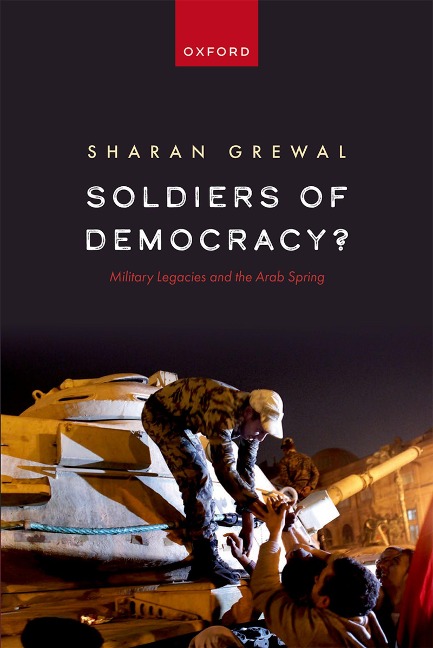
Why do some militaries support and others thwart transitions to democracy? After the Arab Spring revolutions, why did Egypt's military stage a coup to end the transition? Conversely, why did Tunisia's military initially support the transition, only to later facilitate the elected president's dismantling of democracy? In Soldiers of Democracy? Military Legacies and the Arab Spring, Sharan Grewal argues that a military's behavior under democracy is shaped by how it had been treated under autocracy. Autocrats who had empowered their militaries produce soldiers who will repress protests and stage coups to preserve their privileges. Meanwhile, autocrats who had marginalized their militaries produce soldiers who support democratization, but who are also more susceptible to incumbent takeovers and civil wars. The dictator's choice to either empower or marginalize the military thus creates legacies that shape both the likelihood of democratization and the forms by which it breaks down. Drawing on over 140 interviews with civilian and military leaders, and three surveys of military personnel, this scholarly volume illustrates this theory through detailed case studies of Egypt and Tunisia. Grewal also probes the generalizability of the theory through a cross-national analysis of all countries between 1946-2010. Overall, he brings the military front and center to the study of democratic transition and consolidation.
Sharan Grewal is an Assistant Professor of Government at William & Mary, a non-resident fellow at the Brookings Institution, and a non-resident senior fellow at the Project on Middle East Democracy. His research has been published in the American Political Science Review and the American Journal of Political Science, among other outlets, and has received funding from the National Science Foundation, the Henry Luce Foundation, the John Templeton Foundation, and the Smith Richardson Foundation.
- 1: Introduction - 2: A Theory of Military Behavior - 3: Cross-National Analysis - 4: Case Selection: Egypt and Tunisia - 5: Egypt: Empowering the Military - 6: Egypt: Repression and Revolution - 7: Egypt: A Coup against Democracy - 8: Tunisia: Marginalizing the Military - 9: Tunisia: Shirking in the Revolution - 10: Tunisia: Supporting the Transition - 11: Tunisia: Facilitating the Takeover - 12: Surveying the Military - 13: Conclusion - Bibliography
Dieses eBook wird im PDF-Format geliefert und ist mit einem Adobe Kopierschutz (DRM) versehen. Sie können dieses eBook mit allen Geräten lesen, die das PDF-Format und den Adobe Kopierschutz (DRM) unterstützen.
Zum Beispiel mit den folgenden Geräten:
• tolino Reader
Laden Sie das eBook direkt über den Reader-Shop auf dem tolino herunter oder übertragen Sie das eBook auf Ihren tolino mit einer kostenlosen Software wie beispielsweise Adobe Digital Editions.
• Sony Reader & andere eBook Reader
Laden Sie das eBook direkt über den Reader-Shop herunter oder übertragen Sie das eBook mit der kostenlosen Software Sony READER FOR PC/Mac oder Adobe Digital Editions auf ein Standard-Lesegeräte mit epub- und Adobe DRM-Unterstützung.
• Tablets & Smartphones
Möchten Sie dieses eBook auf Ihrem Smartphone oder Tablet lesen, finden Sie hier unsere kostenlose Lese-App für iPhone/iPad und Android Smartphone/Tablets.
• PC & Mac
Lesen Sie das eBook direkt nach dem Herunterladen mit einer kostenlosen Lesesoftware, beispielsweise Adobe Digital Editions, Sony READER FOR PC/Mac oder direkt über Ihre eBook-Bibliothek in Ihrem Konto unter „Meine eBooks“ - „online lesen“.
Schalten Sie das eBook mit Ihrer persönlichen Adobe ID auf bis zu sechs Geräten gleichzeitig frei.
Bitte beachten Sie, dass die Kindle-Geräte das Format nicht unterstützen und dieses eBook somit nicht auf Kindle-Geräten lesbar ist.