Stöbern
genialokal zum Startbildschirm hinzufügen
Installieren Sie die genialokal App auf Ihrem Startbildschirm für einen schnellen Zugriff und eine komfortable Nutzung.
Installieren Sie die genialokal App auf Ihrem Startbildschirm für einen schnellen Zugriff und eine komfortable Nutzung.
Tippen Sie einfach auf Teilen:
 Und dann auf "Zum Home-Bildschirm [+]".
Ihr gewünschter Artikel ist in 0 Buchhandlungen vorrätig - wählen Sie hier eine Buchhandlung in Ihrer Nähe aus:

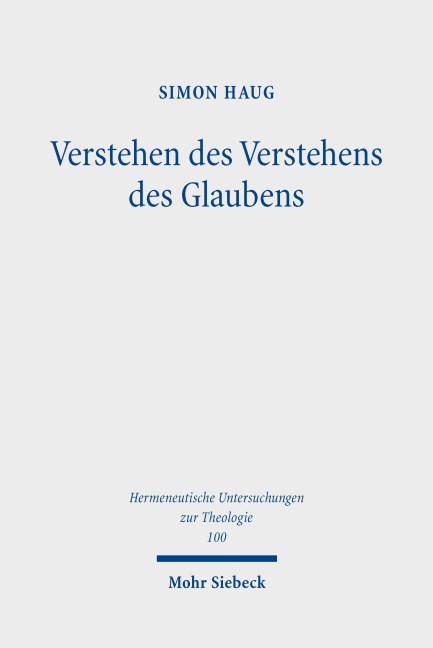
Twentieth-century hermeneutical theology understands faith as a distinctive mode of understanding. Ernst Fuchs, Gerhard Ebeling, and Eberhard Jüngel build upon Rudolf Bultmann's programmatic formula of "faith and understanding" and develop it into an independent theological conception. The central thesis of this study: This conception performs a far-reaching operation by identifying faith with understanding. Understanding advances to become the normative guiding category and mode of execution for theological interpretations of God, the self, and the world; its operative function remains largely unexplained in the process. Simon Haug subjects this identification to a systematic critical examination, problematizes the close coupling of faith and understanding, and develops a disentangling differentiation of both modes with a particular focus on non-understanding. He first draws on Heidegger's existential-ontological analysis of understanding as a conceptual framework, then reconstructs the constellation of faith and understanding in Fuchs, Ebeling, and Jüngel, and concludes with a critical evaluation in which identification, soteriological overloading, and insufficient reflection on the understanding of understanding are problematized. Subsequently, the author specifically inquires into the understanding of understanding: He begins with a critique of hermeneutics (Hörisch, Lévinas, Waldenfels), situates the identified problem within current hermeneutical discourses through an exemplary engagement with Emil Angehrn's negative hermeneutics, and culminates in a cartography of understanding that systematically distinguishes between understanding, misunderstanding, and non-understanding. Finally, he realigns the constellation: He marks a lasting difference between faith and understanding, opens up further horizons of discourse, identifies non-understanding as a constitutive dimension of both understanding and faith, and thereby breaks the coupling of faith/understanding and unfaith/non-understanding.
Born 1994; studied Protestant Theology in Ewersbach and Heidelberg; 2025 doctorate (Dr. theol.) at Heidelberg University; 2025-26 Research Associate at FEST Heidelberg; since 2026 Pastor of the Free Evangelical Church in Dortmund.
A Einleitung: Glauben und Verstehen
I. Glauben - Verstehen
II. Verstehen des Verstehens des Glaubens
III. Aufbau und Gliederung
B Verstehen des Glaubens
I. Verstehen verstehen in der hermeneutischen Philosophie
II. Das Verstehen des Glaubens - im Kontext der Hermeneutischen Theologie
III. Das Verstehen des Verstehens des Glaubens in der Hermeneutischen Theologie - Kritische Auswertung
C Verstehen des Verstehens
I. Kritik des Verstehens
II. Das Verstehen des Verstehens - nach der Hermeneutikkritik
III. Verstehen verstehen - eine Kartographie
D Verstehen des (Nicht-)Verstehens des Glaubens
I. Ergebnis der Arbeit: Zur bleibenden Differenz von Glauben und Verstehen
II. Diskurshorizonte
III. Verstehen des Nichtverstehens des Glaubens