
Stöbern
genialokal zum Startbildschirm hinzufügen
Installieren Sie die genialokal App auf Ihrem Startbildschirm für einen schnellen Zugriff und eine komfortable Nutzung.
Installieren Sie die genialokal App auf Ihrem Startbildschirm für einen schnellen Zugriff und eine komfortable Nutzung.
Tippen Sie einfach auf Teilen:
 Und dann auf "Zum Home-Bildschirm [+]".
Bei genialokal.de kaufen Sie online bei Ihrer lokalen, inhabergeführten Buchhandlung!
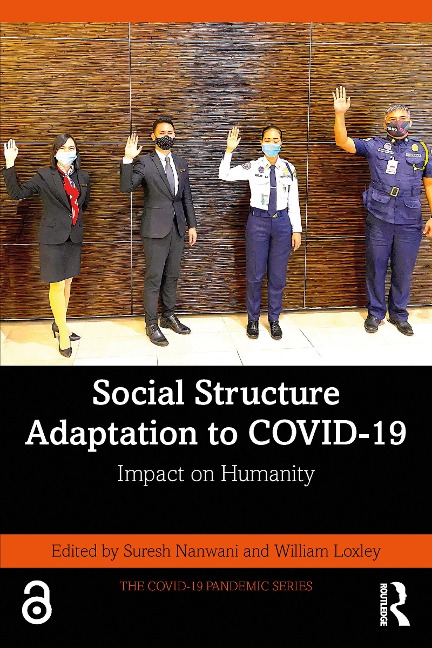
Social Structure Adaptation to COVID-19 offers global, interdisciplinary perspectives that examine how the COVID-19 pandemic has altered the development trajectory of schools, public health, the workforce, and technology adoption. It explores social themes in society, economy, policy, and culture and draws on a social framework to describe key functions of societal adaptation to the pandemic. Edited by Suresh Nanwani and William Loxley, the volume is grounded in the study of system components and their objectives to improve overall well-being given the ill effects of the COVID-19 pandemic. Chapters explore interconnected social networks and how sectors restructured themselves to stabilize or transform society. International contributors from 20 countries offer case studies that highlight key themes including personal connectivity, societal equality, well-being, big data, and national resilience. They predict how impactful the pandemic might be in reshaping the future and assess how the COVID-19 pandemic has affected school system shutdown, public health collapse, business closures, public policy failure, and technology-driven social media acceleration. Offering insights into how institutions and sectors work together in times of crisis, and how COVID-19 has restructured social behavior, Social Structure Adaptation to COVID-19 will be valuable reading for scholars and students of sociology, political science, anthropology, comparative international development, psychology, and education. It will also be of interest to policymakers concerned with education, work and organizations, and media and technology. The Open Access version of this book, available at www.taylorfrancis.com, has been made available under a Creative Commons Attribution-Non Commercial-No Derivatives (CC-BY-NC-ND) 4.0 international license.
Suresh Nanwani is Professor in Practice in the School of Government and International Affairs at Durham University, the United Kingdom. He has more than 35 years of development work experience in international organizations, including the World Bank, the Asian Development Bank, and the European Bank for Reconstruction and Development. He is a certified mediator with the Center for Effective Dispute Resolution, the United Kingdom, and an associate certified coach with the International Coaching Federation. He is the author of Organization and Education Development: Reflecting and Transforming in a Self-Discovery Journey (Routledge, 2021). William Loxley is a former principal education specialist at the Asian Development Bank and executive director of the International Association for the Evaluation of Academic Achievement (IEA) headquartered in the Netherlands. He is now retired and living in the Philippines, and he maintains an advisory role in education at the above institutions. He also previously worked at the World Bank, the Ford Foundation, the Fulbright Program in Vietnam, and the Peace Corps in the Philippines.
1. Society and COVID-19 2. Identifying international essays about COVID-19 3. Awakening from a paradise lost: Experiences and lessons of the pandemic Part II: Educational opportunity and social mobility 4. Introduction 5. Personal development in a time of crisis 6. Tails we go, heads we stay 7. Adapting to virtual education during the COVID-19 pandemic in Peru 8. The plight of virtual education in India due to COVID-19 9. COVID-19 and tertiary education: Experiences in Lesotho institutions 10. Lifelong learning as a powerful force in the post-pandemic world Part III: Public policy and risk management 11. Introduction 12. New Zealand: Global connectivity and digital diplomacy 13. Brazil in crisis mode: Institutions in times of uncertainty 14. Legal practice in Kenya: Embracing automation and e-judiciary 15. The pandemic and post-pandemic aftershocks: Whither legal education? 16. Change and continuity: COVID-19 and the Philippine legal system 17. Digital technology: A best friend for implementing COVID-19 policy in China 18. The goldfish and the net(work) Part IV: Diversity in workforce behavior 19. Introduction 20. Entering the workforce in the COVID-19 era 21. How a Gen Y became a Gen Z at heart 22. Unlocking from lockdown: Reframing the future through appreciative dialogue 23. COVID-19 and moving to the new normal 24. Financial literacy: Its relevance in the education curriculum 25. Self-coaching for pandemic survivors Part V: Technology and culture 26. Introduction 27. Will technology replace or recreate humans? 28. Privacy issues in online education technologies in China 29. Digital technology during COVID-19 in global living educational theory research 30. I'm gonna let it shine: Local musicians in the Virginia countryside during the pandemic 31. Emotional and physical isolation in a Latino community 32. Braving COVID-19 through the Gross National Happiness way in Bhutan 33. A resurrection: Human connections and beyond Part VI: Conclusion 34. Social structure adaptability to the pandemic