Und dann auf "Zum Home-Bildschirm [+]".

Stöbern
genialokal zum Startbildschirm hinzufügen
Installieren Sie die genialokal App auf Ihrem Startbildschirm für einen schnellen Zugriff und eine komfortable Nutzung.
Installieren Sie die genialokal App auf Ihrem Startbildschirm für einen schnellen Zugriff und eine komfortable Nutzung.
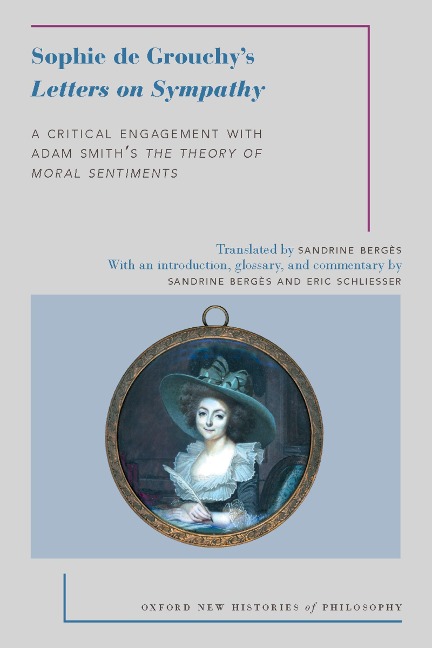
Adam Smith, in his The Theory of Moral Sentiments, largely left his readers to develop his argument's full implications. Many philosophers famously did so, including Mary Wollstonecraft, Thomas Paine, and John Millar, among others, but less known are Sophie de Grouchy's own contributions, presented here alone in translation. Grouchy (1764-1822) published her Letters on Sympathy in 1798 together with her French translation of The Theory of Moral Sentiments. While Grouchy's Letters mainly engage critically with Smith's philosophical analysis of sympathy, they offer valuable perspectives and original thoughts about the relationship of emotional and moral development to legal, economic, and political reform. In particular, Grouchy sought to understand how the mechanisms of sympathy could help the development of new social and political institutions after the revolution. Her Letters further contain profound reflections on the dangers of demagoguery, the nature of tragedy, and the roles of love and friendship. Though ostensibly a commentary on Smith, the Letters stand in their own right as significant and original contributions to political philosophy. This new translation by Sandrine Bergès of a text by a forgotten female philosopher illuminates new inroads to Enlightenment and feminist thought and reveals insights that were far ahead of their time. The volume includes a critical introduction, explanatory notes, and a glossary of terms to provide critical and historical analysis for the novice reader.
Sandrine Bergès is Associate Professor in Philosophy at Bilkent University in Ankara. Her books include: The Routledge Companion to Wollstonecraft's A Vindication of the Rights of Woman (2013) and A Feminist Perspective on Virtue Ethics (Palgrave, 2015). She is also co-editor of The Social and Political Philosophy of Mary Wollstonecraft (Oxford University Press, 2017) and the forthcoming The Wollstonecraftian Mind with Eileen Hunt Botting and Alan Coffee (Routledge). Eric Schliesser is Professor of Political Science at the University of Amsterdam and Visiting Scholar in the Smith Institute for Political Economy and Philosophy at Chapman University. He has published widely on early modern philosophy and sciences, including political economy as well as recent philosophy of economics. He is author of Adam Smith: Systematic Philosopher and Public Thinker (2017) and editor of Sympathy: A History (2015), The Oxford Handbook of Isaac Newton (forthcoming), and Ten Neglected Classics of Philosophy (2016), all for Oxford University Press.
Series Editors' Foreword I. Preface and Acknowledgments II. Note on the text and translation III. Introduction 1. Life and Context 2. The Text 3.Themes IV. Translation 4. Letter I 5. Letter II 6. Letter III 7. Letter IV 8. Letter V 9. Letter VI 10. Letter VII 11. Letter VIII V. Glossary VI. Further readings VII. Bibliography
Dieses eBook wird im PDF-Format geliefert und ist mit einem Adobe Kopierschutz (DRM) versehen. Sie können dieses eBook mit allen Geräten lesen, die das PDF-Format und den Adobe Kopierschutz (DRM) unterstützen.
Zum Beispiel mit den folgenden Geräten:
• tolino Reader
Laden Sie das eBook direkt über den Reader-Shop auf dem tolino herunter oder übertragen Sie das eBook auf Ihren tolino mit einer kostenlosen Software wie beispielsweise Adobe Digital Editions.
• Sony Reader & andere eBook Reader
Laden Sie das eBook direkt über den Reader-Shop herunter oder übertragen Sie das eBook mit der kostenlosen Software Sony READER FOR PC/Mac oder Adobe Digital Editions auf ein Standard-Lesegeräte mit epub- und Adobe DRM-Unterstützung.
• Tablets & Smartphones
Möchten Sie dieses eBook auf Ihrem Smartphone oder Tablet lesen, finden Sie hier unsere kostenlose Lese-App für iPhone/iPad und Android Smartphone/Tablets.
• PC & Mac
Lesen Sie das eBook direkt nach dem Herunterladen mit einer kostenlosen Lesesoftware, beispielsweise Adobe Digital Editions, Sony READER FOR PC/Mac oder direkt über Ihre eBook-Bibliothek in Ihrem Konto unter „Meine eBooks“ - „online lesen“.
Schalten Sie das eBook mit Ihrer persönlichen Adobe ID auf bis zu sechs Geräten gleichzeitig frei.
Bitte beachten Sie, dass die Kindle-Geräte das Format nicht unterstützen und dieses eBook somit nicht auf Kindle-Geräten lesbar ist.