Und dann auf "Zum Home-Bildschirm [+]".

Stöbern
genialokal zum Startbildschirm hinzufügen
Installieren Sie die genialokal App auf Ihrem Startbildschirm für einen schnellen Zugriff und eine komfortable Nutzung.
Installieren Sie die genialokal App auf Ihrem Startbildschirm für einen schnellen Zugriff und eine komfortable Nutzung.
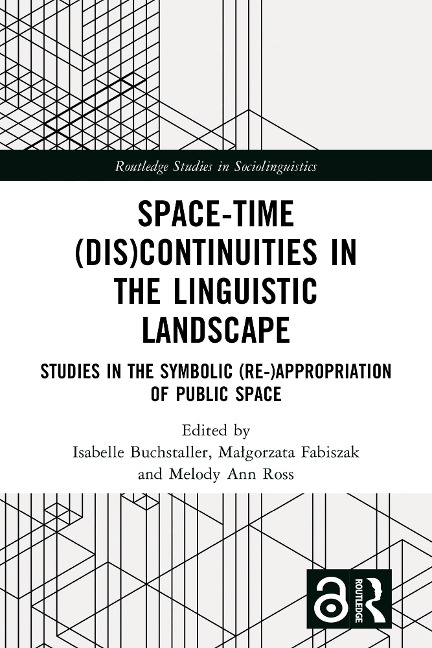
This collection spotlights the diachronic dimensions of the linguistic landscape, the importance of exploring temporal dissonances in historical events in order to better understand semiotic, political, and social transformations across different communities over the last century. The volume seeks to expand the current borders of linguistic landscape (LL) research by situating the analysis of signs in the LL within their time-space organization, which has been understudied in existing scholarship. The book, featuring chapters from established and emerging scholars, argues that a focus on the historicity of the city text can reveal unique insights into the role of semiotic processes as precursors and support mechanisms for political and social changes. The collection is structured around different temporal clusters and geographic contexts across the globe where shorter and longer waves of politically driven resemioticization can be most sharply observed - post-colonial communities; post-communist societies; and recent and current sociopolitical upheavals. Taken together, the volume proposes a kaleidoscope view of the complex temporalities that underpin multimodal discourses in contested public spaces, offering new directions for LL research. This book will be of interest to students and scholars in sociolinguistics, discourse analysis, semiotics, visual anthropology, and political science. The Introduction and Chapter 8 of this book is freely available as a downloadable Open Access PDF at http://www.taylorfrancis.com under a Creative Commons Attribution-Non Commercial-No Derivatives (CC-BYNC-ND) 4.0 license.
Isabelle Buchstaller is Professor of English Linguistics and Director of the Sociolinguistics Lab at the University of Duisburg-Essen, Germany. Malgorzata Fabiszak is a professor at the Faculty of English and Head of the Department of Cognitive Linguistics at Adam Mickiewicz University, Poznan, Poland. Melody Ann Ross is a sociolinguist and researcher in the Sociolinguistics Lab at the University of Duisburg-Essen, Germany.
List of figures List of tables List of contributors Introduction (Isabelle Buchstaller, Malgorzata Fabiszak, Melody Ann Ross) Part I: Post-colonial transitions in the LL 1. Plantations, place-naming, and the contested afterlife of slavery (Derek H. Alderman) 2. The spatial politics of the commemorative street names of Hong Kong (Wenchuan Huang) 3. Multilingualism for whom in Rwanda? The nexus of power and practices (Tove Rosendal) 4. Politics in the linguistic landscape of Dili, Timor-Leste (Melody Ann Ross) 5. A tale of two cities: Recycling history through discourses of identity, nostalgia, and heritage (Rani Rubdy) 6. Timespace discontinuity in the LL - the case of two slavery sites in Ghana (Stefania Tufi, Robert Blackwood and Jemima Asabea Anderson) Part II: Post-communist transformations of the LL 7. Murals as a carrier of change: The transformative power of a street art festival in a small Bulgarian village (Patryk Borowiak) 8. Commemorative street naming practices in the border towns Frankfurt (Oder) / Slubice (Malgorzata Fabiszak, Isabelle Buchstaller, Anna Weronika Brzezinska, and Seraphim Alvanides) 9. Street name plates as a mirror of compromised decommunization: The influence of lower-level urban actors on the linguistic streetscape in Ukraine (Oleksiy Gnatiuk and Anatoliy Melnychuk) 10. The walls of peril: Belligerent symbolics of post-war murals in Bosnia-Herzegovina (Maida Kosatica) Part III: Current contestations in and of the LL 11. The Tree of Life synagogue shooting in Pittsburgh: Linguistic landscape, document, and poetic autoethnography analyses (David I. Hanauer) 12. Stonewall was a riot!: Politics in Cologne's Pride (Hannah Sawall) 13. Semiotic assemblages in the linguistic landscape of protest in Venezuela (Jessica Velásquez Urribarrí) 14. Code choice, humour, intertextuality, and the expression of emotions in the linguistic landscape of the women's protest in Poland 2020-2021 vs. the 1980s (Michal Wasilewski) 15. Production of representational spaces as the political construction of "New Turkey": Re/naming public spaces after the coup attempt (Ece Yoltay) Index
Dieses eBook wird im PDF-Format geliefert und ist mit einem Adobe Kopierschutz (DRM) versehen. Sie können dieses eBook mit allen Geräten lesen, die das PDF-Format und den Adobe Kopierschutz (DRM) unterstützen.
Zum Beispiel mit den folgenden Geräten:
• tolino Reader
Laden Sie das eBook direkt über den Reader-Shop auf dem tolino herunter oder übertragen Sie das eBook auf Ihren tolino mit einer kostenlosen Software wie beispielsweise Adobe Digital Editions.
• Sony Reader & andere eBook Reader
Laden Sie das eBook direkt über den Reader-Shop herunter oder übertragen Sie das eBook mit der kostenlosen Software Sony READER FOR PC/Mac oder Adobe Digital Editions auf ein Standard-Lesegeräte mit epub- und Adobe DRM-Unterstützung.
• Tablets & Smartphones
Möchten Sie dieses eBook auf Ihrem Smartphone oder Tablet lesen, finden Sie hier unsere kostenlose Lese-App für iPhone/iPad und Android Smartphone/Tablets.
• PC & Mac
Lesen Sie das eBook direkt nach dem Herunterladen mit einer kostenlosen Lesesoftware, beispielsweise Adobe Digital Editions, Sony READER FOR PC/Mac oder direkt über Ihre eBook-Bibliothek in Ihrem Konto unter „Meine eBooks“ - „online lesen“.
Schalten Sie das eBook mit Ihrer persönlichen Adobe ID auf bis zu sechs Geräten gleichzeitig frei.
Bitte beachten Sie, dass die Kindle-Geräte das Format nicht unterstützen und dieses eBook somit nicht auf Kindle-Geräten lesbar ist.