Und dann auf "Zum Home-Bildschirm [+]".

Stöbern
genialokal zum Startbildschirm hinzufügen
Installieren Sie die genialokal App auf Ihrem Startbildschirm für einen schnellen Zugriff und eine komfortable Nutzung.
Installieren Sie die genialokal App auf Ihrem Startbildschirm für einen schnellen Zugriff und eine komfortable Nutzung.
Ihr gewünschter Artikel ist in 0 Buchhandlungen vorrätig - wählen Sie hier eine Buchhandlung in Ihrer Nähe aus:

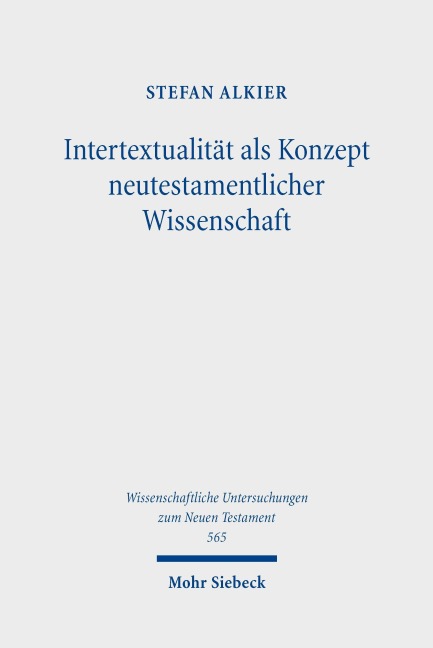
In his collected essays on international biblical intertextuality research, Stefan Alkier demonstrates what distinguishes the concept of intertextuality when both components - the spatial "inter" and the theoretical "textuality" - are taken at face value. In doing so, he highlights the innovative and productive contributions this concept makes to the exegesis of biblical texts. At the center is a decentralizing concept of meaning generation that takes into account the semiotic dynamics, performativity, complexity, and limitations of interpretive processes, as well as the inexhaustible richness of biblical texts in their intertextual and intermedial relationships and respective communicative contexts. Through concepts from intertextuality research, fundamental questions of human communication are thus brought into discussion: What can be meant by the "meaning" of a text, where and how is this meaning to be sought or constructed, and what characterizes the sign structure of a text? While the hermeneutic tradition of historical-critical exegesis is oriented toward the preposition "in" and presupposes a fixable locus of meaning, the preposition "inter" replaces the notion of a singular locus of meaning with a dynamic space of textual relationships that are constantly re-performed through the creative work of text producers and text recipients. The essays included in this volume offer a representative selection of Stefan Alkier's contributions to international intertextuality research over the past 25 years. The epilogue features an annotated bibliography looking back on 40 years of intertextuality research, as well as a previously unpublished in-depth interview with Richard B. Hays, the founder of New Testament intertextuality research, who passed away in 2025.
Born 1961; studied Protestant Theology, Philosophy and German Studies in Münster, Bonn and Hamburg; Professor of New Testament and History of the Early Church at the Faculty of Protestant Theology at Goethe University Frankfurt am Main.
Vorwort
Einleitung
Intertextualität als Konzept neutestamentlicher Wissenschaft
Theoretische Grundlegungen
Intertextualität. Annäherungen an ein texttheoretisches Paradigma
Die Bibel im Dialog der Schriften und das Problem der Verstockung in Mk 4. Intertextualität im Rahmen einer kategorialen Semiotik biblischer Texte
Erlesenes Sehen mit offenen Augen und allen Sinnen. Zum Verhältnis von Intratextualität, Intertextualität, Intermedialität und Visualisierung
Intertextuality Based on Categorical Semiotics
Intertextuality
New Testament Studies on the Basis of Categorical Semiotics
Der Kanon als intertextuelle Disposition
Unerhörte Stimmen. Bachtins Konzept der Dialogizität als Interpretationsmodell biblischer Polyphonie
Die Bibel - das Buch der Bücher. Kanongeschichtliche, theologische, intertextuelle und poetologische Anmerkungen zu einem Bestseller
Die Zumutung der Schriftauslegung. Sola scriptura als ihr Grund legendes hermeneutisches und methodisches Prinzip
Reading the Canon Intertextually. The Decentralization of Meaning
How Scripture interprets itself: The intertextual Composition of New Testament Literature as a Basis for the Canon of the Old and New Testament and the Canon as a Guide for Reading
Die Vielfalt der Stimmen und ihre intertextuelle Verknüpfung als Leitthema Neutestamentlicher Wissenschaft
Intertextuelle Studien
Zeichen der Erinnerung. Die Genealogie in Mt 1 als intertextuelle Disposition
Konzeptionen, Beobachtungen und Überlegungen zur intertextuellen Schreibweise des Matthäusevangeliums
Positionierung - Transpositionierung - Dialogizität. Zur aktuellen hermeneutischen Relevanz der paulinischen Schriftrezeption
Hoffnung hören und sehen! Beobachtungen zur Dialogizität des Hebräerbriefs und der Johannesapokalypse
The Book of Re(ve)lation: How to Read Intertextuality
Jerusalem, Sodom, Babylon und ihre intertextuellen Bezüge zu Schriften der LXX
Corpus Johanneum, oder: über den intertextuellen Zusammenhang der fünf johanneischen Schriften
Intertextuality and the Semantics of Violence in 1 Basileion 15
Verlorene Söhne. Rameder, Rilke, Lukas - ein intertextueller Bericht
Epilog
Intertextuality. New Testament. An Annoitated Bibliography
21 Questions to Richard B. Hays on Intertextuality. An Interview
Nachruf Prof. Dr. Dr.h.c. Richard B. Hays