Und dann auf "Zum Home-Bildschirm [+]".

Stöbern
genialokal zum Startbildschirm hinzufügen
Installieren Sie die genialokal App auf Ihrem Startbildschirm für einen schnellen Zugriff und eine komfortable Nutzung.
Installieren Sie die genialokal App auf Ihrem Startbildschirm für einen schnellen Zugriff und eine komfortable Nutzung.
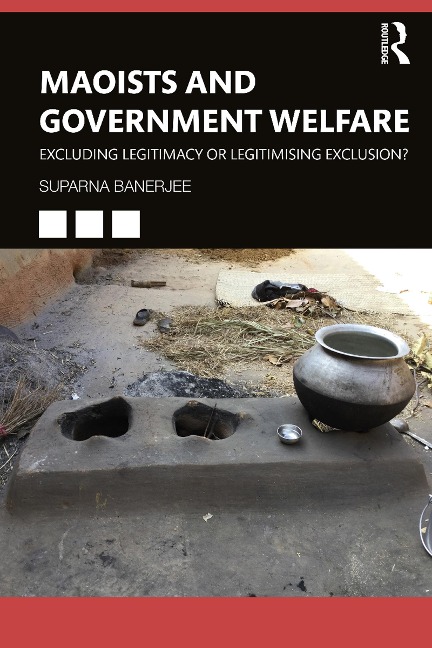
This book systematically analyses state responses towards Maoism in India and studies the role of state policies in prolonging conflict. It looks at how the structural maladies that once gave rise to conflict have now found a place in the government responses meant to address it. The book studies the socio-political conditions of Adivasis and lower caste groups that make up large sections of the cadre and highlights the exclusionary nature of the Indian political landscape. It discusses various themes such as state legitimacy, the political landscape through exclusion, the agency of Maoist foot soldiers, limitations of government welfare responses, and the idea of the marginalised in India. Rich in empirical data, the book will be useful for scholars and researchers of development studies, political studies, political sociology, minority studies, exclusion studies, sociology and social anthropology. It will also be of interest to policy-makers.
Suparna Banerjee has a PhD in Political Science from Zentrum für Entwicklungsforschung, Rheinische Friedrich-Wilhelms-Universität Bonn (Center for Development Research, University of Bonn), Germany. She was a senior research fellow at International Strategic and Security Studies Programme, National Institute of Advanced Studies, Bangalore, India. In this position, she worked on Myanmar ethnic conflicts and conducted field work in the country in 2015 during its transition phase. She completed her M.Phil in Foreign Policy Studies from the Institute of Foreign Policy Studies, University of Calcutta during which she wrote her thesis on Iran's Nuclear Programme. She has a Master's in Sociology from the University of Calcutta and a Bachelor's degree from Presidency College, Kolkata, India. She has been working on conflicts, violence, legitimacy and Maoism for a decade now. She has travelled across India interacting with Maoists, Adivasis and other marginalised groups. Her writings have been published as issue briefs, web articles, as well as journal articles
List of Figures Acknowledgements List of Abbreviations 1. Introduction 2. The Question of Positionality 3. Conceptualising India's Legitimacy 4. Reimagining the Political Landscape Through Exclusion 5. Contextualising the Excluded 6. Welfare Responses - Too Little Too Late 7. Conclusion Index
Dieses eBook wird im PDF-Format geliefert und ist mit einem Adobe Kopierschutz (DRM) versehen. Sie können dieses eBook mit allen Geräten lesen, die das PDF-Format und den Adobe Kopierschutz (DRM) unterstützen.
Zum Beispiel mit den folgenden Geräten:
• tolino Reader
Laden Sie das eBook direkt über den Reader-Shop auf dem tolino herunter oder übertragen Sie das eBook auf Ihren tolino mit einer kostenlosen Software wie beispielsweise Adobe Digital Editions.
• Sony Reader & andere eBook Reader
Laden Sie das eBook direkt über den Reader-Shop herunter oder übertragen Sie das eBook mit der kostenlosen Software Sony READER FOR PC/Mac oder Adobe Digital Editions auf ein Standard-Lesegeräte mit epub- und Adobe DRM-Unterstützung.
• Tablets & Smartphones
Möchten Sie dieses eBook auf Ihrem Smartphone oder Tablet lesen, finden Sie hier unsere kostenlose Lese-App für iPhone/iPad und Android Smartphone/Tablets.
• PC & Mac
Lesen Sie das eBook direkt nach dem Herunterladen mit einer kostenlosen Lesesoftware, beispielsweise Adobe Digital Editions, Sony READER FOR PC/Mac oder direkt über Ihre eBook-Bibliothek in Ihrem Konto unter „Meine eBooks“ - „online lesen“.
Schalten Sie das eBook mit Ihrer persönlichen Adobe ID auf bis zu sechs Geräten gleichzeitig frei.
Bitte beachten Sie, dass die Kindle-Geräte das Format nicht unterstützen und dieses eBook somit nicht auf Kindle-Geräten lesbar ist.