Und dann auf "Zum Home-Bildschirm [+]".

Stöbern
genialokal zum Startbildschirm hinzufügen
Installieren Sie die genialokal App auf Ihrem Startbildschirm für einen schnellen Zugriff und eine komfortable Nutzung.
Installieren Sie die genialokal App auf Ihrem Startbildschirm für einen schnellen Zugriff und eine komfortable Nutzung.
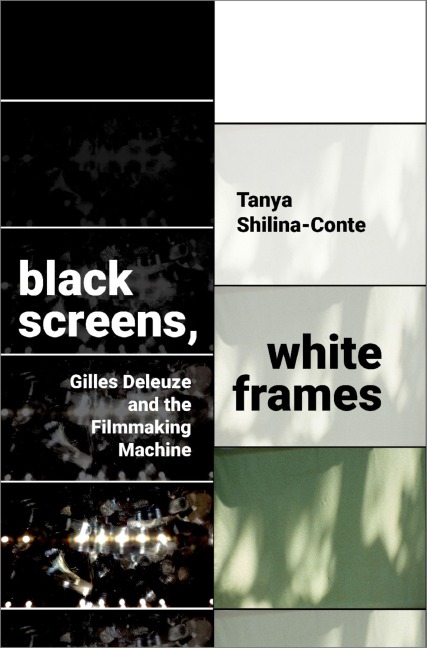
Black Screens, White Frames offers a new understanding of cinematic blankness. Drawing on Gilles Deleuze's philosophy, Tanya Shilina-Conte provides a detailed examination of non-images throughout film history. In different arts, including cinema, absence has often been understood in a negative way as a lack or lacuna, a vacuum or void. To remedy this, Shilina-Conte advances the concept of the filmmaking machine as an abstract art machine in constant production, which shifts our understanding of absence in cinema from negative to generative theorization. In the course of machinic production, dissociation ceases to be a negative characteristic of failure or incapacity and becomes a creative and capacious gesture of artistic experimentation. Shilina-Conte's approach is guided by a film-philosophical methodology and experimental modes of cinema rather than a thematic interpretation of its narrative forms. Further, she argues that blank screens (and their derivatives) function as points of deterritorialization within the filmmaking machine. In each chapter, she demonstrates that black or white screens either instigate relative deterritorializations or engender absolute escapes from narrative regimes in cinema. Blank screens in cinema, as machinic mutations and conditions of possibility, do not represent or symbolize but instead activate what has yet to appear and is still to become. This innovative reconsideration of non-images allows us to perform more nuanced analyses of cinematic modes often overlooked in traditional film criticism. The wide-ranging discussion of canonical and rare examples in Shilina-Conte's book uncovers how absence as a productive process not only alters the ways in which we study cinema but also changes the questions we ask about its history.
Tanya Shilina-Conte is Assistant Professor of Global Film Studies in the Department of English, University at Buffalo. Her essays have appeared in Screen, Film-Philosophy, Frames Cinema Journal, Word & Image, Studia Phænomenologica, In Media Res, Iran Namag, Leitura: Teoria & Prática, Studia Linguistica, Border Visions: Identity and Diaspora in Film, and elsewhere.
Acknowledgments Fade-In: Introduction. The Filmmaking Machine, or Thirteen Ways of Looking at the Black or White Screen Chapter 1. Divergent Darkness: The Black Screen in Early Cinema Chapter 2. Convergent Codes: Fade-ins and Fade-outs as Rational Transitions in Classical Cinema Chapter 3. The Black or White Screen as a Tool of Deterritorialization in Modern and Experimental Cinema Chapter 4. One Chapter Less: The Black or White Screen in Minor Cinema Chapter 5. Folds to Black or White in Minor Cinema and Art Practice Chapter 6. Alternate Endings: The Black or White Screen in Post-Cinema Fade-Out: Conclusion. This Video Does Not Exist: The Remix of Black or White Screens and Multimodal Scholarship Notes Index
Dieses eBook wird im PDF-Format geliefert und ist mit einem Adobe Kopierschutz (DRM) versehen. Sie können dieses eBook mit allen Geräten lesen, die das PDF-Format und den Adobe Kopierschutz (DRM) unterstützen.
Zum Beispiel mit den folgenden Geräten:
• tolino Reader
Laden Sie das eBook direkt über den Reader-Shop auf dem tolino herunter oder übertragen Sie das eBook auf Ihren tolino mit einer kostenlosen Software wie beispielsweise Adobe Digital Editions.
• Sony Reader & andere eBook Reader
Laden Sie das eBook direkt über den Reader-Shop herunter oder übertragen Sie das eBook mit der kostenlosen Software Sony READER FOR PC/Mac oder Adobe Digital Editions auf ein Standard-Lesegeräte mit epub- und Adobe DRM-Unterstützung.
• Tablets & Smartphones
Möchten Sie dieses eBook auf Ihrem Smartphone oder Tablet lesen, finden Sie hier unsere kostenlose Lese-App für iPhone/iPad und Android Smartphone/Tablets.
• PC & Mac
Lesen Sie das eBook direkt nach dem Herunterladen mit einer kostenlosen Lesesoftware, beispielsweise Adobe Digital Editions, Sony READER FOR PC/Mac oder direkt über Ihre eBook-Bibliothek in Ihrem Konto unter „Meine eBooks“ - „online lesen“.
Schalten Sie das eBook mit Ihrer persönlichen Adobe ID auf bis zu sechs Geräten gleichzeitig frei.
Bitte beachten Sie, dass die Kindle-Geräte das Format nicht unterstützen und dieses eBook somit nicht auf Kindle-Geräten lesbar ist.