Und dann auf "Zum Home-Bildschirm [+]".

Stöbern
genialokal zum Startbildschirm hinzufügen
Installieren Sie die genialokal App auf Ihrem Startbildschirm für einen schnellen Zugriff und eine komfortable Nutzung.
Installieren Sie die genialokal App auf Ihrem Startbildschirm für einen schnellen Zugriff und eine komfortable Nutzung.
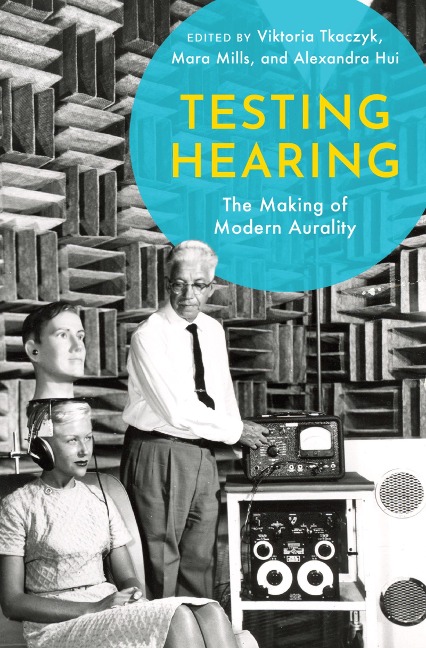
Testing Hearing: The Making of Modern Aurality argues that the modern cultural practices of hearing and testing have emerged from a long interrelationship. Since the early nineteenth century, auditory test tools (whether organ pipes or electronic tone generators) and the results of hearing tests have fed back into instrument calibration, human training, architecture, and the creation of new musical sounds. Hearing tests received a further boost around 1900 as a result of injury compensation laws and state and professional demands for aptitude testing in schools, conservatories, the military, and other fields. Applied at large scale, tests of seemingly small measure-of auditory acuity, of hearing range-helped redefine the modern concept of hearing as such. During the twentieth and twenty-first centuries, the epistemic function of hearing expanded. Hearing took on the dual role of test object and test instrument; in the latter case, human hearing became a gauge by which to evaluate or regulate materials, nonhuman organisms, equipment, and technological systems. This book considers both the testing of hearing and testing with hearing to explore the co-creation of modern epistemic and auditory cultures. The book's twelve contributors trace the design of ever more specific tests for the arts, education and communication, colonial and military applications, sociopolitical and industrial endeavors. Together, they demonstrate that testing as such became an enduring and wide-ranging cultural technique in the modern period, one that is situated between histories of scientific experimentation and many fields of application.
Viktoria Tkaczyk, Professor for the History of Knowledge, Humboldt-Universität zu Berlin, Germany, Mara Mills, Associate Professor of Media, Culture, and Communication, New York University, Alexandra Hui, Associate Professor of History, Mississippi State University Viktoria Tkaczyk is Professor of Media and Knowledge Technologies at Humboldt University in Berlin. Mara Mills is Associate Professor of Media, Culture, and Communication at New York University who works at the intersection of disability studies and media studies. Alexandra Hui is Associate Professor of History at Mississippi State University and Co-Editor of the journal Isis.
Testing Hearing: An Introduction Alexandra Hui, Mara Mills, and Viktoria Tkaczyk Sorting and Screening Human Hearers: Testing the Culturally Molded Ear Testing Hearing with Speech Mara Mills The Testing of a Hundred Listeners: Otto Abraham's Studies on "Absolute Tone Consciousness" Viktoria Tkaczyk Murray Island versus Aberdeenshire: Contextualizing the Cross-Cultural Hearing Tests of the Cambridge Anthropological Expedition to Torres Straits, 1898-1899 Sebastian Klotz Designing Instruments, Calibrating machines Hearing Perfection Emily I. Dolan Opelt's Siren and the Technologies of Musical Hearing Alexander Rehding The Software Passes the Test When the User Fails It: Constructing Digital Models of Analog Signal Processors Jonathan Sterne Managing Sound, Assessing Space To Hear As I Do: The Concessions of Hearing in Taiwan's Noise Management System Jennifer Hsieh Testing Spatial Hearing and the Development of Kunstkopf Technology, 1957-1981 Stefan Krebs Absorption, Transmission, Reflection: Testing Materials in the Laboratory Roland Wittje World as Testbed: Testing beyond Human Auditory Perception Of Silent Sirens and Pied Pipers: Auditory Thresholds and High-Frequency Technologies of Animal Control Joeri Bruyninckx Testing the Underwater Ear: Hearing, Standardizing, and Classifying Marine Sounds from World War I to the Cold War Lino Camprubí and Alexandra Hui This Is Not a Test: Listening with Günther Anders in the Nuclear Age Benjamin Steege Afterword Hans-Jörg Rheinberger and Trevor Pinch
Dieses eBook wird im PDF-Format geliefert und ist mit einem Adobe Kopierschutz (DRM) versehen. Sie können dieses eBook mit allen Geräten lesen, die das PDF-Format und den Adobe Kopierschutz (DRM) unterstützen.
Zum Beispiel mit den folgenden Geräten:
• tolino Reader
Laden Sie das eBook direkt über den Reader-Shop auf dem tolino herunter oder übertragen Sie das eBook auf Ihren tolino mit einer kostenlosen Software wie beispielsweise Adobe Digital Editions.
• Sony Reader & andere eBook Reader
Laden Sie das eBook direkt über den Reader-Shop herunter oder übertragen Sie das eBook mit der kostenlosen Software Sony READER FOR PC/Mac oder Adobe Digital Editions auf ein Standard-Lesegeräte mit epub- und Adobe DRM-Unterstützung.
• Tablets & Smartphones
Möchten Sie dieses eBook auf Ihrem Smartphone oder Tablet lesen, finden Sie hier unsere kostenlose Lese-App für iPhone/iPad und Android Smartphone/Tablets.
• PC & Mac
Lesen Sie das eBook direkt nach dem Herunterladen mit einer kostenlosen Lesesoftware, beispielsweise Adobe Digital Editions, Sony READER FOR PC/Mac oder direkt über Ihre eBook-Bibliothek in Ihrem Konto unter „Meine eBooks“ - „online lesen“.
Schalten Sie das eBook mit Ihrer persönlichen Adobe ID auf bis zu sechs Geräten gleichzeitig frei.
Bitte beachten Sie, dass die Kindle-Geräte das Format nicht unterstützen und dieses eBook somit nicht auf Kindle-Geräten lesbar ist.