Und dann auf "Zum Home-Bildschirm [+]".

Stöbern
genialokal zum Startbildschirm hinzufügen
Installieren Sie die genialokal App auf Ihrem Startbildschirm für einen schnellen Zugriff und eine komfortable Nutzung.
Installieren Sie die genialokal App auf Ihrem Startbildschirm für einen schnellen Zugriff und eine komfortable Nutzung.
Ihr gewünschter Artikel ist in 0 Buchhandlungen vorrätig - wählen Sie hier eine Buchhandlung in Ihrer Nähe aus:

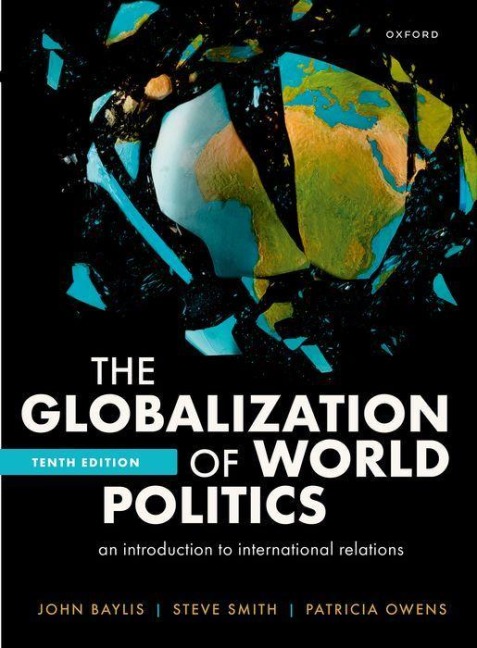
Celebrating its landmark tenth edition, The Globalization of World Politics remains the best-selling and most comprehensive introductory text to international relations.
Fully updated and expanded, this milestone edition continues to tackle the most urgent and complex challenges that dominate international relations today. Written by leading scholars in the field, The Globalization of World Politics now includes brand new chapters on ecological thought in international relations, the rise of the modern international order, and Marxist theories of international relations.
Tailored pedagogical features are seamlessly woven throughout the text and are designed to help students to cultivate analytical thinking and bridge the gap between theory and real-world practice. Interactive activities such as multiple-choice questions and the 'Opposing Opinions' feature foster active learning, enhancing students' understanding of key concepts and debates.
Key features
- Unrivalled coverage of history, theory, structures, processes, and international issues by leading international scholars makes it ideal for introductory courses while also being a valuable reference for the remainder of an IR degree.
- Reflects the latest developments in the field including the US presidential elections, climate change, and Artificial Intelligence.
- A wide-range of case studies span cultures and geographies and highlight contemporary crises such as the UN and conflict in Gaza, ending plastics pollution, and the Russia-Ukraine war, connecting theory to today's most pressing international challenges.
- Integrated learning features in the e-book and Trove editions, including author videos, opposing opinions features, and end-of-section multiple-choice questions are carefully developed to help students achieve a firm foundation in the discipline.
- Carefully edited by highly respected International Relations experts John Baylis, Steve Smith and Patricia Owens to ensure a coherent style throughout, making it ideal for students who are new to international relations.
- Available as an e-book enhanced with self-assessment activities and multi-media content to offer a fully immersive experience and extra learning support.
New to this edition
- New Chapter 3: The rise of the modern international order by Ay-e Zarakol
- New Chapter 8: Marxist theories of international relations by Maïa Pal
- New Chapter 13: Ecological thought in International Relations by Andrea Brock
- Expanded coverage of non-Western approaches, particularly perspectives from the Global South, are woven throughout all the chapters to emphasise the importance of viewing international relations from representative and varied perspectives.
- Updated exploration of the contemporary crisis of the liberal international order and the challenge of the second Trump administration to ideas about 'globalization'.
Digital formats and resources
The Globalization of World Politics is available for students and institutions to purchase in a variety of formats and is supported by extensive online resources.
The e-book offers a mobile experience and convenient access, with learning resources embedded and hyperlinked throughout to offer self-assessment activities and extra support: www.oxfordtextbooks.co.uk/ebooks
The student resources, accessible via the e-book and Politics Trove, include:
- Topical videos
- End-of-section multiple-choice questions
- Flashcard glossary
The book's teaching resources, accessible online for adopting lecturers, include:
- PowerPoint slides
- Test bank
- Question bank
- Part 1: International relations in a global era
- 1: Patricia Owens, John Baylis, Steve Smith: Introduction
- 2: Anthony McGrew: Globalization and global politics
- Part 2: The historical context
- 3: Ayse Zarakol: The rise of the modern international order
- 4: Len Scott: International history of the twentieth century
- 5: Michael Cox: From the end of the cold war to the crisis of the liberal order
- 6: Andrew Hurrell: Emerging powers and the global south
- Part 3: Theories of world politics
- 7: Tim Dunne: Liberal internationalism
- 8: Maïa Pal: Marxist theories of international relations
- 9: Or Rosenboim: Realism
- 10: Helen M. Kinsella: Feminism
- 11: Meera Sabaratnam: Postcolonial and decolonial approaches
- 12: Lene Hansen: Poststructuralism
- 13: Andrea Brock: Ecological thought in International Relations
- 14: Michael Barnett: Social constructivism
- Part 4: Structures and processes
- 15: Tarak Barkawi: War and world politics
- 16: John Baylis: International and global security
- 17: Nicola Phillips, Danielle F.S. Cohen: Global political economy
- 18: Paul Kirby: Gender
- 19: Robbie Shilliam: Race in world politics
- 20: Christian Reut-Smith: International law
- 21: Susan Park: International organizations in world politics
- 22: Devon E.A. Curtis, Paul Taylor: The United Nations
- 23: Jutta Joachim: NGOS in world politics
- 24: Edward Best, Thomas Christiansen: Regionalism in international affairs
- Part 5: International issues
- 25: John Vogler: Environmental issues
- 26: Sophie Harman: Global health
- 27: Ariadna Estevez, Danielle F.S. Cohen: Refugees and forced migration
- 28: Tony Evans: Poverty, hunger and development
- 29: Matthew Watson: Global trade and global finance
- 30: James D. Kiras: Terrorism and globalization
- 31: Sheena Chestnut Greitens: Proliferation of weapons of mass destruction
- 32: John Breuilly: Nationalism, national self-determination, and international relations
- 33: Ratna Kapur: Human rights