Stöbern
genialokal zum Startbildschirm hinzufügen
Installieren Sie die genialokal App auf Ihrem Startbildschirm für einen schnellen Zugriff und eine komfortable Nutzung.
Installieren Sie die genialokal App auf Ihrem Startbildschirm für einen schnellen Zugriff und eine komfortable Nutzung.
Tippen Sie einfach auf Teilen:
 Und dann auf "Zum Home-Bildschirm [+]".
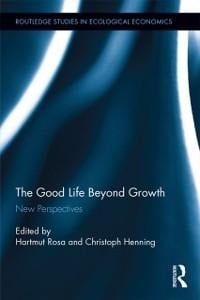
Many countries have experienced a decline of economic growth for decades, an effect that was only aggravated by the recent global financial crisis. What if in the 21st century this is no longer an exception, but the general rule? Does an economy without growth necessarily bring hardship and crises, as is often assumed? Or could it be a chance for a better life? Authors have long argued that money added to an income that already secures basic needs no longer enhances well-being. Also, ecological constraints and a sinking global absorption capacity increasingly reduce the margin of profitability on investments. Efforts to restore growth politically, however, often lead to reduced levels of social protection, reduced ecological and health standards, unfair tax burdens and rising inequalities. Thus it is time to dissolve the link between economic growth and the good life. This book argues that a good life beyond growth is not only possible, but highly desirable. It conceptualizes "the good life" as a fulfilled life that is embedded in social relations and at peace with nature, independent of a mounting availability of resources. In bringing together experts from different fields, this book opens an interdisciplinary discussion that has often been restricted to separate disciplines. Philosophers, sociologists, economists and activists come together to discuss the political and social conditions of a good life in societies which no longer rely on economic growth and no longer call for an ever expanding circle of extraction, consumption, pollution, waste, conflict, and psychological burnout. Read together, these essays will have a major impact on the debates about economic growth, economic and ecological justice, and the good life in times of crisis.
Hartmut Rosa is Professor of Sociology at the University of Jena, Co-director of the Kolleg Postwachstumsgesellschaften in Jena (with Klaus Dörre) and Director of the Max Weber Centre for Advanced Cultural and Social Studies at the University of Erfurt. Christoph Henning is Junior Fellow for Philosophy at the Max-Weber-Kolleg for advanced Cultural and Social Studies, University of Erfurt, Germany.
List of Figures and Tables List of Contributors Introduction Hartmut Rosa & Christoph Henning I Foundations: Alternative Conceptions of the Good Life 1 The Misadventures of the Good Life between Modernity and Degrowth: From Happiness to Buen Vivir Serge Latouche 2 Buen Vivir: A Proposal with Global Potential Alberto Acosta 3 Available, Accessible, Attainable. The Mindset of Growth and the Resonance Conception of the Good Life Hartmut Rosa 4 Resonance and the Romantic era: A Comment on Rosa's Conception of the Good life Charles Taylor II Beyond the Growth Paradigm: Alternative Conceptions of the Economic 5 A Philosophy of Ecological Economics Manfred-Max Neef 6 Productivity, Property, and Violence: A Critique of liberal justifications of Growth Christoph Henning 7 Growth regimes and visions of the good life: Why capitalism will not deliver Dennis Eversberg 8 Political Economic Conditions of a Good Life beyond Growth Andrew Sayer III The Good Society: Alternative Conceptions of Social Justice and Wellbeing 9 The Common Good as a Principle of Social Justice Michael J. Thompson 10 Bread and Roses. 'Good work' from a Union Perspective Nicole Mayer-Ahuja 11 Income Distribution for a Sane Society Philippe Van Parijs & Yannik Vanderborght 12 How not to argue against Growth: Happiness, Austerity and Inequality John O'Neill IV Subjects beyond Growth: Changing Practices 13 Happiness, the Common Good, and Volunteer Work Bettina Hollstein 14 Is Love still a Part of the Good Life? Eva Illouz 15 Empowering Ourselves in the Transformation to a Good Life beyond Growth Felix Rauschmayer 16 Subjective Limits to Growth and the Limits to a Life-Style Oriented Critique of Growth Stefanie Graefe V One World without Growth: Alternative Conceptions of the Political 17 The Good life of Nations: A Global Perspective Martin Fritz & Max Koch 18 Cultures of Wellbeing in the South: Lessons to learn Sarah White 19 Europe, Capitalist Landnahme and the Economic-Ecological Double Crisis: Prospects for a Non-Capitalist Post-Growth Society Klaus Doerre 20 Toward radical Alternatives to Development Ashish Kothari Index
Dieses eBook wird im PDF-Format geliefert und ist mit einem Adobe Kopierschutz (DRM) versehen. Sie können dieses eBook mit allen Geräten lesen, die das PDF-Format und den Adobe Kopierschutz (DRM) unterstützen.
Zum Beispiel mit den folgenden Geräten:
• tolino Reader
Laden Sie das eBook direkt über den Reader-Shop auf dem tolino herunter oder übertragen Sie das eBook auf Ihren tolino mit einer kostenlosen Software wie beispielsweise Adobe Digital Editions.
• Sony Reader & andere eBook Reader
Laden Sie das eBook direkt über den Reader-Shop herunter oder übertragen Sie das eBook mit der kostenlosen Software Sony READER FOR PC/Mac oder Adobe Digital Editions auf ein Standard-Lesegeräte mit epub- und Adobe DRM-Unterstützung.
• Tablets & Smartphones
Möchten Sie dieses eBook auf Ihrem Smartphone oder Tablet lesen, finden Sie hier unsere kostenlose Lese-App für iPhone/iPad und Android Smartphone/Tablets.
• PC & Mac
Lesen Sie das eBook direkt nach dem Herunterladen mit einer kostenlosen Lesesoftware, beispielsweise Adobe Digital Editions, Sony READER FOR PC/Mac oder direkt über Ihre eBook-Bibliothek in Ihrem Konto unter „Meine eBooks“ - „online lesen“.
Schalten Sie das eBook mit Ihrer persönlichen Adobe ID auf bis zu sechs Geräten gleichzeitig frei.
Bitte beachten Sie, dass die Kindle-Geräte das Format nicht unterstützen und dieses eBook somit nicht auf Kindle-Geräten lesbar ist.