Stöbern
genialokal zum Startbildschirm hinzufügen
Installieren Sie die genialokal App auf Ihrem Startbildschirm für einen schnellen Zugriff und eine komfortable Nutzung.
Installieren Sie die genialokal App auf Ihrem Startbildschirm für einen schnellen Zugriff und eine komfortable Nutzung.
Tippen Sie einfach auf Teilen:
 Und dann auf "Zum Home-Bildschirm [+]".
Ihr gewünschter Artikel ist in 0 Buchhandlungen vorrätig - wählen Sie hier eine Buchhandlung in Ihrer Nähe aus:

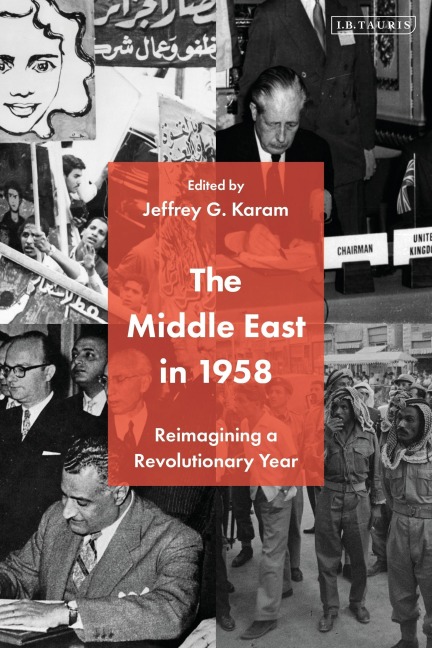
The revolutionary year of 1958 epitomizes the height of the social uprisings, military coups, and civil wars that erupted across the Middle East and North Africa in the mid-twentieth century. Amidst waning Anglo-French influence, growing US-USSR rivalry, and competition and alignments between Arab and non-Arab regimes and domestic struggles, this year was a turning point in the modern history of the Middle East. This multi and interdisciplinary book explores this pivotal year in its global, regional and local contexts and from a wide range of linguistic, geographic, academic specialties. The contributors draw on declassified and multilingual archives, reports, memoirs, and newspapers in thirteen country-specific chapters, shedding new light on topics such as the extent of Anglo-American competition after the Suez War, Turkey's efforts to stand as a key pillar in the regional Cold War, the internationalization of the Algerian War of Independence, and Iran and Saudi Arabia's abilities to weather the revolutionary storm that swept across the region. The book includes a foreword from Salim Yaqub which highlights the importance of Jeffrey G. Karam's collection to the scholarship on this vital moment in the political history of the modern middle east.
Jeffrey G. Karam is an Assistant Professor of Political Science at the Lebanese American University. He is also an Associate at Harvard University's Middle East Initiative. He is the author of several articles, book chapters, and policy briefs on U.S. intelligence and foreign policy in the Middle East. He is the recipient of several awards, including the Christopher Andrew-Michael Handel Prize for the best article in Intelligence and National Security in 2017.
Foreword: Salim Yaqub, University of California, Santa Barbara Chapter 1: Reimagining 1958 Through the Lenses of Multilingual Sources and Interdisciplinary Perspectives, Jeffrey G. Karam, Lebanese American University Part 1 - The Regional and International Context of 1958: Declining and Rising Powers in the Middle East Chapter 2: The Point of Departure: The Impact of the Revolutionary Year of 1958 on British Policy, Robert McNamara, Ulster University Chapter 3: France and the Middle East in 1958: Continuity and Change Through Crisis, Sofia Papastamkou, French National Centre for Scientific Research (CNRS), University of Lille. Chapter 4: Cautious Revisionism and the Limits of Hegemony in 1958: A Revolutionary Year for the United States in the Middle East, Jeffrey G. Karam, Lebanese American University Chapter 5: The 'Partisans of Peace' Between Baku and Moscow: The Soviet Experience of 1958, Elizabeth Bishop, Texas State University-San Marcos Part 2 - Rivalry and Alliances between Arab and Non-Arab States: Regionalizing Dynamics of the Cold War Chapter 6: Saudi Arabia in the Crucible of 1958, Nathan Citino, Rice University Chapter 7: Egypt's Revolutionary Year: Regime Consolidation at Home, Pragmatism Abroad, and Neutralism in the Cold War, Dina Rezk, University of Reading Chapter 8: The Outsider Inside: Turkey and the Domino Effect of Arab Nationalism in 1958, Murat Kasapsaraçoglu, Antalya Bilim University Chapter 9: Creating the 'Island of Stability': Iran, the Cold War, and American Cultural Diplomacy at the End of the 1950s. John Ghazvinian, University of Pennsylvania Part 3 - Connecting the Local to the Global: Revolutions, Wars, and Coups in the Middle East Chapter 10: How about 1958 in Algeria? A Transnational Event in the Context of the War of Independence, Sylvie Thénault, French National Centre for Scientific Research, University of Paris 1 Pantheon-Sorbonne Chapter 11: The Iraqi Revolution of 1958: Its Historic Significance and Relevance for the Present, Juan Romero, Western Kentucky University Chapter 12: No Turning Back: Syria and the 1958 Watershed, Fadi Esber, London School of Economics and Political Science Chapter 13: The Crisis of 1958 in Lebanon: Political Rivalries, Caroline Attie, Dar al Hekma University Chapter 14: Evolution and Revolution: Jordan in 1958, Clea Hupp, Syracuse University Chapter 15: Reflections and Conclusions from the Revolutionary Year of 1958, Jeffrey G. Karam, Lebanese American University