
Stöbern
genialokal zum Startbildschirm hinzufügen
Installieren Sie die genialokal App auf Ihrem Startbildschirm für einen schnellen Zugriff und eine komfortable Nutzung.
Installieren Sie die genialokal App auf Ihrem Startbildschirm für einen schnellen Zugriff und eine komfortable Nutzung.
Tippen Sie einfach auf Teilen:
 Und dann auf "Zum Home-Bildschirm [+]".
Bei genialokal.de kaufen Sie online bei Ihrer lokalen, inhabergeführten Buchhandlung!
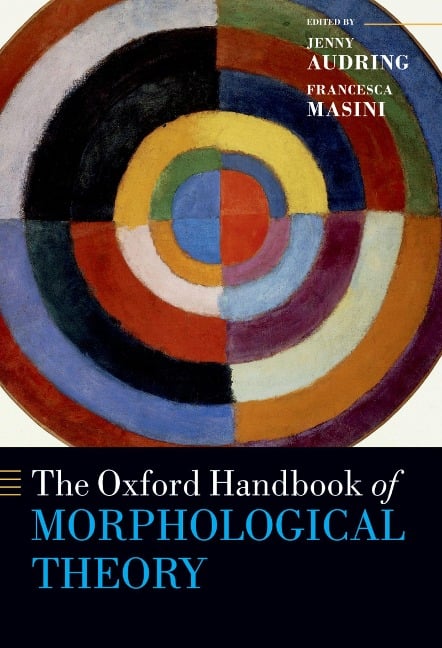
This volume is the first handbook devoted entirely to the multitude of frameworks adopted in the field of morphology, including Minimalism, Optimality Theory, Network Morphology, Cognitive Grammar, and Canonical Typology. Following an introduction from the editors, the first part of the volume offers critical discussions of the main theoretical issues within morphology, both in word formation and in inflection, as well as providing a short history of morphological theory. In the core part of the handbook, part II, each theory is introduced by an expert in the field, who guides the reader through its principles and technicalities, its advantages and disadvantages, and its points of agreement and disagreement with alternative theories. Chapters in part III explore the bigger picture, connecting morphological theory to other subdisciplines of linguistics, such as diachronic change, language acquisition, psycholinguistics, and sign language theory. The handbook is intended as a guide for morphologists from all theoretical backgrounds who want to learn more about frameworks other than their own, as well as for linguists in related subfields looking for theoretical connections with the field of morphology.
Jenny Audring is Assistant Professor of Linguistics at Leiden University. She specializes in morphology and has written extensively on grammatical gender. Her research interests range from linguistic complexity and Canonical Typology to Construction Morphology and morphological theory. She is the co-editor, with Sebastian Fedden and Greville G. Corbett, of Non-Canonical Gender Systems (OUP 2018) and co-author, with Ray Jackendoff, of The Texture of the Lexicon: Relational Morphology and the Parallel Architecture (OUP, 2020). Francesca Masini is Associate Professor of Linguistics at the University of Bologna. Her research interests are in semantics, morphology and the lexicon, primarily within Construction Grammar and Construction Morphology. Her main focus is on multiword expressions, word classes, lexical typology, and the lexicon-syntax interface. She is currently Associate Editor of The Oxford Encyclopedia of Morphology, a special project of The Oxford Research Encyclopedia of Linguistics.
- 1: Jenny Audring and Francesca Masini: Introduction: Theory and theories in morphology - PART I: Issues in morphology - 2: Stephen R. Anderson: A short history of morphological theory - 3: Rochelle Lieber: Theoretical issues in word formation - 4: Gregory Stump: Theoretical issues in inflection - PART II: Morphological theories - 5: Thomas Stewart: Structuralism - 6: Pius ten Hacken: Early Generative Grammar - 7: Fabio Montermini: Later Generative Grammar and beyond: Lexicalism - 8: Daniel Siddiqi: Distributed Morphology - 9: Antonio Fábregas: Minimalism in morphological theories - 10: Laura J. Downing: Optimality Theory and Prosodic Morphology - 11: Rachel Nordlinger and Louisa Sadler: Morphology in LFG and HPSG - 12: Livio Gaeta: Natural Morphology - 13: James P. Blevins, Farrell Ackerman, and Robert Malouf: Word and Paradigm Morphology - 14: Gregory Stump: Paradigm Function Morphology - 15: Dunstan Brown: Network Morphology - 16: Nikolas Gisborne: Word Grammar Morphology - 17: Ronald W. Langacker: Morphology in Cognitive Grammar - 18: Francesca Masini and Jenny Audring: Construction Morphology - 19: Ray Jackendoff and Jenny Audring: Relational Morphology in the Parallel Architecture - 20: Oliver Bond: Canonical Typology - PART III: Morphological theory and other fields - 21: Peter Arkadiev and Marian Klamer: Morphological theory and typology - 22: Ana R. Luís: Morphological theory and creole languages - 23: Matthias Hüning: Morphological theory and diachronic change - 24: Angela Ralli: Morphological theory and synchronic variation - 25: Elma Blom: Morphological theory and first language acquisition - 26: John Archibald and Gary Libben: Morphological theory and second language acquisition - 27: Christina Gagné and Thomas Spalding: Morphological theory and psycholinguistics - 28: Niels O. Schiller and Rinus G. Verdonschot: Morphological theory and neurolinguistics - 29: Vito Pirrelli: Morphological theory and computational linguistics - 30: Donna Jo Napoli: Morphological theory and sign languages - References - Index
Dieses eBook wird im PDF-Format geliefert und ist mit einem Adobe Kopierschutz (DRM) versehen. Sie können dieses eBook mit allen Geräten lesen, die das PDF-Format und den Adobe Kopierschutz (DRM) unterstützen.
Zum Beispiel mit den folgenden Geräten:
• tolino Reader
Laden Sie das eBook direkt über den Reader-Shop auf dem tolino herunter oder übertragen Sie das eBook auf Ihren tolino mit einer kostenlosen Software wie beispielsweise Adobe Digital Editions.
• Sony Reader & andere eBook Reader
Laden Sie das eBook direkt über den Reader-Shop herunter oder übertragen Sie das eBook mit der kostenlosen Software Sony READER FOR PC/Mac oder Adobe Digital Editions auf ein Standard-Lesegeräte mit epub- und Adobe DRM-Unterstützung.
• Tablets & Smartphones
Möchten Sie dieses eBook auf Ihrem Smartphone oder Tablet lesen, finden Sie hier unsere kostenlose Lese-App für iPhone/iPad und Android Smartphone/Tablets.
• PC & Mac
Lesen Sie das eBook direkt nach dem Herunterladen mit einer kostenlosen Lesesoftware, beispielsweise Adobe Digital Editions, Sony READER FOR PC/Mac oder direkt über Ihre eBook-Bibliothek in Ihrem Konto unter „Meine eBooks“ - „online lesen“.
Schalten Sie das eBook mit Ihrer persönlichen Adobe ID auf bis zu sechs Geräten gleichzeitig frei.
Bitte beachten Sie, dass die Kindle-Geräte das Format nicht unterstützen und dieses eBook somit nicht auf Kindle-Geräten lesbar ist.