Und dann auf "Zum Home-Bildschirm [+]".

Stöbern
genialokal zum Startbildschirm hinzufügen
Installieren Sie die genialokal App auf Ihrem Startbildschirm für einen schnellen Zugriff und eine komfortable Nutzung.
Installieren Sie die genialokal App auf Ihrem Startbildschirm für einen schnellen Zugriff und eine komfortable Nutzung.
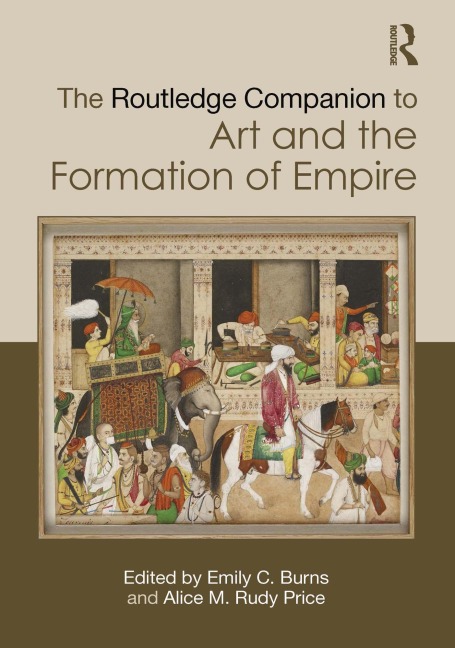
This companion comprises essays that analyze interactions between art and global imperial relationships from 1800 to World War II. The essays in this volume expose and add to historical layers of meaning in their discussions of art and empire. Found across much of the globe, sites of sedimentary rock allegorize the dynamics of art and empire and frame the section structure for this book. Twenty-two authors unpack imperial layers in a variety of global and historical contexts through case studies that center art and visual and material culture. The authors show how art and aesthetics have operated as tools of empire. Interpreting a comprehensive array of media as well as inter-media dialogues, they analyze and intervene in how we remember and examine entwinements between empire and aesthetic practices. In this volume's attention to the role of art in imperial formation, as well as the legacy of colonization, the essays disentangle sediments of culture as they are moved and shaped by homogenizing forces of empire, showing that the aesthetics of empire inflect not only individuals, makers, and economies, but also practices of circulation and collecting. The book will be of interest to graduate students, researchers, and professors and may be used in classes focused on art history, imperialism, and colonialism.
Emily C. Burns is Director, Charles M. Russell Center for the Study of Art of the American West, and Associate Professor of Art History at University of Oklahoma. Alice M. Rudy Price is Adjunct Assistant Professor at Temple University, Tyler School of Art and Architecture, and Thomas Jefferson University, College of Architecture and the Built Environment.
Introduction: Solidifying as Rock: Enmeshed Layers of Empire Part I: Sediment: The Dynamic Elements of Place 1.Colonial Complicities Beyond the Empire. Czechoslovakia Inbetween Worlds and World's Fairs 2. "The Kingdom Grown Out of a Little Boy's Garden": Dole Pineapples and Hawaiian Occupation in U.S. Art and Visual Culture 3. Imperialism for the Million: Mass-market Glasshouses and the Botanical Arts of Empire 4. Meditating on Aivazovsky's Black Sea: Representing Russian Imperial Expansion 5. Beyond European Palettes: The Overlooked Contributions of Indigenized Artists in the Historiography of Painting in Mexico 6. Beyond the Modernist Canon of Involuntary Aesthetic Colonization: Aina Onabolu's Mimicry as Rejection of Colonial Anti-modernity 1900-1937. Rambles in Natchez: John James Audubon and Colonial Aesthetics on the Mississippi Frontier (1820-1850) Part II: What Moves the Sediment: Exchange and Conflict 8. The Empire Looks Back: Derivativeness in Nineteenth-century Brazilian Art 9. "Southern Fragrance" of the Japanese Empire: Visualizing Botany in Colonial Taiwan 10. How to Interpret John B. Flannagan Through Empire 11. Face-Off: A Russian Prince at the Courts of India 12. Orientalism, Arts, and Scottish Identity: David Roberts (1796-1864) and David Wilkie (1785-1841) in the Ottoman Levant 13. Mapping the British Railways in Western Anatolia: From a Speculative to an Imperial Vision 14. Manufacturing Empire: The Visual and Material Culture of Chicago's Marquette Building 15. The Italian Fascist Vision for the "World of Tomorrow" at the New York 1939 World's Fair Part III: What Solidifies the Sediment into Rock: Forces of Homogenization (or Consolidation) 16. Maternal Orientalism: Women's Work and the Photographs of Jessie Tarbox Beals at the Louisiana Purchase Exposition 17. ''Self-colonization' as a Cultural Strategy: Konstantin Korovin's Image of Russian Northern Peripheries 18. Adapting Empire for the Buying Public: The Algerian Conquest and a Printed Adaptation of Gros's Bonaparte Visiting the Plaguehouse at Jaffa 19. Surveying for Empire: Arthur Schott's Boundary Pictures and the Slavery Extension Controversy 20. Whose American South? Winslow Homer and The Cuban Question 21. Hegemony, Hierarchy, and Struggle in Korean Colonial Art: The Activities and Artworks of Shinichi Yamada
Dieses eBook wird im PDF-Format geliefert und ist mit einem Adobe Kopierschutz (DRM) versehen. Sie können dieses eBook mit allen Geräten lesen, die das PDF-Format und den Adobe Kopierschutz (DRM) unterstützen.
Zum Beispiel mit den folgenden Geräten:
• tolino Reader
Laden Sie das eBook direkt über den Reader-Shop auf dem tolino herunter oder übertragen Sie das eBook auf Ihren tolino mit einer kostenlosen Software wie beispielsweise Adobe Digital Editions.
• Sony Reader & andere eBook Reader
Laden Sie das eBook direkt über den Reader-Shop herunter oder übertragen Sie das eBook mit der kostenlosen Software Sony READER FOR PC/Mac oder Adobe Digital Editions auf ein Standard-Lesegeräte mit epub- und Adobe DRM-Unterstützung.
• Tablets & Smartphones
Möchten Sie dieses eBook auf Ihrem Smartphone oder Tablet lesen, finden Sie hier unsere kostenlose Lese-App für iPhone/iPad und Android Smartphone/Tablets.
• PC & Mac
Lesen Sie das eBook direkt nach dem Herunterladen mit einer kostenlosen Lesesoftware, beispielsweise Adobe Digital Editions, Sony READER FOR PC/Mac oder direkt über Ihre eBook-Bibliothek in Ihrem Konto unter „Meine eBooks“ - „online lesen“.
Schalten Sie das eBook mit Ihrer persönlichen Adobe ID auf bis zu sechs Geräten gleichzeitig frei.
Bitte beachten Sie, dass die Kindle-Geräte das Format nicht unterstützen und dieses eBook somit nicht auf Kindle-Geräten lesbar ist.