Und dann auf "Zum Home-Bildschirm [+]".

Stöbern
genialokal zum Startbildschirm hinzufügen
Installieren Sie die genialokal App auf Ihrem Startbildschirm für einen schnellen Zugriff und eine komfortable Nutzung.
Installieren Sie die genialokal App auf Ihrem Startbildschirm für einen schnellen Zugriff und eine komfortable Nutzung.
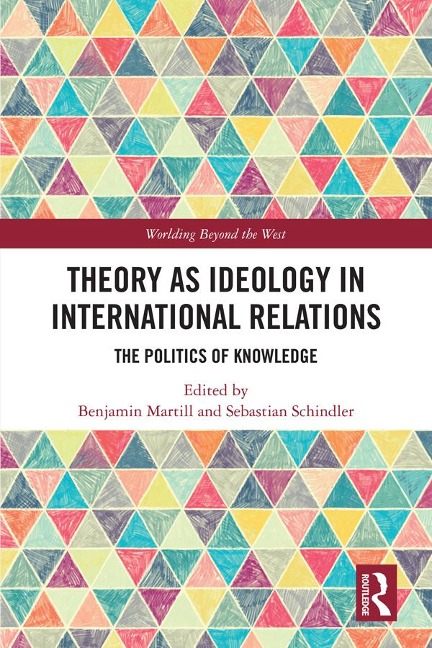
Are theoretical tools nothing but political weapons? How can the two be distinguished from each other? What is the ideological role of theories like liberalism, neoliberalism or democratic theory? And how can we study the theories of actors from outside the academic world? This book examines these and related questions at the nexus of theory and ideology in International Relations. The current crisis of politics made it abundantly clear that theory is not merely an impartial and neutral academic tool, but instead is implicated in political struggles. However, it is also clear that it is insufficient to view theory merely as a political weapon. This book brings together contributions from a number of different scholarly perspectives to engage with these problems. The contributors, drawn from various fields of International Relations and Political Science, cast new light on the ever-problematic relationship between theory and ideology. They analyse the ideological underpinnings of existing academic theories and examine the theories of non-academic actors such as staff members of international organisations, Ecovillagers and liberal politicians. This edited volume is a must-read for all those interested in the contemporary political crisis and its relation to theories of International Relations.
Benjamin Martill is Lecturer in Politics and International Relations at the University of Edinburgh, UK, where he conducts research and teaching on the politics of European foreign and security policy. He is co-editor (with Uta Staiger) of the volume Brexit and Beyond: Rethinking the Futures of Europe (2018) and his work has featured in Security Studies, International Politics, the Journal of Political Ideologies and the British Journal of Politics and International Relations. He has previously worked at the London School of Economics, University College London, Canterbury Christ Church University and the University of Oxford. Sebastian Schindler is Research Associate at Geschwister-Scholl-Institute for Political Science, Ludwig Maximilians Universität, Munich, Germany. His research interests include theories of International Relations, international organisations, theories of practice and critical theories. He holds a doctoral degree from Goethe University, Frankfurt/Main, Germany, and has published articles in leading journals of the field, including International Studies Quarterly, International Theory and Politische Vierteljahresschrift. In 2014, he won Millennium - Journal of International Studies' F.S. Northedge Essay Competition, with an article on contested agency in the United Nations. In 2019, a special issue on 'Rethinking Agency in International Relations', which he co-edited with Benjamin Braun and Tobias Wille, appeared in the Journal of International Relations and Development. The focus of his current research lies on the problem of post-truth politics.
Introduction: Theory as Ideology in International Relations Part I: Understanding Theory and Ideology 1. Theory vs. Ideology: Validity Criteria for Knowledge Claims and Normative Conditions of Critique 2. Ideology as Decontestation 3. Theory, Ideology and IR's Quest for Scientific Credibility 4. 'I see Something You Don't See': Niklas Luhmann's Social Theory between Observation and Meta-Critique Part II: Contemporary Theories as Ideologies 5. The Costs of the Democratic Turn in Political Theory 6. The Spirits We Cite: How Democratic War Theory Reproduces what it Opposes 7. From Theory to Practice: The Paradox of Neoliberal Hegemony in Twenty-First-Century World Politics 8. Liberalism and the Cold War: The International Thought of Jo Grimond Part III: Theorisation outside Academia 9. Ideologies of International Organisation: Exploring the Trading Zones between Theory and Practice 10. From Allegations of Ideology to Conflicts over Forms of Life: Or, Why Political Scientists Don't Talk about Ecovillages 11. Microanalysis as Ideology Critique: The Critical Potential of 'Zooming In' on Everyday Social Practices Conclusion: From the Politics of Knowledge to Knowledge of Politics
Dieses eBook wird im PDF-Format geliefert und ist mit einem Adobe Kopierschutz (DRM) versehen. Sie können dieses eBook mit allen Geräten lesen, die das PDF-Format und den Adobe Kopierschutz (DRM) unterstützen.
Zum Beispiel mit den folgenden Geräten:
• tolino Reader
Laden Sie das eBook direkt über den Reader-Shop auf dem tolino herunter oder übertragen Sie das eBook auf Ihren tolino mit einer kostenlosen Software wie beispielsweise Adobe Digital Editions.
• Sony Reader & andere eBook Reader
Laden Sie das eBook direkt über den Reader-Shop herunter oder übertragen Sie das eBook mit der kostenlosen Software Sony READER FOR PC/Mac oder Adobe Digital Editions auf ein Standard-Lesegeräte mit epub- und Adobe DRM-Unterstützung.
• Tablets & Smartphones
Möchten Sie dieses eBook auf Ihrem Smartphone oder Tablet lesen, finden Sie hier unsere kostenlose Lese-App für iPhone/iPad und Android Smartphone/Tablets.
• PC & Mac
Lesen Sie das eBook direkt nach dem Herunterladen mit einer kostenlosen Lesesoftware, beispielsweise Adobe Digital Editions, Sony READER FOR PC/Mac oder direkt über Ihre eBook-Bibliothek in Ihrem Konto unter „Meine eBooks“ - „online lesen“.
Schalten Sie das eBook mit Ihrer persönlichen Adobe ID auf bis zu sechs Geräten gleichzeitig frei.
Bitte beachten Sie, dass die Kindle-Geräte das Format nicht unterstützen und dieses eBook somit nicht auf Kindle-Geräten lesbar ist.