Stöbern
genialokal zum Startbildschirm hinzufügen
Installieren Sie die genialokal App auf Ihrem Startbildschirm für einen schnellen Zugriff und eine komfortable Nutzung.
Installieren Sie die genialokal App auf Ihrem Startbildschirm für einen schnellen Zugriff und eine komfortable Nutzung.
Tippen Sie einfach auf Teilen:
 Und dann auf "Zum Home-Bildschirm [+]".
Ihr gewünschter Artikel ist in 0 Buchhandlungen vorrätig - wählen Sie hier eine Buchhandlung in Ihrer Nähe aus:

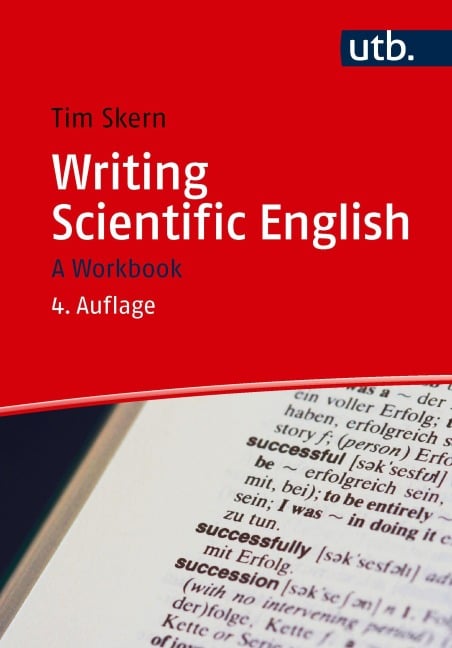
Success in science depends nowadays on effective communication in English. This workbook is specifically designed to give under- and post-graduates confidence in writing in English. Examples and exercises show how to avoid common errors and how to rephrase and improve scientific texts. The generation of a model manuscript enables the reader to recognise how scientific English is constructed and how to follow the conventions of scientific writing. Guidelines for structuring written work and vocabulary lists should encourage young scientists to develop a concise and mature style. The workbook is accessible to students of many fields, including those of the natural and technical sciences, medicine, psychology and economics. The fourth edition extends the list of words in the scientific lexicon and, as requested by many readers of previous editions, provides several short texts that illustrate the use of many of the less common words in the lexicon.
Tim Skern, native English speaker, studied biochemistry in Liverpool and London. Now working at the Max F. Perutz Laboratories, he has been teaching scientific English at the University of Vienna and the Medical University of Vienna since 1992.
Chapter 1 An introduction to scientific English 15 1.1 Advantages and disadvantages of English 15 1.1.1 British or American? 19 1.2 Formal English, the language of science 21 1.2.1 Complete sentences 21 1.2.2 Punctuation marks 22 1.2.3 Write out all verb forms 25 1.2.4 Avoid starting sentences with "and", "but", "because" or "so" 25 1.2.5 Avoid ending sentences with "too", "also", "though" or "yet" 26 1.2.6 Avoid "get" 27 1.2.7 Avoid vagueness, sensationalism and exaggeration 27 1.2.8 Using "the" and "a" 28 1.3 Words for writing scientific English 31 1.4 Take-home messages from Chapter 1 34 1.5 References 34 1.6 Improvements to exercises 34 Chapter 2 Writing clear scientific English 37 2.1 Eight guidelines for improving your writing technique 37 2.1.1 Make a plan 37 2.1.2 Use a clean and legible layout 38 2.1.3 Use paragraphs 39 2.1.4 Write simple sentences 39 2.1.5 Write positive sentences 41 2.1.6 Write active sentences 43 2.1.7 Omit needless words 43 2.1.8 Read and think about your work 45 2.2 Just to make you feel better 45 2.3 Take-home messages from Chapter 2 48 2.4 References 49 2.5 Improvements to exercises 49 Chapter 3 Applying the fundamentals 51 3.1 Summarising the text "Fighting for Breath" 51 3.2 Improving four summaries of "Fighting for Breath" 54 3.3 Writing abstracts for scientific presentations 63 3.4 Improving four abstracts 64 3.5 What is science? 74 3.6 Improving four texts on "What is science?" 78 3.7 The five most common commands and comments from improved texts in Chapter 3 86 3.8 Take-home messages from Chapter 3 87 3.9 References 87 Chapter 4 Constructing a scientific manuscript 89 4.1 The process of publishing original data in a scientific manuscript 89 4.2 Planning a scientific manuscript 95 4.3 Writing a scientific manuscript 99 4.3.1 Prepare the figures and tables 100 4.3.2 Describe the figures and tables 104 4.3.3 Write a first draft of the "results" 105 4.3.4 Write a first draft of the "discussion" 108 4.3.5 What about writing a combined section entitled "results and discussion"? 110 4.3.6 Write a first draft of the "introduction" 113 4.3.7 Write a first draft of the "title", the "abstract" and the "keywords" 114 4.3.8 Write a first draft of "materials and methods" 117 4.3.9 List and sort the references 119 4.3.10 Write the "acknowledgements" 121 4.3.11 Write the "abbreviations" 121 4.4 Assembling and improving the model manuscript 122 4.4.1 First draft of the model manuscript 124 4.5 Editing and refining a scientific manuscript 129 4.5.1 Improved model manuscript 130 4.6 Take-home messages from Chapter 4 134 4.7 References 135 Chapter 5 Practising writing and improving scientific manuscripts 137 5.1 Improving the quality of bread 137 5.2 Your views on human activity and global warming 147 5.3 Measuring biodiversity 151 5.4 Stereotypic Man 157 5.5 Searching for the best firewood to reduce global warming 163 5.6 Is there a connection between eating organic food and cigarette smoking? 168 5.7 The six most common commands and comments from improved texts in Chapter 5 175 5.7 Take-home messages from Chapter 5 175 5.8 References 176 Chapter 6 Easing the pain: writing whilst researching 177 Chapter 7 On your own 181 7.1 Resources 184 7.2 The comments that I use to correct texts in my course 187 7.3 A reading list to improve your vocabulary and your scientific writing 188 7.4 Some tips for oral presentations 199 7.5 References 199 Chapter 8 The scientific vocabulary of this book 201 8.1 Linking words 201 8.2 Words from the basic scientific lexicon 202 8.3 Words that extend the basic scientific lexicon 204 8.4 Exercises using texts from Nature and Science 205 8.5 References 209 8.6 Further words to extend the scientific lexicon 209 8.7 Texts illustrating the use of selected words listed in this book 210 8.8 Words that you wish to add 212