
Stöbern
genialokal zum Startbildschirm hinzufügen
Installieren Sie die genialokal App auf Ihrem Startbildschirm für einen schnellen Zugriff und eine komfortable Nutzung.
Installieren Sie die genialokal App auf Ihrem Startbildschirm für einen schnellen Zugriff und eine komfortable Nutzung.
Tippen Sie einfach auf Teilen:
 Und dann auf "Zum Home-Bildschirm [+]".
Bei genialokal.de kaufen Sie online bei Ihrer lokalen, inhabergeführten Buchhandlung!
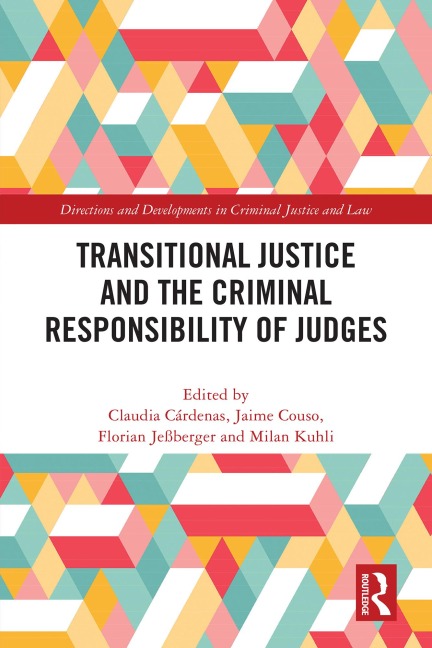
This collective volume delves into the criminal responsibility of judges under authoritarian regimes, with case studies from Germany, Argentina, and Chile, examining their involvement in criminal human rights abuses and failures to protect victims from such crimes. Through comparative analysis, this volume offers insights into the legal and doctrinal challenges of prosecuting judicial involvement in crimes such as murder ('judicial murder'), kidnapping, unlawful detention, and torture. Bridging a gap in transitional justice and international criminal law literature, it focuses on the rarely explored criminal responsibility of judges beyond judicial misconduct. In doing so, it provides readers with a deeper understanding of judicial roles in authoritarian regimes and the complex legal standards involved in prosecuting such cases. It also informs the ongoing discourse on judicial accountability and the potential legal implications for judges in contemporary contexts. Transitional Justice and the Criminal Responsibility of Judges is ideal for students, scholars, and civil servants or practitioners working in the domestic or the international criminal justice system.
Claudia Cárdenas is Associate Professor in the Department of Criminal Sciences at the Faculty of Law of the Universidad de Chile. Jaime Couso is Professor in the Department of Criminal Law and Dean of the Faculty of Law at Universidad Diego Portales (Chile). Florian Jeßberger is Professor at Humboldt- Universität zu Berlin (Germany), where he holds the Chair in Criminal Law, Criminal Procedure, International Criminal Law, and Modern Legal History. Milan Kuhli is Professor and Vice Dean for Academic Affairs of the Faculty of Law at Universität Hamburg (Germany), where he holds the Chair in Criminal Law and Criminal Procedure, including its International and Historical Context.
Introduction Section A: Case Studies: Germany, Argentina, Chile 1. Settling Accounts for Nazi-era Judicial Injustice (NS-Justizunrecht) Before Allied and (West-) German Courts: Charting New Territories and Failed Opportunities 2. Malfeasance in Office as a Crime in the Context of Dictatorships: The Example of Judicial Perversion of Justice in the East German Waldheim Trials 3. Prosecuting State Criminality After German Unification - Judging the Judges 4. Dictatorship and Judicial Complicity: The Case of Argentina 5. Judicial Murder in Chile: Patterns, Cases, and Doctrines for Prosecuting Jurists 6. Self-Representations of the Chilean Judiciary Regarding their Responsibility in Relation to the Crimes of the Dictatorship Section B. Judicial Immunity and the Invalidation of Judicial Decisions 7. Judicial Immunity and its Limits: The Anglo-American Approach 8. Judicial Immunity: A South American Approach 9. Invalidation of 'Judicial' Decisions in Cases of Sham or Show Trials: An International Criminal Law Perspective 11. Fraudulent Res Judicata and Impunity: A Chilean Perspective Section C | Intent, Mistake of Law and Other Issues of Imputation 12. Judicial Abuse and Mistake of Law: A Normative Approach Based on a Comparative Law Perspective 13. Defending the Indefensible: The Mistake of Law Defence Applied to the Case of Judges in Dictatorships and Rogue Regimes - A Comparative Approach 14. Judicial Murder, Torture, and Unlawful Detention: An Overview from the Italian Legal System 15. On the Relationship Between Judicial Perversion of Justice and Judges' Participation in Crimes Against Humanity Section D | Modes of Responsibility and Criminal Association 16. Superior Responsibility and Judicial Murder: When Judges Are Not "Superior" 17. Jurists' Responsibility for Crimes of Dictatorships - An International Criminal Law Perspective 18. Judges' Responsibility for Participation in a Criminal Association: A Comparative and Theoretical Analysis 19. Judges as Criminal Associates of Totalitarian Regimes: The Chilean Case Under the Framework of International Law. 20. A Judge's Participation in a Criminal or Terrorist Organisation: From Nuremberg to Contemporary German Criminal Law Closing Remarks
Dieses eBook wird im PDF-Format geliefert und ist mit einem Adobe Kopierschutz (DRM) versehen. Sie können dieses eBook mit allen Geräten lesen, die das PDF-Format und den Adobe Kopierschutz (DRM) unterstützen.
Zum Beispiel mit den folgenden Geräten:
• tolino Reader
Laden Sie das eBook direkt über den Reader-Shop auf dem tolino herunter oder übertragen Sie das eBook auf Ihren tolino mit einer kostenlosen Software wie beispielsweise Adobe Digital Editions.
• Sony Reader & andere eBook Reader
Laden Sie das eBook direkt über den Reader-Shop herunter oder übertragen Sie das eBook mit der kostenlosen Software Sony READER FOR PC/Mac oder Adobe Digital Editions auf ein Standard-Lesegeräte mit epub- und Adobe DRM-Unterstützung.
• Tablets & Smartphones
Möchten Sie dieses eBook auf Ihrem Smartphone oder Tablet lesen, finden Sie hier unsere kostenlose Lese-App für iPhone/iPad und Android Smartphone/Tablets.
• PC & Mac
Lesen Sie das eBook direkt nach dem Herunterladen mit einer kostenlosen Lesesoftware, beispielsweise Adobe Digital Editions, Sony READER FOR PC/Mac oder direkt über Ihre eBook-Bibliothek in Ihrem Konto unter „Meine eBooks“ - „online lesen“.
Schalten Sie das eBook mit Ihrer persönlichen Adobe ID auf bis zu sechs Geräten gleichzeitig frei.
Bitte beachten Sie, dass die Kindle-Geräte das Format nicht unterstützen und dieses eBook somit nicht auf Kindle-Geräten lesbar ist.