Und dann auf "Zum Home-Bildschirm [+]".

Stöbern
genialokal zum Startbildschirm hinzufügen
Installieren Sie die genialokal App auf Ihrem Startbildschirm für einen schnellen Zugriff und eine komfortable Nutzung.
Installieren Sie die genialokal App auf Ihrem Startbildschirm für einen schnellen Zugriff und eine komfortable Nutzung.
Ihr gewünschter Artikel ist in 0 Buchhandlungen vorrätig - wählen Sie hier eine Buchhandlung in Ihrer Nähe aus:

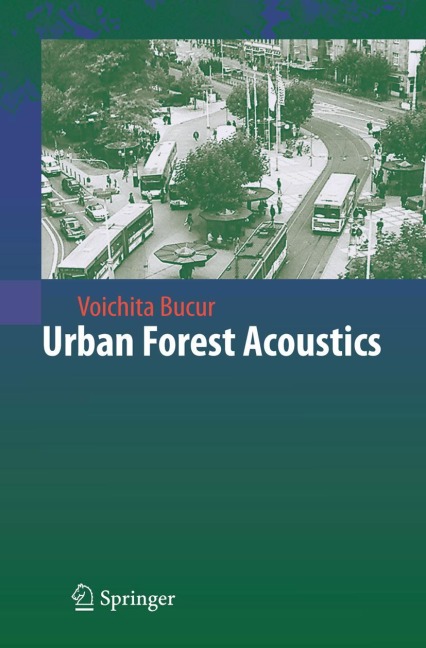
In general, trees are viewed as admired symbolic individuals, producing rec- ational, spiritual and emotional rejuvenation. Their lifespan can far exceed that of humans. Planting a tree is a singular act of faith in the future, c- ating a legacy for the community members who will follow. The presence of trees in an urban area has been a reality for several centuries. Beautiful trees in urban plazas are synonymous with a high sense of community and civic pride. Trees signi?cantly enhance the landscaping and appearance of the built environment. City trees improve several architectural and engineering functions, prov- ing a green infrastructure for communities. Trees create a friendlier envir- ment for walking, riding bikes and working, by reducing glare and softening harsh traf?c sounds and concrete views. Trees enhance the viewing in urban areas of a variety of birds and small animals, such as squirrels. They are of extreme importance to the functioning of many different ecosystems. Trees planted in the right place around buildings can improve air conditioning and heating costs by providing shade or by affecting wind speed or direction. Ev- green trees with dense, persistent needles can be used to provide a windbreak, while deciduous trees allow the sun to warm a house in winter. The more c- pact the branches and foliage of a group of trees, the greater their in?uence as a windbreak.
Professor Dr. eng. Voichita Bucur, currently adjunct professor at School of Science, RMIT University Melbourne, Australia, received her bachelor in Engineering in 1962 from Polytechnic Institute Brasov, Romania, and her PhD in Mechanics-Ultrasonics in 1984 from the Institut Supérieur des Materiaux, St Ouen, Paris, today known as Institut Supérieur de Mécanique de Paris, France.
Her fields of research encompass development of non-destructive techniques (vibrational, acoustic, ultrasonic, X- rays) for the assessment of the quality of trees, wood products and wood-based composites, mechanical characterisation of materials with non-destructive techniques, wood science and technology, and mechanical characterisation of wood for musical instruments. She wrote and edited books (7) published by Springer since 2003 and published more than 150 articles in scientific journals.
In 2004 she was awarded with silver medal by Société d' Encouragement du Progrès, France, for contributions to mechanics, acoustics, wood science, education and service to the society. In 2007 she had the distinguish award at 15th International Symposium on Nondestructive Testing of Wood, Duluth, Minnesota, USA, for contribution to the development of nondestructive techniques for wood and wood-based composites. In 2021 she had the prestigious RWB Stephens Medal awarded by the Institute of Acoustics UK for outstanding contributions to acoustics research or education.
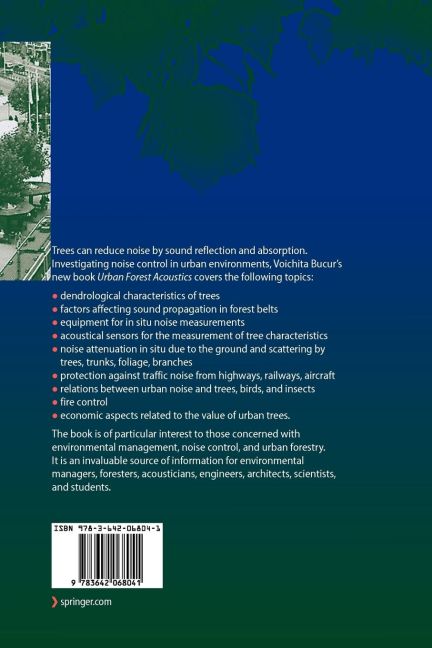
1 Introduction 2 Noise in Urban Forest 2.1 Sound Propagation 2.1.1 Definition and Theoretical Considerations 2.1.2 Factors Affecting Sound Propagation 2.2 Equipment for Noise Measurement 2.2.1 Instrumentation and Noise Sources 2.2.2 Measurement In Situ 2.2.2.1 Effects of Distance 2.2.2.2 Effect of Frequency 2.2.2.3 Effect of Visibility 2.3 Summary 3 Tree Characteristics and Acoustic Sensors 3.1 Morphological Characteristics 3.2 Mechanical Characteristics 3.2.1 Devices and Instrumentation 3.2.2 Mechanical Characteristics of Standing Trees 3.2.3 Detection of Internal Defects in Standing Trees 3.2.3.1Ultrasonic Velocity Method 3.2.3.2 Stress Wave Method 3.3 Genotypic Characteristics 3.4 Sylvicultural Practices 3.5 Summary 4 Noise Attenuation with Plant Material 4.1 Physical Aspects of Noise Attenuation with Plants 4.2 Ground Attenuation 4.3 Scattering by Trees 4.3.1 Scattering by Stems 4.3.2 Scattering by Canopy and Foliage 4.3.2.1 Measurements in Anechoic Room 4.3.2.2 Measurements in Reverberation Room 4.3.2.3 Outdoor Measurements 4.3.3 Reverberation in a Forest Stand 4.3.4 Atmospheric Conditions 4.4 Sound Scattering by Barriers 4.4.1 Psychological Effects 4.4.2 Solid Barriers without Vegetation 4.4.3 Solid Barriers with Vegetation 4.5 Summary 5 Traffic Noise Abatement 5.1 Road Traffic Noise 5.2 Railway Transportation Noise 5.3 Aircraft Noise 5.4 Summary 6 Noise Abatement and Dwellings 6.1 Urban Area 6.2 Suburban Area 6.3 Summary 7 Noise, Birds and Insects in Urban Forest 7.1 Bird Acoustic Communication in Forest Environment 7.2 Detection of Termite Infestation in Urban Trees 7.3 Summary 8 Acoustics for Fire Control in Forest 9 Economic Aspects Annex 1 Symbols Annex 2 Some Theoretical Considerations Annex 3 Frequency Weighting Annex 4 Standards Annex 5 Units References Subject Index