Und dann auf "Zum Home-Bildschirm [+]".

Stöbern
genialokal zum Startbildschirm hinzufügen
Installieren Sie die genialokal App auf Ihrem Startbildschirm für einen schnellen Zugriff und eine komfortable Nutzung.
Installieren Sie die genialokal App auf Ihrem Startbildschirm für einen schnellen Zugriff und eine komfortable Nutzung.
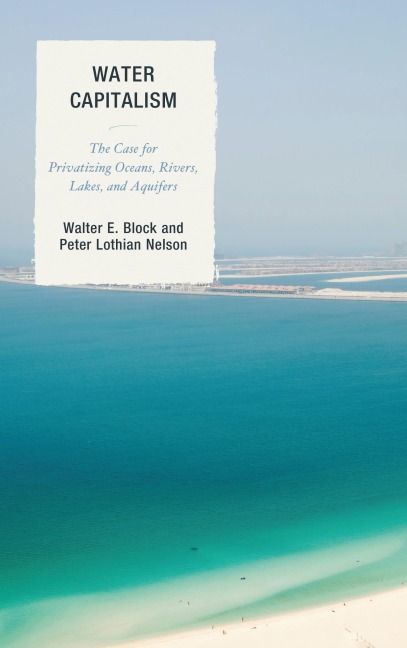
Water covers some 75% of the earth's surface, while land covers 25%, approximately. Yet the former accounts for less than 1% of world GDP, the latter 99% plus. Part of the reason for this imbalance is that there are more people located on land than water. But a more important explanation is that while land is privately owned, water is unowned (with the exception of a few small lakes and ponds), or governmentally owned (rivers, large lakes). This gives rise to the tragedy of the commons: when something is unowned, people have less of an incentive to care for it, preserve it, and protect it, than when they own it. As a result we have oil spills, depletion of fish stocks, threatened extinction of some species (e.g. whales), shark attacks, polluted and dried-up rivers, misallocated water, unsafe boating, piracy, and other indices of economic disarray which, if they had occurred on the land, would have been more easily identified as the result of the tragedy of the commons and/or government ownership and mismanagement. The purpose of this book is to make the case for privatization of all bodies of water, without exception. In the tragic example of the Soviet Union, the 97% of the land owned by the state accounted for 75% of the crops. On the 3% of the land privately owned, 25% of the crops were grown. The obvious mandate requires that we privatize the land, and prosper. The present volume applies this lesson, in detail, to bodies of water.
Walter E. Block is Harold E. Wirth Endowed Chair and professor of economics in the College of Business at Loyola University New Orleans and senior fellow at the Mises Institute.
Peter Lothian Nelson is former president of PLN Engineering and a professional engineer.
Chapter 1 Privatize the Oceans and All Other Bodies of Water
Chapter 2 Why Privatize Anything?
Chapter 3 Why Privatize Bodies of Water?
Chapter 4 Aquatic Ownership Concepts
Chapter 5 The Process of Privatization Homesteading, Abandonment
Chapter 6 Existing Law Governing the Seas
Chapter 7 Oceans-Concepts of Oceanological Ownership
Chapter 8 Rivers-Concepts of Potamological Ownership
Chapter 9 Lakes-Concepts of Limnological Ownership
Chapter 10 Aquifers-Concepts of Hydrogeological Ownership
Chapter 11 Mainstream Views on Ocean Management
Chapter 12 Piracy
Chapter 13 Case Studies
Chapter 14 Debate-Technological Viewpoints that Inform Homesteading, Technological Units
Dieses eBook wird im PDF-Format geliefert und ist mit einem Adobe Kopierschutz (DRM) versehen. Sie können dieses eBook mit allen Geräten lesen, die das PDF-Format und den Adobe Kopierschutz (DRM) unterstützen.
Zum Beispiel mit den folgenden Geräten:
• tolino Reader
Laden Sie das eBook direkt über den Reader-Shop auf dem tolino herunter oder übertragen Sie das eBook auf Ihren tolino mit einer kostenlosen Software wie beispielsweise Adobe Digital Editions.
• Sony Reader & andere eBook Reader
Laden Sie das eBook direkt über den Reader-Shop herunter oder übertragen Sie das eBook mit der kostenlosen Software Sony READER FOR PC/Mac oder Adobe Digital Editions auf ein Standard-Lesegeräte mit epub- und Adobe DRM-Unterstützung.
• Tablets & Smartphones
Möchten Sie dieses eBook auf Ihrem Smartphone oder Tablet lesen, finden Sie hier unsere kostenlose Lese-App für iPhone/iPad und Android Smartphone/Tablets.
• PC & Mac
Lesen Sie das eBook direkt nach dem Herunterladen mit einer kostenlosen Lesesoftware, beispielsweise Adobe Digital Editions, Sony READER FOR PC/Mac oder direkt über Ihre eBook-Bibliothek in Ihrem Konto unter „Meine eBooks“ - „online lesen“.
Schalten Sie das eBook mit Ihrer persönlichen Adobe ID auf bis zu sechs Geräten gleichzeitig frei.
Bitte beachten Sie, dass die Kindle-Geräte das Format nicht unterstützen und dieses eBook somit nicht auf Kindle-Geräten lesbar ist.