Und dann auf "Zum Home-Bildschirm [+]".

Stöbern
genialokal zum Startbildschirm hinzufügen
Installieren Sie die genialokal App auf Ihrem Startbildschirm für einen schnellen Zugriff und eine komfortable Nutzung.
Installieren Sie die genialokal App auf Ihrem Startbildschirm für einen schnellen Zugriff und eine komfortable Nutzung.
Ihr gewünschter Artikel ist in 0 Buchhandlungen vorrätig - wählen Sie hier eine Buchhandlung in Ihrer Nähe aus:

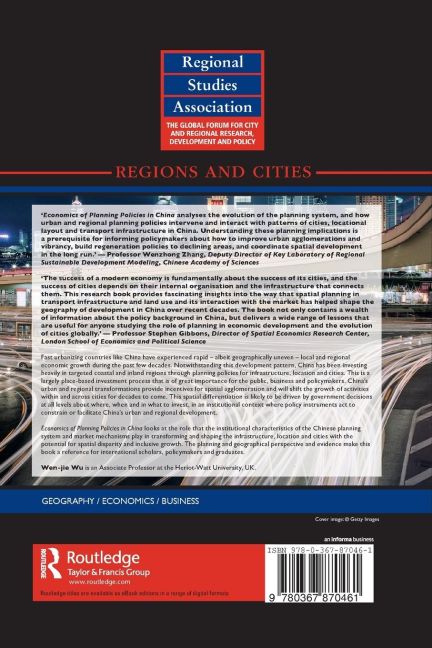
Fast urbanizing countries like China have experienced rapid - albeit geographically uneven - local and regional economic growth during the past few decades. Notwithstanding this development pattern, China has been investing heavily in targeted coastal and inland regions through planning policies for infrastructure, location and cities. This is a largely place-based investment process that is of great importance for the public, business and policymakers. China's urban and regional transformations provide incentives for spatial agglomeration and will shift the growth of activities within and across cities for decades to come. This spatial differentiation is likely to be driven by government decisions at all levels about where, when and in what to invest, in an institutional context where policy instruments act to constrain or facilitate China's urban and regional development.
Economics of Planning Policies in China looks at the role that the institutional characteristics of the Chinese planning system and market mechanisms play in transforming and shaping the infrastructure, location and cities with the potential for spatial disparity and inclusive growth. The planning and geographical perspective and evidence make this book a reference for international scholars, policymakers and graduates
Wen-jie Wu is an Associate Professor at Heriot-Watt University, UK.
List of figures List of tables Foreword I by Professor Paul Cheshire Foreword II by Professor Siqi Zheng Acknowledgements PART I Overview 1 Introduction 2 Fundamentals of China's planning policies PART II Spatial evolution of planning policies in China 3 Planning for spatial development in the post-war era 4 Planning for transformation: spatial economic prosperity and disparity 5 Planning for urban and regional agglomeration PART III Planning implications: infrastructure, location and cities 6 Dynamics of urban networks: evidence from airport infrastructure expansion 7 Geographical evolution of railway network development 8 Market reform, land development and urban vibrancy PART IV Conclusions 9 Concluding remarks Index