Und dann auf "Zum Home-Bildschirm [+]".

Stöbern
genialokal zum Startbildschirm hinzufügen
Installieren Sie die genialokal App auf Ihrem Startbildschirm für einen schnellen Zugriff und eine komfortable Nutzung.
Installieren Sie die genialokal App auf Ihrem Startbildschirm für einen schnellen Zugriff und eine komfortable Nutzung.
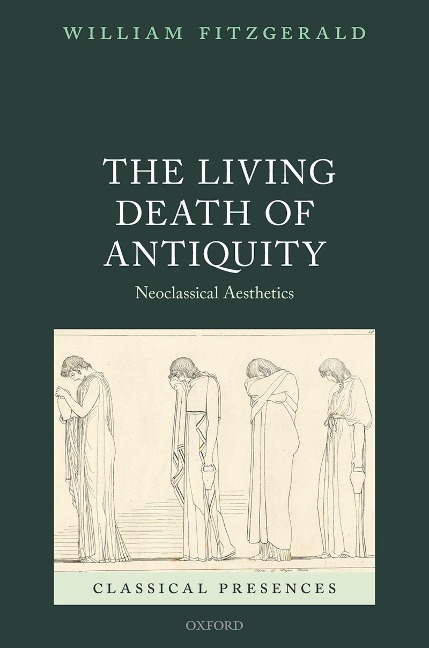
The Living Death of Antiquity examines the idealization of an antiquity that exhibits, in the words of Johann Joachim Winckelmann, 'a noble simplicity and quiet grandeur'. Fitzgerald discusses the aesthetics of this strain of neoclassicism as manifested in a range of work in different media and periods, focusing on the late eighteenth and early nineteenth centuries. In the aftermath of Winckelmann's writing, John Flaxman's engraved scenes from the Iliad and the sculptors Antonio Canova and Bertel Thorvaldsen reinterpreted ancient prototypes or invented new ones. Earlier and later versions of this aesthetic in the ancient Greek Anacreontea, the French Parnassian poets and Erik Satie's Socrate, manifest its character in different media and periods. Looking with a sympathetic eye on the original aspirations of the neoclassical aesthetic and its forward-looking potential, Fitzgerald describes how it can tip over into the vacancy or kitsch through which a 'remaindered' antiquity lingers in our minds and environments. This book asks how the neoclassical value of simplicity serves to conjure up an epiphanic antiquity, and how whiteness, in both its literal and its metaphorical forms, acts as the 'logo' of neoclassical antiquity, and functions aesthetically in a variety of media. In the context of the waning of a neoclassically idealized antiquity, Fitzgerald describes the new contents produced by its asymptotic approach to meaninglessness, and how the antiquity that it imagined both is and is not with us.
After taking a BA in Classics at Oxford (1974) and a PhD in Comparative Literature at Princeton (1980), William Fitzgerald taught for 23 years in the US, at the University of California, San Diego and Berkeley. He returned to the UK in 2003 and taught at Cambridge University until 2007, when he became Professor of Latin Language and Literature at King's College London. He has published books and articles on Latin literature, especially poetry, and on classical reception.
- 1: Introduction: Why Neoclassicism? - 2: The Iliad Backtranslated: Alexander Pope and John Flaxman - 3: Sculpture between the Graceful and the Heroic: Antonio Canova and Bertel Thorvaldsen - 4: Voicing Antiquity: the Anacreontea and Charles Leconte de Lisle's Études Latines - 5: Modernism, Neoclassicism, and Irony: Erik Satie's Socrate - Conclusion
Dieses eBook wird im PDF-Format geliefert und ist mit einem Adobe Kopierschutz (DRM) versehen. Sie können dieses eBook mit allen Geräten lesen, die das PDF-Format und den Adobe Kopierschutz (DRM) unterstützen.
Zum Beispiel mit den folgenden Geräten:
• tolino Reader
Laden Sie das eBook direkt über den Reader-Shop auf dem tolino herunter oder übertragen Sie das eBook auf Ihren tolino mit einer kostenlosen Software wie beispielsweise Adobe Digital Editions.
• Sony Reader & andere eBook Reader
Laden Sie das eBook direkt über den Reader-Shop herunter oder übertragen Sie das eBook mit der kostenlosen Software Sony READER FOR PC/Mac oder Adobe Digital Editions auf ein Standard-Lesegeräte mit epub- und Adobe DRM-Unterstützung.
• Tablets & Smartphones
Möchten Sie dieses eBook auf Ihrem Smartphone oder Tablet lesen, finden Sie hier unsere kostenlose Lese-App für iPhone/iPad und Android Smartphone/Tablets.
• PC & Mac
Lesen Sie das eBook direkt nach dem Herunterladen mit einer kostenlosen Lesesoftware, beispielsweise Adobe Digital Editions, Sony READER FOR PC/Mac oder direkt über Ihre eBook-Bibliothek in Ihrem Konto unter „Meine eBooks“ - „online lesen“.
Schalten Sie das eBook mit Ihrer persönlichen Adobe ID auf bis zu sechs Geräten gleichzeitig frei.
Bitte beachten Sie, dass die Kindle-Geräte das Format nicht unterstützen und dieses eBook somit nicht auf Kindle-Geräten lesbar ist.